




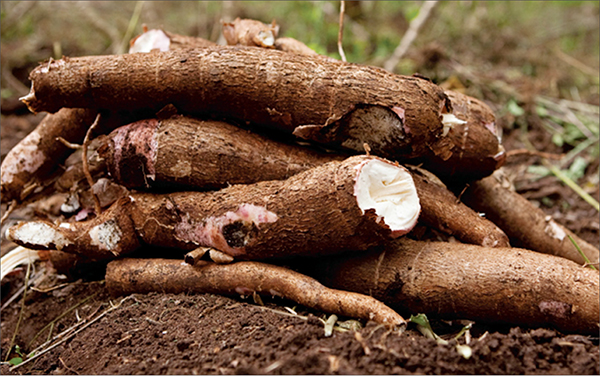
ROME – Yields of cassava, a key crop feeding millions of people across Africa, are not keeping pace with population growth despite its tolerance for climate change, a leading scientist said.
More than half the world’s cassava, a high-energy root crop, is grown in sub-Saharan Africa, where it is often the cheapest source of calories for poor people, said Clair Hershey, programme leader at the Colombia-based International Centre for Tropical Agriculture (CIAT).
“More than 200 million people rely on cassava as a basic food crop,” he said during a lecture at the UN’s Food and
Agriculture Organisation (FAO) this week.
A native of South America, cassava was first introduced to sub-Saharan Africa by Portuguese traders in the 17th century, and is one of the key sources of carbohydrates in the region.
It is estimated that more than 30% of the calories consumed by sub-Saharan Africans come from the crop, which can be boiled and eaten or used in soups and stews, research group CGIAR says.
But despite a rapid increase in yields across Asia, Africa’s production is not rising fast enough for a rapidly growingpopulation.
Africa’s population is projected to rise to between 3,5 billion and 5,1 billion by 2100 from about one billion now, the United Nations and population experts said in September.
Farms in Asia, particularly Thailand, where cassava is often produced for animal feed or industrial uses, yield 21 tonnes per hectare, compared to less than 13 in Africa, Hershey said.
Poor planning and a lack of investment in research partly explain why yields have not risen in Africa as much as Asia, he said.
But as the planet warms, making droughts more likely and impacting yields of key crops like corn and beans, researchers should pay more attention to cassava, he said.
The crop is naturally “climate smart” Hershey said, and can grow on land with poor quality soil.
“(It) doesn’t seem to suffer from a few degrees of change in the climate” unlike other crops, he said.
Scientists from CIAT and other groups released a study in 2012 showing that cassava was expected to grow better by 2030 in nearly all parts of sub-Saharan Africa if the region sees temperature increases of between 1,2 and two degrees Celsius and accompanying shifts in rainfall patterns.
– Nampa-Reuters