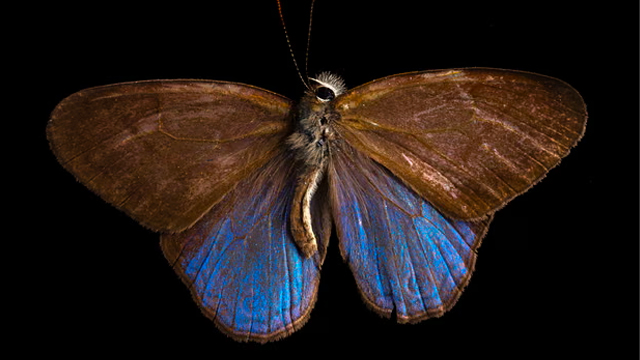
The World is becoming less colourful. For butterflies, bold and bright wings once meant survival, helping them attract mates and hide from prey.
But a new research project suggests that as humans replace rich tropical forests with monochrome, the colour of other creatures is leaching away.
“The colours on a butterfly’s wings are not trivial – they have been designed over millions of years,” says researcher and photographer Roberto García-Roa, part of a project in Brazil documenting how habitat loss is bleaching the natural world of colour.
Whether dazzlingly red, deep green or ghostly pale, the richness of a tropical forest provides butterflies with a diversity of habitats in which to communicate, camouflage and reproduce.
BROADER TREND
As humans replace tropical forests with environments such as eucalyptus monocultures, however, this is changing.
In a plantation, the ecological backdrop is stripped bare and drab species do better. Being bland – like your surroundings – becomes an advantage.
The difference is stark, researchers say.
These preliminary findings are part of a broader body of research, which examines how nature loss is altering the colours of the natural world.
Butterflies are an ideal subject: they are among the most colourful organisms in the world.
They respond quickly to environmental changes and are easy to monitor.
Colour isn’t just about aesthetics, it has important evolutionary functions.
In a broader trend, ecosystems that once supported many colours are becoming more muted as they are degraded, simplified and polluted by humans.
Coral reefs are bleaching, oceans are becoming greener – even rainbows are predicted to become less visible in densely populated and polluted areas.
Nature’s palette is always changing in response to natural selection pressures.
“Even planet Earth itself is losing brightness as seen from space.
It is truly remarkable and concerning how interconnected these processes are, and how every impact cascades into further consequences,” says Ricardo Spaniol from the Federal University of Rio Grande do Sul.
Researchers first discovered that being colourful in the Amazon may be turning into a disadvantage in 2019.
“The most colourful species are often the first to disappear locally after deforestation, probably because of the loss of native vegetation and their increased exposure to predators,” says Spaniol.
ECO INDICATORS
Butterflies that persisted in deforested areas typically had brown or grey wings and bodies.
In a preserved forest, however, a dazzling array of very colourful butterflies were found alongside the duller ones.
Researchers did not expect to find such a clear and consistent pattern, and say it opened up a new area of research on how habitat loss can shape diversity.
“Discovering that forests are losing their colours was frightening and revelatory,” says Spaniol.
“It felt like we were uncovering a hidden dimension of how species respond to environmental change, a dimension that had remained invisible until then, but is incredibly rich.”
It may signal the erosion of ecological functioning. Butterflies are often considered indicators of broader biodiversity trends, says Spaniol.
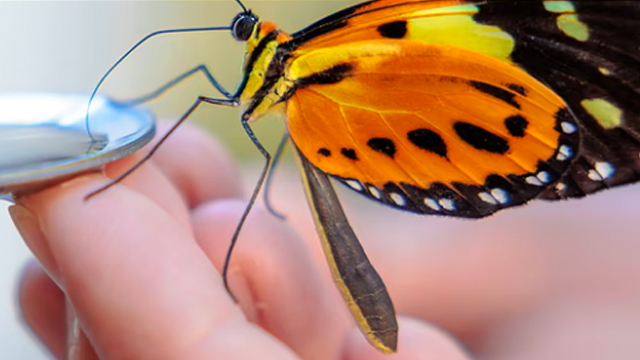
FLEXING … A harmonia tigerwing drinking sugar water from a spoon, Santa Teresa, Brazil. Butterflies are ideal to study as they display a vast array of colours across habitats
LOO PAPER A FACTOR
Monoculture forests are being grown over huge areas.
According to one estimate, eucalyptus plantations – among the most common type, farmed for wood pulp, timber and toilet paper – cover at least 22m hectares around the world.
If nothing is done to protect native habitats and prevent the further loss of forests, many of the most colourful and ecologically specialised species of butterfly could disappear, leaving behind only a few generalist species.
However, this outcome is not inevitable. Spaniol’s research found that forested habitats in the Amazon rainforest that have been regenerating for 30 years after being used as cattle pasture showed an increase in butterfly colour diversity.
“We still have the opportunity to restore this colourful world,” he says.
– This is an edited version of an article from The Guardian’s age of extinction series.
In an age of information overload, Sunrise is The Namibian’s morning briefing, delivered at 6h00 from Monday to Friday. It offers a curated rundown of the most important stories from the past 24 hours – occasionally with a light, witty touch. It’s an essential way to stay informed. Subscribe and join our newsletter community.

The Namibian uses AI tools to assist with improved quality, accuracy and efficiency, while maintaining editorial oversight and journalistic integrity.
Stay informed with The Namibian – your source for credible journalism. Get in-depth reporting and opinions for
only N$85 a month. Invest in journalism, invest in democracy –
Subscribe Now!