



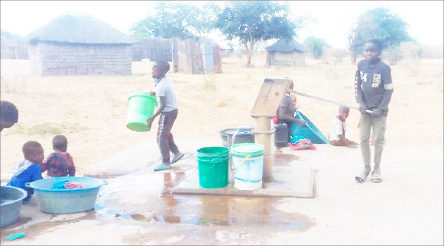
Frequent borehole breakdowns, drought and vandalism in the Zambezi region are disrupting rural water supply, leaving many communities relying on unsafe sources.
Ministry of Agriculture, Fisheries, Water and Land Reform spokesperson Simon Nghipandulwa this week revealed that apart from constant breakdowns, the 639 boreholes in the region often dry up due to drought, while vandalism poses an ongoing challenge.
The region has about 95 000 rural residents out of a total population of about 142 000 people, the latest census statistics have shown.
Nghipandulwa said the theft of solar panels and submersible pumps, both from old and newly installed boreholes, is another major challenge.
“The regional rural water supply directorate plans to drill nine new boreholes in the 2025/26 financial year. In addition, 21 installations of previously drilled boreholes will be completed, and two earth dams will be excavated,” he said.
Nghipandulwa said service delivery in the region is constrained by a limited budget for transport and materials, affecting the timely response to community requests and reports.
Additionally, the regional vehicle fleet is old, leading to high maintenance costs.
“Replacing the fleet would be a more efficient and cost-effective solution, improving service delivery and reducing operational delays,” he said.
The spokesperson said the low pressure along water pipelines is a challenge in areas such as Katima-Linyanti, Katima-Sibbinda, Katima-Ngoma, and Kongola-Makanga.
To address these challenges, the ministry is implementing the Katima Mulilo-Ngoma phases three and four pipeline project and the Katima Mulilo-Kongola water pipeline phase four project under the Namibia Water Sector Support Programme, he said.
“These projects are designed to strengthen bulk water supply reliability and expand coverage, especially for rural communities along the Zambezi River floodplain.
“They will also ensure the provision of water to settlements along the trunk road between Kongola and Kapani.”
Kabbe South constituency councillor Kamwi Sezuni yesterday said there is an urgent need for the government to install more boreholes in the rural areas.
He said some villagers are currently consuming water directly from the river and self-dug wells.
“The water is not safe for human consumption at all, but the community has no choice, because either the boreholes are broken or have dried up,” Sezuni said.
Sibbinda constituency councillor Micky Lukaezi yesterday said only one out of the 10 boreholes in his constituency is currently functioning, and the rest are either broken or the water is not fit for human consumption.
He said his constituency is also challenged due to the fact that the majority of the underground water is not fit for human consumption.
“Currently, most of the other areas are getting water from the NamWater pipeline for consumption and for their animals, because of the borehole challenges. However, that water from NamWater is not subsidised by the government.
“The community’s water is therefore closed because they cannot afford it. I think the government should also start giving people water for free like they are doing with food, especially for us who are getting it from the NamWater pipeline,” Lukaezi said.