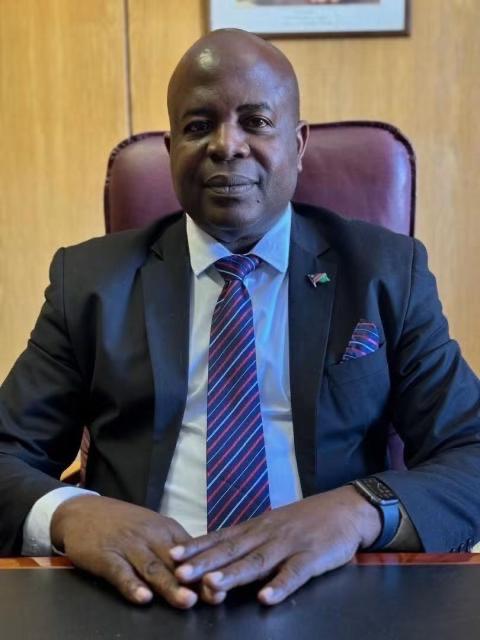





URBAN AND rural development minister James Sankwasa has said that traditional chiefs are appointed from royal bloodlines, and are only accountable to royal families.
This was after the IKhomanin community voted to remove their chief for selling land and for keeping donations.
While Namibia is a republic, it has many traditional monarchies, kingdoms, chiefdoms and royal houses: Ovambo (Ondonga, Oukwanyama, Ongandjera, Uukwambi, etc); Herero (Ovaherero, Ovambanderu); Witboois; Bondelswarts; Zambezi (Mafwe, Masubia, etc); and Kavango (Kwangali, Mbunza, etc.)
Namibia’s monarchies are political actors, not neutral cultural institutions. They control land, influence local governance, shape social norms and receive state funding.
They are part of the power structure and must be analysed like any other institution.
Culture does not exist outside politics. Traditional authority is a form of political authority.
‘ROYAL’ ROOTS
Monarchies emerged from pre‑colonial societies that also had social class divisions and often sat at the top of those hierarchies.
Romanticising them hides the reality that many were systems of labour extraction, patriarchal control and unequal access to land and cattle.
German and South African colonial administrations empowered certain monarchies to control populations on their behalf.
This created new colonial‑aligned chiefs, hereditary power where it had not existed and chiefs who enforced colonial labour and taxation. They were reshaped to serve colonial administration, not community liberation.
In contemporary Namibia, many monarchies endorse political parties, mobilise votes and receive state salaries.
This is a system that can stabilise the ruling class, suppress dissent and weaken grassroots organising.
Traditional authority can become a buffer that protects the state from direct accountability.
It is the antithesis of the values of the liberation struggle – the struggle said “power belongs to the people”, monarchy says “power belongs to bloodlines”.
It reinforces the idea that some people are born superior, that some families deserve wealth and status, and that social inequality is cultural, not political.
‘SOFT POWER’
This is dangerous in a society where land is still concentrated and wealth is still racialised. Monarchy becomes a cultural justification for social inequality.
This is fundamentally incompatible with democracy and popular sovereignty.
In the final analysis, monarchy is feudalism surviving inside contemporary society.
It turns citizens into subjects. People are not fully autonomous political agents and symbolically subordinate to a ruling family.
Monarchy is incompatible with decolonisation.
Decolonisation requires dismantling inherited hierarchies and building democratic, egalitarian institutions. It is impossible to decolonise while celebrating the institutions of colonisation. Namibia needs active citizens, not symbolic subjects.
Even “symbolic” monarchies stabilise and act as a cultural shield for ruling elites, distract the public with ceremony and tradition, and depoliticise social inequality by wrapping it in nostalgia.
Monarchy becomes a soft power tool that protects the (unjust) economic status quo. It is a distraction from real political power.
It absorbs public attention, creates emotional loyalty to elites, turns politics into spectacle, and hides the real power of big business.
It becomes a political decoy, allowing the ruling class to operate behind the scenes.
It is not about rejecting culture. It is about rejecting hereditary domination.
CORE GOAL
The left-wing is not about attacking tradition or culture. It is about opposing unearned power, hereditary rule, elite privilege and undemocratic institutions.
A left‑wing position can respect cultural identity while rejecting political monarchy. A leftist vision replaces monarchy with a democratic republic and an elected leadership.
It should further be substituted by the redistribution of royal wealth, the abolition of aristocratic titles and cultural institutions run by the people themselves.
The goal is not to erase history, but to democratise power.
A left‑wing view sees monarchy as a barrier to democratic self‑determination.
Traditional authority must be democratised and made accountable to the people, not romanticised.
This critique is not a call for cultural erasure. The goal is not to destroy culture, but to ensure that culture does not become a shield for social inequality.
A democratic future requires the abolition of hereditary rule.
The authors are members of the Marxist Group of Namibia.