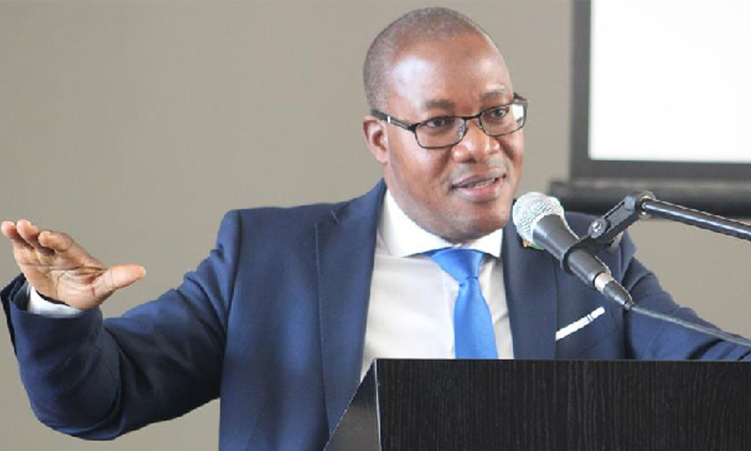
The acting chief executive of the Roads Contractor Company, Dasius Nelumbu, has blamed political interference and a fellow executive for the payment of N$17 million for fuel that was never delivered to the state.
He says he was called by a politician to process payments of around N$17 million to a company linked to fugitive Victor Malima.
Nelumbu made these allegations in answer to The Namibian’s questions on how the RCC managed to pay N$17 million for fuel that was not delivered.
Nelumbu, who has been put on forced leave by the RCC board last week, also blames outside influence for shielding an executive at the company he wanted to discipline.
He has called for a commission of inquiry “so I can clear my name”.
The acting CEO says the inquiry should look into “lost/stolen RCC assets, grading contracts, Road Construction Contracts and many more so that everyone can come and present their case instead of saying Nelumbu this, Nelumbu that”.
These allegations come as the RCC investigates how the company paid about N$30 million for fuel between September 2023 and July 2025 to Oshali Fuel Centre CC, owned by Namcor fraud accused Simeon Handjene, and Eco Fuel Investment CC, a company linked to fugitive businessman Malima.
Fuel worth about N$17 million was allegedly never delivered.
After The Namibian reported on his forced leave on Tuesday, Nelumbu responded by accusing the publication of blaming him for matters he was not responsible for.

In his response he blames several people, mainly Andreas Nambahu, the former acting executive for operations and plant hire, whose contract ended last month.
“Fuel requests are made by the RCC operations department. They will then motivate and present such for approval.
“Why would a department request fuel knowing there are outstanding balances? This is a question that must be directed to those who ordered fuel at the time,” Nelumbu says.
Nelumbu has been the RCC’s acting CEO since 2023 after being its chief financial officer.
“All fuel purchases either from Oshali or any other supplier were paid in advance even before I came to the RCC. This has been the practice as a result of the tainted RCC name.
“Frankly, no supplier of anything wanted to do business with the RCC on credit, including our banks,” he says.
The RCC is one of the institutions that appears to have enriched fugitive Victor Malima and his associated entities, like Eco Fuel, which benefited from alleged irregularities at the National Petroleum Corporation of Namibia (Namcor).
ENQUIRY
A report titled ‘Executive Management Matter’, dated 17 December 2025, shows that the RCC had planned to suspend Nambahu, one of its executives, for misconduct.
Nelumbu copied transport minister Veikko Nekundi in the letter.
“In December 2025 when I constantly requested project input reconciliations, I discovered some abnormalities regarding crucial information withheld by the operations department, including fuel usage reconciliation at sites” the RCCs acting CEO says.
He says he reported the matter to the board, produced a report and requested that Nambahu be suspended.
The board agreed and a suspension letter was issued to Nambahu, Nelumbu says.
He claims a politician intervened, insisting that Nambahu’s suspension be withdrawn.
“To this day, nothing has happened regarding that report,” he says.
Nambahu this week confirmed the attempt to suspend him, adding it was later cancelled without explanation.
Nelumbu says a commission of inquiry must be established to deal with the matter so he can clear his name.
“If I have anything, any wealth at all, investigate it. I don’t have anything that can not be explained, I pay for my cars through the bank with my salary, I have nothing at all.
“Investigate those who have unexplained wealth, I believe there is ‘Roadsrot’, it’s just being ignored,” he says.

EXECUTIVE BATTLE AND MALIMA
Nelumbu and the then operations executive Nambahu have not seen eye to eye since last year.
Nambahu has denied any wrongdoing.
He says he was questioned by the Anti-Corruption Commission (ACC) last year on his involvement, including on whether he knew Malima personally and whether he followed all processes in purchasing the fuel.
He says he has told the ACC he did not know Malima personally or that he owned Eco Fuel.
An email dated February 2026, which The Namibian has seen, shows Nambahu gave his version to RCC board chairperson Lea Namoloh and Nekundi.
“During November 2024, there was an instruction that the RCC will be constructing the remaining 10km of the road to Uis. The operations team proceeded with the initial requests for the plant and also to source for fuel,” he wrote.
According to Nambahu, Eco Fuel, a company linked to Malima, made direct contact and visited the RCC’s offices to see how they could assist the company in delivering fuel.
“A number of calls were made, and the people from Engen recommended the company Eco Fuel who in turn initiated contact by visiting our office and discussed how they could assist in supplying the diesel,” he says.
It’s unclear how Malima’s company came to know about the RCC’s needs for that specific project.
Nambahu says at the time, the sourcing of fuel was being done randomly and the operations team requested a quotation during the meeting which Eco Fuel provided.

“The invoice was sent through to procurement and all necessary approvals were done and a payment was initiated. A purchase requisition was created and signed off. I, however, only signed it after some time since I was not in town when the purchase (payment) was made,” he says.
He says the ACC asked him about his relationship with Malima.
“Something that stood out during the questioning at the ACC was the insistence from the investigator on whether I had a relationship with Mr Victor Malima, whether I knew him personally or whether I knew that he owned Eco Fuel. My answer to all of this was in the negative,” he says.
Nambahu, whom Nelumbu has accused of dealing directly with the companies and sourcing their quotations, says his role in the fuel procurement process should not be interpreted as personal control over the approval or payment of fuel suppliers.
He says his department’s role was primarily to identify and motivate fuel requirements, while the approval and payment processes involved the relevant authorised officials and the finance department.
“The dealings with Oshali Fuel Centre were in place by the time I assumed the acting role as executive for the department, and much of the payments would have been concluded by the time I took over,” he says.
Nambahu says Nelumbu would at times call the different site managers to inquire whether they required fuel and would direct them personally to request the quotations.
“This was common practice and it brought about tension between my office and his,” he says.