Marine life along Namibia’s coastline is rich and diverse. The nutrient-rich Benguela Current supports fish, dolphins, whales, seabirds, seals and many more.
However, these animals face many threats, and one of the biggest is plastic pollution.
Every year, an estimated eight to 13 million tonnes of plastic enter the ocean.
Although Namibia’s beaches may look clean compared to many other countries, the work of Ocean Conservation Namibia (OCN) shows that plastic pollution is a serious problem along our coast and in the waters of the Benguela, much of it is hidden beneath the surface.
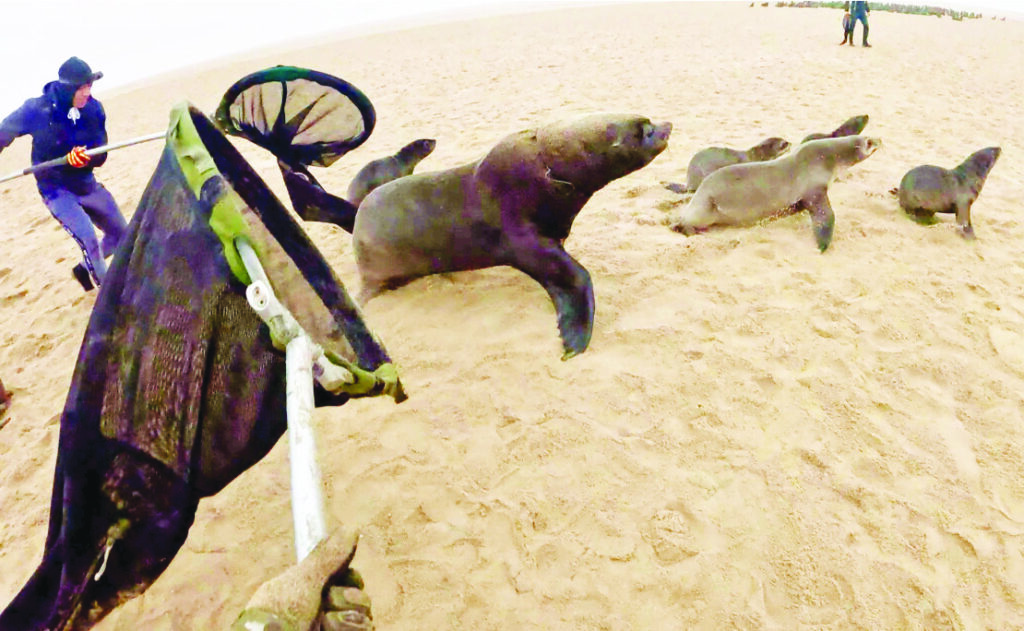
OCN rescues Cape fur seals entangled in plastic and other marine debris. Around 1.4 to 1.6 million Cape fur seals live in Namibian waters, making it the largest population in the world.
Cape Cross is home to the world’s largest single colony, with up to 200 000 seals during peak season.
LOOPS OF DEATH
As top predators, Cape fur seals help keep fish populations healthy, and changes in their numbers can signal problems in the marine environment.
Although they are highly adaptable animals, plastic pollution is a threat they cannot overcome.
Unlike humans, they cannot remove plastic loops caught around their necks, and without rescue, most of the affected seals will die.
By the end of June, OCN had rescued 265 entangled seals. Sadly, one entangled pup was found too late to be saved.
Of these rescues, 145 took place in June alone. Rescue numbers usually increase just before the middle of the year as young seals grow older, spend more time at sea and become more curious.
They often investigate and play with floating or shiny objects, making them more likely to become trapped in plastic.
As a result, most rescued seals are pups less than a year old. This year, pups made up 78% of all rescues.
NEGLECT KILLS
As in previous years, the main causes of seal entanglements remain unchanged.
Recreational fishing line, packaging straps and commercial fishing line were once again the most common items removed from rescued seals.
The most severe injuries are caused by fishing lines, nets and hooks. Packaging straps also cause many injuries and are thought to come mainly from the fishing industry, where they are used to secure fish boxes.
Too often, these straps end up in the ocean because they are not disposed of properly.
The data clearly shows that fishing-related waste has the greatest impact on Cape fur seals.
By the end of June last year, OCN had rescued 436 entangled seals, almost 200 more than this year.
While this is a significant decrease, it is unlikely to mean there is less plastic in the ocean.
Bad weather has often prevented the rescue team from carrying out normal operations, while far fewer seals have been seen at the central coast’s colonies.
This could be linked to the unusually hot weather during the first months of the year, a high mortality rate among newborn pups, or a northward shift in Cape fur seal populations along Namibia’s coast. The exact reason remains unknown.
Although rescue numbers have fallen over the past year, marine plastic pollution remains a serious problem.
It is not only an animal welfare issue but also threatens more vulnerable species such as dolphins, whales and sea turtles, which often die from entanglement unnoticed.
WE MUST STEP UP
OCN’s data clearly shows that most entanglements are linked to recreational and commercial fishing gear.
The fishing sector therefore has a key role to play by increasing awareness, improving waste management, preventing gear loss and ensuring that used fishing gear and other plastic waste are disposed of responsibly.
- – Damian Schreiber, publicist, educator, seal rescuer and junior researcher at Ocean Conservation Namibia. He has a master’s in ecology and society from Costa Rica’s University for Peace.