





The Namibian turns 41 on Sunday. We take you on a journey of how the newspaper is distributed and brought close to you – wherever you may find yourself.
For those who still honour the time-worn tradition of reading the news in print, it may seem that newspapers appear in shops, on service station shelves and in the hands of hustling street vendors as if by magic.
There’s little awareness of the delivery vans trundling into the dark at 23h00 or of the drivers departing from Windhoek, navigating over 8 000kms of our beautiful country, to make sure the newspaper reaches people in time for their morning coffee.
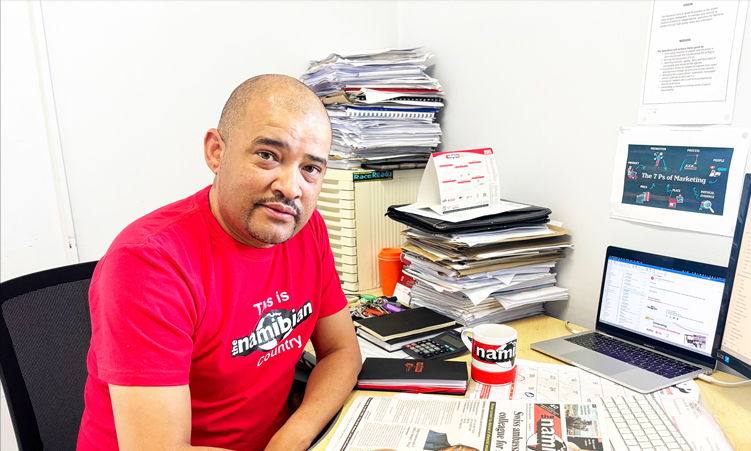
There’s even less appreciation of The Namibian’s operations manager, Elrich Tilling, who orchestrates it all as his phone lights up with messages that confirm the newspaper’s editorial and design are done, printing can begin, and that the paper has hit the road.
“Morning, done loading,” writes Fatty at 02h23.
“Arrived at Grootfontein,” says Mike at 05h36.
“Khorixas, out,” confirms Mr Linus just before 11h00.
Tilling’s stream of WhatsApp notifications is anxiety-inducing, but he handles them all with the signature calm that has carried him through the newspaper business for the better part of 18 years.
After dark room printing for The Observer and The Economist in 2007 and working as a computer-to-plate (CPT) operator at WordPress Namibia between 2014 and 2021, Tilling manages The Namibian’s operations with a deep understanding of the printing and distribution process and a passion for stocking the nation’s newsstands.
“Every day, yes, every single production day, the newspaper should be with WordPress at 19h00 at the latest, because it takes us an hour to prepare the plates,” says Tilling from his office at The Namibian’s headquarters in Windhoek West.
“It usually takes me an hour to go through all the material, to see if the colours are correct and that there are no registration problems. It’s not sheet-fed, it’s web-based,” he says.
“So, you don’t just press a button and then it prints. You have to make adjustments, get the colours coordinated and correct. It’s quite the process. The machine can print up to 30 000 copies per hour. That’s very fast.”
Once pull-outs are inserted and the right package quantities are allocated by WordPress’ Ferag machine, the printed newspaper is collected by the distribution team.
“Once that is done, my team arranges the packages according to the place they are going to. We have different routes, north, south, east and west,” Tilling says.
“The first route that should go out at night, because it’s the furthest, is the northern route. So, the driver goes up to Oshakati, from Oshakati to Oshikango and the towns nearby, Ondangwa, all those places.”
‘LIKE OWLS’
Tilling says the delivery drivers, who are meant to leave at 22h00 each night, are like owls.
“They sleep during the day and at night they are awake. They drive from WordPress, take the newspapers to Newsprint where they’re packed into the cars, and then they head out on the different routes,” he says.
“Altogether, every day, we drive about 4 426km. More, because they drive that twice as they have to come back.”
This well-oiled game of ‘pass the parcel’ sees primary drivers handing the paper over to secondary drivers at various towns, which guards against fatigue and sends initial drivers back to Windhoek as soon as possible.
Drivers also alternate routes so nobody is constantly driving the longest road, which is to Katima Mulilo. The newspaper generally arrives there at around 12h00.
As the delivery drivers journey across the country, Windhoek’s newspaper vendors make their way to The Namibian’s street sales office at around 04h00. There, in a little hatch facing the street, they meet Jeremia ‘Jerry’ Amwaama, who has been managing newspaper vendors for 25 years. By the dim light of the early morning, Amwaama hands the vendors their newspapers before they hurry to their preferred points of sale.
“You have up to 40 guys who come to the office to pick up the paper every day. All of Windhoek’s street vendors come here and then they go sell,” Tilling says.
“Some of them, like the one in front of Telecom, has Bank of Namibia, Telecom, and NamPost as his daily clients.”
Considering when and where the newspaper sells best, Tilling has numerous insights. Service stations sell better than stores. Northern readers buy the most newspapers.
Newspaper sales tend to drop mid-month as consumers run out of disposable income. Sales pick up again when people get their salaries from around the 20th of the month.
“Service stations sell better than stores because most people buy the paper in the morning when grocery stores aren’t open yet,” Tilling says.
“There are people who drive at 06h00, take their kids to school, want to buy a quick brötchen, and then sommer buy the newspaper as well.”
HARD COPY STILL KING
While global trends indicate that print media is on the decline as consumers pivot to accessing news online, Tilling says Namibia is somewhat special.
“In Namibia, people still want to read the hard copy. When the paper’s not on the street or on the shelves anymore, people get mad. I get calls,” says Tilling.
“It’s never really happened that we haven’t had a paper out. But, when there’s a big story, and people can’t find the paper, they’ll even come to office because they want to read what’s going on,” he says.
“They want the physical paper because they can take their time, really sit and read it thoroughly. One day, this will phase out, but not completely.”
While Tilling enjoys the challenges of circulation, he stresses that The Namibian being on time depends on all facets of its production. Any hiccoughs or delays in the sales, design and editorial departments can set printing and distribution back considerably.
Still, he remains appreciative of the entire team’s hard work.
“If people could see the time and effort that goes into printing a newspaper, they’ll really start appreciating it. The effort and amount of people involved in getting the newspaper out is enormous,” he says.
“When people buy the paper, it actually provides for us to make another paper.”
Tilling says he generally gets to bed around midnight.
He watches the drivers’ WhatsApp messages come in as they confirm loading and leaving Windhoek with the newspapers and he eventually drifts off to sleep.
“I have to make sure my drivers are out,” he says.
“I’m worried when I get WhatsApps. Sometimes, it’s a car that’s broken down, but mostly it’s just the drivers saying they’ve arrived.”
In his free time, Tilling cherishes spending time with his wife and children and loves to braai.
Family time makes him happy as does getting The Namibian out into the world.
“I just want the paper to be on the shelves, on the street and to reach the towns on time,” he says.
“Then I’m the happiest guy.”