





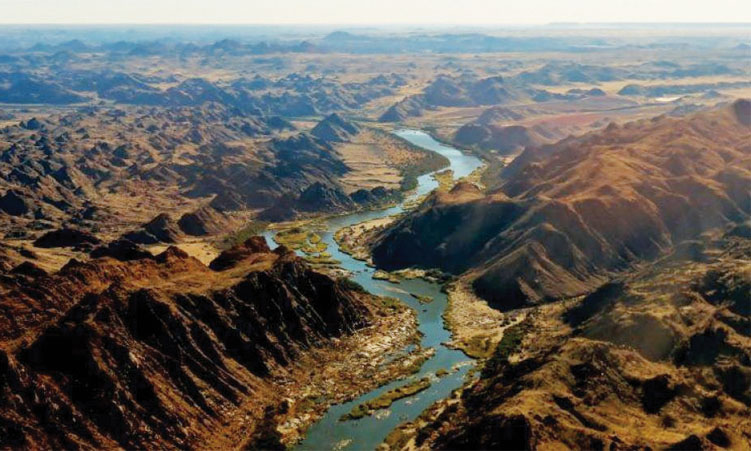
The decades-old dispute over the Orange River boundary between Namibia and South Africa remains unresolved after the two countries failed to conclude the matter during the fourth Namibia-South Africa Binational Commission in Pretoria, South Africa, on Friday.
The dispute centres on where the international boundary lies.
Namibia argues the border should run through the middle of the Orange River under modern international law, while South Africa maintains that the boundary follows the river’s northern bank, based on the 1890 Heligoland-Zanzibar Treaty between Germany and Britain.
President Netumbo Nandi-Ndaitwah on Friday said Namibia and South Africa had engaged constructively on the matter and expressed hope that an urgent solution would be found to provide legal certainty for both countries and future generations.
“The issue has been on our agenda for some time. It started in 1991 and while progress has been made, implementation of what was agreed on remains the challenge,” she said.
The disagreement has implications for territorial jurisdiction, natural resources and future developments in the Orange River Basin.
Despite reaffirming the strong historical ties between the two countries, Nandi-Ndaitwah said both governments remain committed to resolving the issue in good faith.
Speaking after returning from South Africa on Friday, she said the matter would now be handled directly by her and South African president Cyril Ramaphosa, with a dedicated meeting planned during the first quarter of 2027.
She said the matter had previously been referred to the two countries’ foreign affairs and justice ministries following the 2023 binational commission, but officials failed to reach agreement despite meeting at Swakopmund.
A joint committee of experts established in 2016 completed its report in 2017, which was considered by ministers responsible for political, diplomatic and legal affairs at Swakopmund in October 2024.
However, no final agreement was reached.
Quoting Namibia’s founding president Sam Nujoma, Nandi-Ndaitwah said resolving the dispute would “close the chapter on colonialism” for the benefit of future generations.
Popular Democratic Movement president McHenry Venaani has criticised the outcome of the binational commission, describing it as “very disappointing”.
He is accusing South Africa of avoiding meaningful discussion on the boundary dispute and says Namibia has made no progress on an issue affecting its territorial integrity.
“They don’t want the Orange River to be shared, and that is an outstanding issue,” Venaani says, adding that Namibia should continue pursuing the matter after 35 years without resolution.
He also criticises South African international relations minister Ronald Lamola’s handling of the issue and says he wants to meet with Nandi-Ndaitwah to discuss the matter.
Ramaphosa, meanwhile, on Friday hinted at the economic potential of the Orange Basin, describing it as one of the world’s most promising new energy frontiers capable of driving oil and gas production, engineering, refining, logistics, maritime services and manufacturing.
Former ambassador Tuliameni Kalomoh says Africa continues to spend unnecessary time and resources on colonial-era border disputes instead of advancing continental unity.
He urges African leaders to resolve outstanding boundaries through honest dialogue and greater commitment to African integration.
Retired diplomat Pius Dunaiski says the close historical relationship between Namibia and South Africa requires practical solutions beyond border disputes.
He proposes stronger legal frameworks, including easier long-term residency and mutual recognition of official documents and pension portability, to better protect citizens living in each other’s countries while respecting the sovereignty of both states.