





Ministries were allocated N$6.5 billion this financial year to develop the country, but by the end of September they had used only 42% of it.
They have about five five months left to deliver the rest of their projects before the year closes on 31 March 2027.
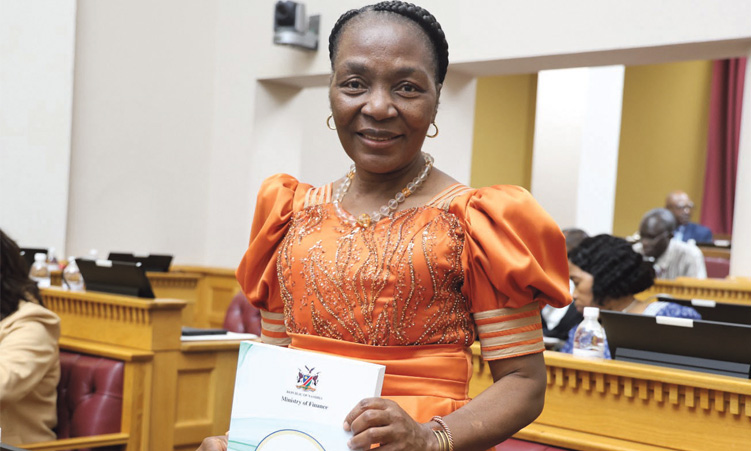
During the tabling of the mid-term budget review, minister Ericah Shafudah announced that the government reallocated N$110.6 million from underperforming development projects.
Economists warn that the figures expose a gap between money spent and tangible improvements in the economy, because salaries, grants and other running costs absorb most public spending while infrastructure projects struggle to advance.
The mid-year budget review identifies recurring problems that delay implementation, economists say.
This includes projects receiving funding before feasibility studies and engineering designs are complete, environmental approvals are outstanding, and land rights have not been secured.
Economist Jason Kasuto says the country was unlikely to deliver all its plans this financial year, despite the headline spending figures suggesting the government was on track.
“The difficulty is that the operational budget, which pays salaries and grants, is always spent in full, while the development budget, which builds the roads, schools and clinics that people actually see, had reached only 42%,” Kasuto says.
He warns that capital projects could not simply double their pace because the financial year was approaching its end.
“With revenue revised down by N$1.5 billion and ministries receiving N$0.7 billion of the N$13.1 billion they asked for, I expect the capital plans to be partly delivered this year and the balance rolled over into the next,” he says.
“The government is running on schedule, but building behind schedule,” economist Almandro Jansen says.
Jansen says roughly N$3.7 billion of the N$6.5 billion development budget still had to be delivered in the second half of the financial year.
“That is more than was delivered in the first half,” he says, adding that he did not expect every planned capital project to be completed this financial year.
The development budget is intended to finance infrastructure and other projects that can expand economic activity, improve public services and support job creation.
Ministries are also spreading limited funds across too many projects, leaving individual sites without sufficient resources to progress quickly.
Jansen says new projects were sometimes introduced during the financial year without adequate preparation, while too many projects were being implemented simultaneously.
The N$110.6-million reallocation was intended to move money away from underperforming projects towards those progressing faster and urgent spending needs.
Donor-funded projects have also struggled. Their projected spending was reduced from N$2.6 billion to N$1.8 billion because implementation was slow.
SPENDING DOES NOT MEAN DELIVERY
The figures also raise questions about how much of the money the government spends translates into new infrastructure, jobs and productive capacity.
Jansen says the N$47 billion figure includes commitments, such as contracts and orders signed but not yet paid. Actual cash payments are, therefore, lower than the headline figure suggests.
“Partly. The answer depends on what the money is spent on,” he says when asked whether the spending was being felt in the economy.
Government spending supports household incomes and economic activity through salaries, grants and purchases. However, Jansen argues that this does not necessarily expand the economy’s ability to grow.
By the end of September, reported infrastructure outputs included 13 kilometres of new bitumen roads, 14 kilometres of low-volume sealed roads, 18 kilometres of gravel roads and 32 kilometres of rehabilitated roads. The government also completed 92 pre-primary classrooms and 38 permanent school classrooms.
“Against a country of three million people, they do not change what people see on the ground,” Jansen says, referring to the scale of these outputs relative to the country’s needs.
The revised economic growth forecast of 2.3% adds to the pressure on the government to ensure that public expenditure produces stronger economic activity.
Debt costs are another concern. The government’s interest bill is projected at N$15.4 billion for the financial year, equivalent to 17.5% of revenue and more than the entire Ministry of Health and Social Services budget, according to Jansen.
“Every year that debt grows, more money goes to lenders and less to services,” he says.
TREASURY PROMISES TIGHTER CONTROLS
The mid-year review proposes stricter conditions for future capital funding, including requiring completed feasibility studies, verified bills of quantities, environmental approvals and procurement plans before projects receive money.
The Ministry of Works and Transport is also expected to help ministries plan and cost projects, while the government intends to prioritise completing existing projects that support the sixth National Development Plan rather than starting new projects that are not ready.
Jansen says the reforms could help improve execution from next year, but would not resolve the immediate delivery risks facing the current budget.
The pressure is compounded by the weaker revenue outlook. The government revised revenue down by N$1.5 billion to N$8.1 billion, while the budget deficit remains at 5.5% of gross domestic product (GDP) and public debt is projected to reach 68.7% of GDP.