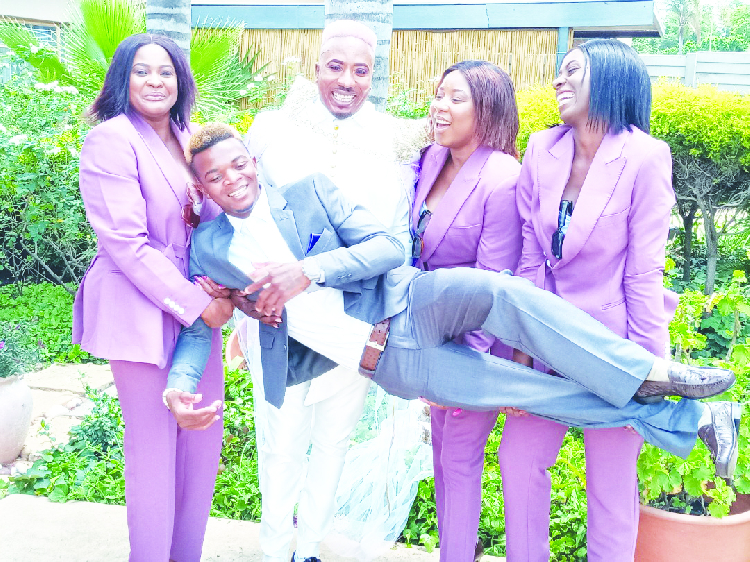
Perhaps one of the country’s loudest defenders of LGBTQI+ rights, Wendelinus Hamutenya, says his journey has never been a bed of roses, and it was only after tying the knot last year that he could finally find rest for his soul.
Despite the rocky road to his happy-ever-after, nothing could stop his dream wedding from taking place in South Africa in November last year, and in a Dutch Reformed Church, no less.
Hamutenya met his husband, Jeremia Immaneul, at the Ongwediva Trade Fair in August 2015 and was soon swept off his feet.
“At the time I was coming out of an abusive relationship but then I met this young good-looking guy. He asked for my number and we soon went out for a drink. Our time together was invigorating, we talked about our work, where our lives had taken us. I was intrigued by the self-confidence of this fantastic man sitting across the table from me.”
Hamutenya chuckles while recounting how he was schooled by his young lover, who was way more liberal than himself.
“He had an intellect that was sharp and always open to new ideas. And damn, he was so sophisticated. He invited me to have cocktails at a friend’s place.
“He wasn’t the first man to come on to me after my break-up, but he was the first I had a real desire to share a life with.”
Despite being a vocal campaigner for LGBTQI+ rights, news of his union still came as a surprise to many, some of whom completely shut him out.
It was very disheartening that some family members wouldn’t support their union, he says.
“I feel at ease now that we are legally married. It means a lot to us since we have been trying to convince our families. But for now, we are at peace. We are married, we are happy, it’s like a dream come true.”
The general public also had mixed reactions to their same-sex union.
“Looking back at the history of equality in Namibia, one is allowed to feel proud of the progress that has been made. The road to equality for LGBTQI+ people in Namibia has been a long and arduous one, but with hate crimes against our community still a common occurrence, it is far from over.
“Even if the law allows same-sex marriages in Namibia, there remains work to be done to dispel the archaic attitudes that are still present among many.”
Hamutenya stresses that no culture is cast in stone and societies could eventually embrace new ideas and norms across genders, sexualities, races and belief systems.
Anecdotal evidence shows that homosexuality has always been part of African cultures, he notes.
“In fact, the Ovambo have terminology describing homosexuality. Eshenge refers to men who have sexual intercourse with other men,” he says.
Other hot button issues include who is ‘the man’ between the two, who pays lobola and most importantly whose clan names are used once both families are joined.
“Some may find these questions too invasive but they present an opportunity to shed some light and educate those who don’t understand.
“A same-sex relationship is a union, it does not depend on roles. No one has to wear a dress, or everyone can! If lobola is going to be paid, it would only make sense that it’s done by both families, just like the gift exchange ceremony. And clan names? Well, both clan names can be recognised.”
There is also a clear need to ensure there is sensitisation of families, friends, pastors and society, says Hamutenya. This must extend to wedding planners who should ensure their service providers such as security, waiters, waitresses and other staff are sensitised.
“No one needs homophobia at a celebration of love.”
–unWrap.online