





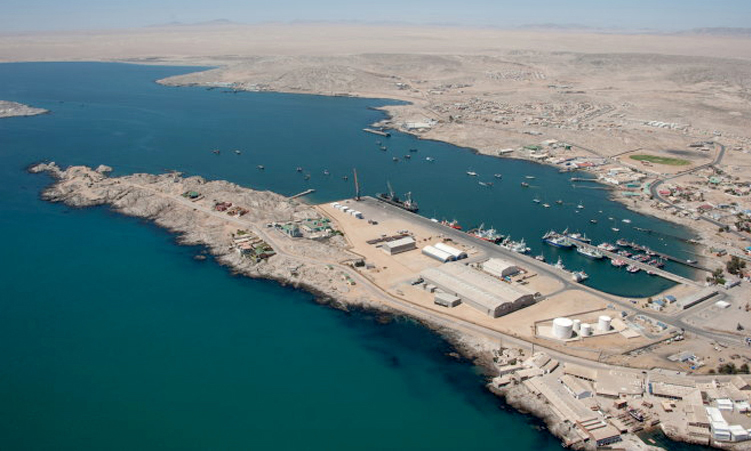
The Namibian Ports Authority has rejected a proposal by a Ghanaian businessman and his Namibian partners to develop a N$4-billion oil and gas supply base at the Port of Lüderitz.
The project was intended to support Namibia’s emerging offshore oil and gas sector by expanding the port.
Namport has found that Alpha Nautical Services Limited (Anol), owned by Ghanaian businessman Jory Adu-Boahene, did not meet the requirements to develop and operate the facility under a proposed design, build, own, operate and transfer concession.
The project is a partnership between the Namibia Industrial Development Agency (Nida) and Namport. The Cabinet in 2025 tasked the two state-owned entities to find a development partner for 25 years.
Adu-Boahene’s local partners include Namibian businessman Jason Kasuto of Monasa Advisory & Associates, and lawyer Andrew Naunyango.
“I am no longer a director at Anol. You should ask those directly involved with the company,” Kasuto, who is also the chairperson of the Economic Association of Namibia, said this week.
Politically connected businessman Josef Andreas also had an interest in the project.
“I am still interested in investing in the project if opportunities are available,” he said yesterday.
Adu-Boahene and Naunyango yesterday denied that their company lacks financial, technical or operational capacity.
POLITICAL PRESSURE
The rejection comes after politicians allegedly pressured Namport to approve the proposal, according to sources familiar with the matter.
Sources say the decision is expected to pave the way for an open competitive process to select a developer for the strategic project.
In a letter dated 13 May to the minister of works and transport as well as to the minister of industries, mines and energy, Namport chief executive Andrew Kanime says the assessment was based on documents Anol submitted.
“Namport has since carried out an assessment of Anol’s capacity based on a review of the documents available on Anol’s data room,” Kanime writes.
He says the company failed to demonstrate the financial capacity, technical expertise, delivery capability and operational experience required for the project.
“Therefore, our considered assessment based on the submission made is that Anol does not meet the technical capability and track record requirements for the set-up and operation of an oil and gas supply base at Lüderitz,” the letter reads.
Anol yesterday rejected Namport’s findings, saying it has the financial, technical and operational capacity to deliver the project.
Adu-Boahene yesterday told The Namibian the partnership was surprised at Namport’s position given Anol’s deliberate efforts to prioritise local content and compliance with local regulations regarding majority Namibian ownership.
“Anol established a Namibian entity rather than proceeding through a foreign structure, to comply with Namibian laws, which in turn has been used by Namport to understate and disparage Anol’s capability and past experience,” he said.
He added: “It is worth noting that Namport has recently awarded a similar project to a 100% foreign entity, Soneils, raising questions about consistency in their evaluation criteria and perhaps circumvention of Namibian laws, and punishing entities that comply with Namibian law.”
Nida and Anol had a general cooperation agreement signed on 11 June 2024, which expired last month. Sources say there was political pressure to renew the agreement so that the N$4-billion project could be executed through it.
In a letter dated 17 June, acting chief executive Phillip Namundjebo informed the ministries of industries, mines and energy, and of works and transport that no board resolution existed to extend the agreement.
THINGS FALL APART
One of Namport’s major concerns was Anol’s ability to finance the project.
The company submitted a letter of intent as proof of financial capacity, but Namport says this was not enough to determine whether the developer had access to the required funding.
“A simple letter of intent is not sufficient at this stage to make an informed assessment on financial capacity,” Kanime says in the letter.
Namport says Anol should have provided details on its funding model, including equity contributions, debt arrangements, committed financiers, facility letters, sponsor support and guarantees.
Adu-Boahene yesterday said Anol initiated the project and has invested significant capital in developing the technical and design foundations underpinning it. At the time the opportunity was awarded, he says Nida did not have oil and gas expertise and relied on Anol as its partner.
He said Anol’s financing partner has a balance sheet in excess of US$50 billion (about N$820.86 billion) and has the requisite capacity to support this project.
“In our view, any attempt to advance the project without Anol would not reflect the spirit of that partnership and could be considered inconsistent with good faith engagement. Given the technical input, capital investment, and development work contributed by Anol, we believe we have a strong and legitimate basis to continue pursuing the project in Namibia,” Adu-Boahene said.
TRACK RECORD
Namport also questioned Anol’s experience in the oil and gas industry.
The authority said the company itself had no proven history of operating oil and gas supply bases.
“Namport’s initial review indicates that Anol, as a legal entity, has no verifiable operating experience or track record in oil and gas supply base management,” Kanime says.
He says the company also failed to demonstrate its health, safety, security and environment performance.
“The company was incorporated in August 2020 and does not own or manage a supply base,” he says.
Namport says the experience of Anol’s shareholders and employees cannot substitute the company’s own track record because Anol would ultimately be responsible for establishing and operating the facility.
Adu-Boahene, however, defended the company’s track record.
“Anol is owned and supported by sponsors with a combined experience of 100+ years of experience in and operating upstream oil and gas, marine infrastructure and large-scale infrastructure development. Anol shareholders are also shareholders in Ladol, the largest onshore logistics base in Lagos, Nigeria, which supports the operations of major international oil companies, including TotalEnergies and Shell,” he said.
RED FLAGS
The proposed location for the project also became a sticking point.
Anol had proposed developing the facility at Robert Harbour inside the Port of Lüderitz, but Namport says the site does not meet the requirements for supporting offshore oil and gas activities.
The authority says the site is not aligned with its port master plan and presents technical challenges.
“The site has a water depth of 8.75m, founded on hard rock which is not financially viable to dredge,” Kanime says.
He says the depth is insufficient for heavy fabrication and heavy lift activities.
“Therefore, the site proposed by Anol falls short of meeting the government’s directive of setting up Lüderitz to meet the oil and gas requirements for all phases, such as the exploration, development and production phases,” he says.
The Namibian sought comment from both ministries.
They acknowledged receipt of the questions, but had not responded by the time of going to print.
Questions sent to the chief executives of Namport and Nida were not answered either.