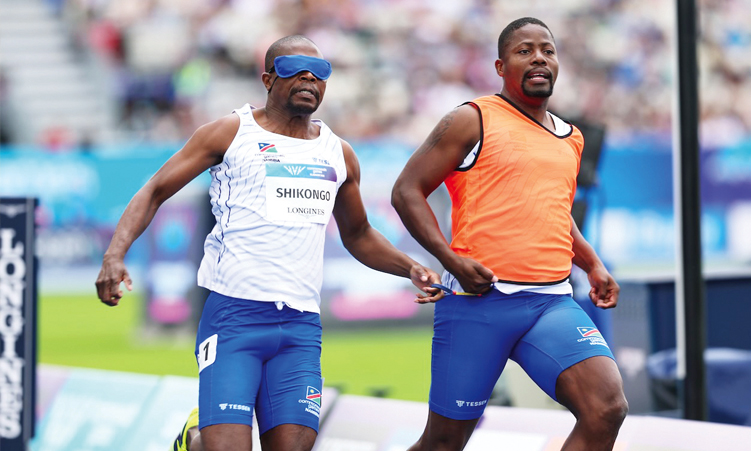
Gold medalist Ananias Shikongo was disqualified from the Commonwealth Games last month after Namibia’s Paralympic committee failed to secure a valid competition licence for him amid internal disputes.
This comes after a years-long power struggle within the leadership of the Namibia National Paralympic Committee (NNPC), which suspended its general secretary, Michael Hamukwaya, late last year.
Hamukwaya has denied wrongdoing but confirmed that he refused the new board access to register Namibian athletes.
The committee, unable to resolve its internal issues, did not pay necessary fees to the International Paralympic Committee at the end of 2025 and did not register athletes.
No Namibian Paralympic athlete has been licensed since 1 January, cutting opportunities for Namibian athletes to qualify for Los Angeles 2028.
Shikongo was one of the first athletes to publicly fall victim to the power struggle.
World Para Athletics (WPA) spokesperson Rafael Maranhao confirmed Shikongo’s status to The Namibian last Thursday.
“In accordance with the WPA Rules and Regulations, athletes must hold a valid athlete licence in order to participate in WPA sanctioned competitions. We can confirm that the athlete in question does not yet have a licence for the 2026 WPA season.
“National Paralympic committees (NPCs) are responsible for registering and licensing athletes,” Maranhao said.
The Namibia National Olympic Committee (NNOC), which funded the preparations and participation costs for the Namibian team to the Commonwealth Games, called the situation “concerning”.
“The NNOC committed resources towards the athletes’ preparation and participation in good faith, on the understanding that the necessary eligibility and registration requirements had been addressed by the relevant Paralympic structures,” NNOC chief executive Anri Parker tells The Namibian.
CANCELLED RACE
On 29 July, Shikongo was set to race in the T12 100-metre heats in Glasgow. He had spent weeks in Europe preparing for the Games.
Shikongo won a silver medal at the Tokyo 2020 Paralympics and gold in Rio in 2016. T12 is a classification used internationally for athletes with low vision.
On the morning of the race, the technical delegates received a protest against Shikongo’s participation.
“WPA were immediately contacted to verify whether the athlete was eligible to compete,” technical delegate Chris Cohen says in the game’s official disqualification communication. WPA responded at 12h35, confirming that Shikongo was not eligible to compete. The race took place at 12h40.
Cohen says there was no time to remove the athlete before the race. “Although WPA had ratified all Para-athletes who would compete at the games, they confirmed that the athlete does not have a 2026 WPA licence and was, therefore, not eligible to compete,” Cohen says. Shikongo tells The Namibian he was not aware, prior to the games, that he did not have a 2026 WPA licence.
THE LICENCE
WPA is the international federation for Para athletics.
Athletes that participate in WPA-sanctioned events, like the Commonwealth Games, have their records count towards global rankings and for qualification towards major events, like the Los Angeles 2028 Paralympics.
The International Paralympic Committee emailed all national committees to open licensing for 2026 on 4 November 2025. The national committees have to log into an athlete management system, pay a fee per sport, and then register athlete details.
Only then does an athlete have a valid licence.
THE BLAME GAME
At the centre of Shikongo’s disqualification is access to the athlete registration system.
Because the system contains sensitive medical information about athletes, each national committee receives only one log in. Until 2025, Hamukwaya controlled Namibia’s system.
In 2025, an interim committee was set up by the Namibia Sports Commission (NSC) to govern the NNPC. In August, that committee suspended Hamukwaya.
In February this year, the interim board called elections and a new board was appointed. However, the international governing body raised concerns about why the previous board was dissolved and the election process.
“The elections held on 14 February were not conducted in alignment with the Namibia [Paralympic] constitution currently on file,” International Paralympic Committee director of membership Felipe Rodrigues said in a May email to all NNPC parties.
Until discrepancies were resolved, Hamukwaya would be the only recognised contact person for the international body.
New NNPC development officer Jean-Paul Schmidt says Hamukwaya did not tell the new board about the licensing fees and did not hand over the login information.
“He wasn’t entering athletes, was not supplying information, was literally holding [the athletes] hostage by not entering. [Ultimately], the person responsible for entering them did not do it,” Schmidt says.
Hamukwaya tells The Namibian that since he was suspended by the board, he could not act on behalf of the NNPC in paying licensing fees or registering athletes.
“The new committee, which is not recognised by the International Paralympic Committee, requested [the log in]. [The international body] still recognises me as the contact person for the NNPC until the right procedures are followed regarding governance,” Hamukwaya says.
“The [new NNPC] are informed that the [committee] does not recognise them. Who am I to recognise them if the mother body does not want to give them the credentials?” he said.
The Namibian understands that the Ministry of Education, Innovation, Youth, Sport, Arts and Culture, the sport commission, NNPC and Hamukwaya met last week. NSC declined to comment, saying that the matter was being handled internally.