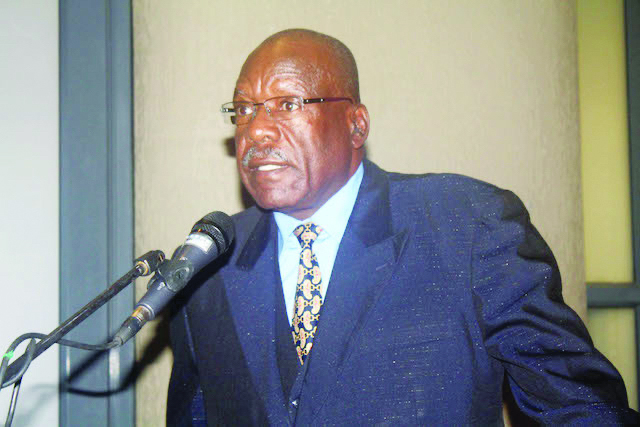
FORMER Namibia Central Intelligence Services (NCIS) director general Lucas ‘Fogu’ Hangula died yesterday due to Covid-19. He died at his house in Windhoek at around 07h00.
Sources say he could not be admitted to a hospital because there were no available beds.
Hangula served as police inspector general from 1995 to 2005. He then served as the head of the national intelligence agency from 2005 to 2015.
He is survived by his wife and four children.
Hangula, known as Fogu (Portuguese for fire), has been described as principled, strong, brave, reserved and patriotic by his colleagues and friends.
NCIS director general Ben Likando yesterday said the intelligence service and the security cluster are devastated by the loss of a man who dedicated his life to serving the Namibian people.
“He was a straight talker and motivational speaker, who left a lasting impact on the NCIS,” Likando said.
He said although he was at the NCIS and Hangula at the police, they worked closely together until they were reunited when Hangula was appointed NCIS director general in 2005.
Members of the Namibian Police, the Namibian Defence Force and the NCIS yesterday drove past the late Hangula’s house to pay their respects.
“A silent giant has fallen,” said retired defence chief Martin Shalli.
Shalli and Hangula were fighters for Swapo’s military wing, the People’s Liberation Army of Namibia (Plan), from 1975.
Shalli said he fought alongside Hangula in the battle of Okero near Onayena in 1976.
He said the tall, strong and young Hangula made a difference on the battlefield.
Shalli believes it was this battle that earned Hangula the respect he kept enjoying until today.
Former ministry of defence permanent secretary and Plan commander Erastus Negonga yesterday said he remembers meeting Hangula as a member of a special unit commanded by then Plan chief Reconnaissance Isaak ‘Pondo’ Shikongo.
“It was April 1976 near Eenhana, and I remember him with his Pika machine gun, wearing camouflage overalls with ammunition chain belts,” he said.
Negonga said he was impressed by Hangula during the 1980s. He said Hangula was working as Plan chief personnel officer and knew almost every Plan fighter personally.
This sentiment was echoed by junior police officers who worked with Hangula during his days as police chief.
“He would remember even details of which police station he last saw you at and the rank you held,” said an officer who did not want to be named.
“Hangula was a very quiet person, but was quick on his feet in difficult situations,” Negonga said.
Other colleagues said Hangula lived a modest lifestyle with humility.
He was among the first group of 100 Plan volunteers who decided to, for the first time, track through Angola to confront the apartheid army in northern Namibia in December 1974.
This was considered a mission of no return.
After that Hangula was made commander of the Tobias Hainyeko Training Centre before he was promoted to deputy chief of personnel at the Plan headquarters at Lubango.
He later became chief of personnel until independence in 1990.
During this time he also served on the Plan military council.
In 1995 Hangula was called back to the uniformed world when then-president Sam Nujoma appointed him as inspector general of the police.
His colleagues credit him for reforming and integrating the police.
Despite resistance, he found a way to ensure that both aparthheid-era officers and Plan fighters worked together in an independent Namibia.