






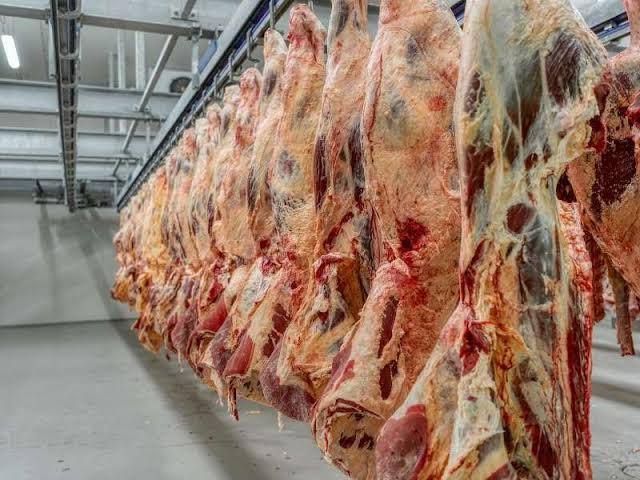
Savanna Beef Processors Ltd reported a lower-than-budgeted operating loss of N$42.6 million for the year ended February 2026 amid expanding European exports.
The company budgeted an operating loss of about N$107 million for the year.
Savanna Beef Processors chairman Mecki Schneider announced this in a report released at the company’s fourth annual general meeting on 13 August.
“Although our financial position shows an overall loss in this start-up phase, this actual loss is less than the budgeted amount. This provides a solid foundation for the future,” he said at the meeting.
Schneider urged members to note that for the 2026/27 financial year, the company still expects to incur a loss due to the four-month ramp-up period from March to June which was budgeted at a loss, and which cannot be reversed in the remaining eight months due to historical lower slaughter volumes in the third and fourth quarters off-season.
“Among other obligations, Savanna has loan agreements which need to be serviced,” he said, adding the company also had 126 employees at the end of February.
Schneider highlighted that total project costs amounted to N$429.3 million, whereas the total budget was N$437.5 million.
“Hence, we spent less than budgeted,” he said.
The chairperson said to enhance fairness among small and large producers, a slaughter right allocation system was developed over the past year and it has been quickly accepted by producers and shareholders.
“Cirrus Capital’s daily feedback on over-the-counter trading (on the Namibia Securities Exchange) shows slaughter rights are being traded, and that the share price has increased by 17% over the past year,” Schneider told the meeting.
He said while the company awaited European export certification, throughput was kept low to minimise financial losses, as all products had to be sold in the local saturated market, a reflection of the resilience of the business model and operating strategy.
Over the past year Savanna saw positive progress supported by improved operational efficiencies, disciplined cost management, and continued demand for Savanna products, driven by a sound and transparent sales and marketing agreement with international marketing partner goals, priorities and strategies.
“After obtaining European certification on 7 April, all cattle slaughtered were for export. The first two containers with Savanna Beef destined for Europe left the Walvis Bay harbour on 18 May,” he said.
Two weeks before the meeting Savanna was allocated 15% of the transferred Norway quota from Botswana, as it cannot export beef due to its foot-and-mouth disease status.
“This implies about 130.5 tonnes of beef. Norway still is a prime market,” he said, adding that the BlockHouse Group in Germany, a big steakhouse group, is eager to serve Savanna Beef on their menu.
“To directly reach the end consumer was always one of Savanna’s marketing strategies,” he said.
Schneider emphasised that the fundamental aim of Savanna Beef Processors, which was awarded the Seal of Quality by the Livestock and Livestock Products Board of Namibia, is to retain 50 000 additional weaners in the country.
This will be done by paying a premium for slaughter cattle to encourage producers to focus on local value addition by delivering slaughter cattle to the export abattoir instead of South African feedlots.
“Livestock producers will then extend their control in the value chain to their direct benefit and of the farming community. This in turn will lead to additional job creation, starting on farm level through all agri-businesses, as well as boosting foreign currency earnings for Namibia,” he said.
Schneider said Savanna’s main focus in the year ahead will be to reach the set throughput of 250 slaughter cattle a day or 50 000 head per year.
– email: matthew@namibian.com.na