





At the end of August, conservationists, bird enthusiasts and students once again gathered for the annual Walvis Bay Wetland Winter Bird Count.
For two days, several teams surveyed the lagoon and the Walvis Bay Salt Works along predetermined routes on foot and by vehicle.
They carefully counted and recorded every bird they saw, including noting its species.
The winter bird count, held around July or August each year, is complemented by a summer count in February or March.
Together, these two annual counts provide valuable long-term information about bird numbers and the health of the Walvis Bay Lagoon.
The counts rely on a popular approach known as citizen science: members of the public volunteer their time to help collect scientific data.
By bringing together many volunteers, large amounts of valuable information can be collected efficiently and at a much lower cost than would be possible with scientists working alone.
Beyond that, citizen science gives ordinary people the opportunity to play an active role in understanding and protecting their local environment.
HABITAT ‘HOPPERS’
This winter, citizen scientists counted just over 87 000 birds. In comparison, 33 000 were counted in August last year and 74 500 in 2024.
The highest winter count ever – 114 000 birds – was recorded in 1992.
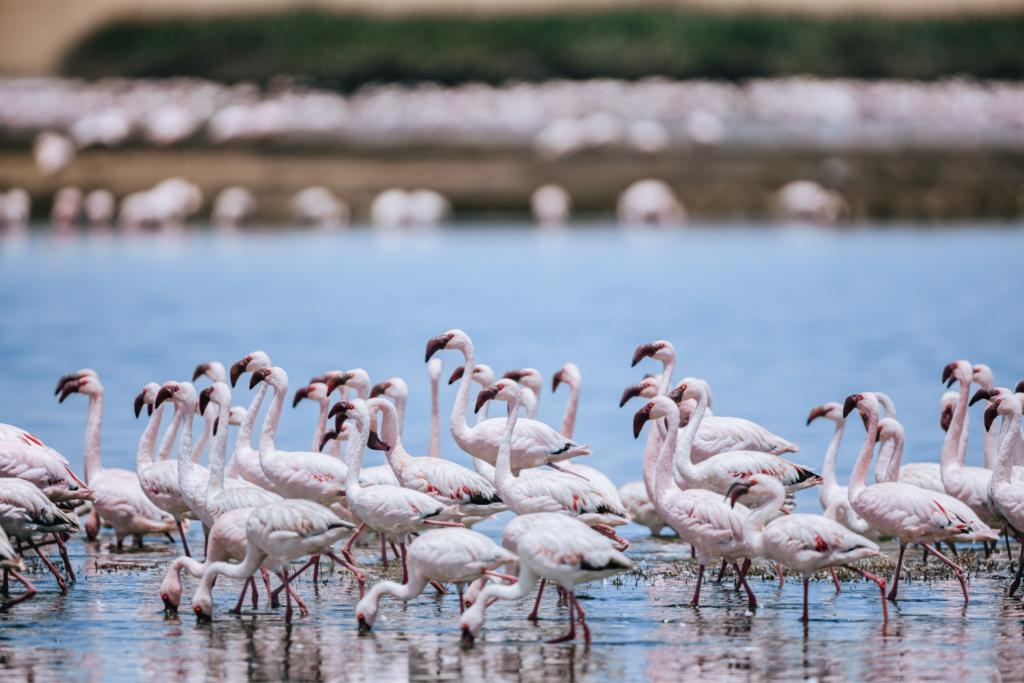
Of the 87 000 birds counted this winter, 51 000 were flamingos.
In summer this year, volunteers counted almost 90 000 birds in total but only around 5 500 of those were flamingos.
Why such a big difference? The answer lies in the seasonal movements of these fascinating birds.
This year has seen very good rainfall inland, filling Namibia’s Etosha Pan, Botswana’s Sua Pans and other smaller shallow water bodies.
Flamingos are considered intra-African migrants, meaning they move between different habitats across Africa.
When the inland pans fill with water, flamingos move there to breed.
Once their chicks are big enough, they fly back to the coast, where they can feed in the rich coastal wetlands, including the Walvis Bay Lagoon.
It is also why the flamingo counts are much higher during the winter months.
CELEBRITY SIGHTING
The count also had a celebrity sighting in store. In 43 years of the local bird count, a red-knobbed coot had only been spotted once before.
This year’s count produced the second record!
Red-knobbed coots are found across southern and eastern Africa and, like flamingos, are intra-African migrants.
While counting birds may not be everyone’s cup of tea, many tourists come to Walvis Bay to see the famous flamingos and other bird species.
These birds add to the beauty of the lagoon, attract tourists and generate local income, while also playing an important role in the area’s biodiversity.
Many birds, like flamingos and red-knobbed coots, travel from other African countries to the lagoon because they find an abundance of food here.
Tens of thousands of other birds migrate from as far away as Siberia and northern Europe for the same reason.
‘VITAL SIGNS’
The Walvis Bay lagoon and other coastal wetlands act as essential refuelling stations along the birds’ lengthy migration routes.
The count helps monitor bird populations over the long term because when bird numbers change, it can signal problems in the ecosystems that support them.
This long-term monitoring and research project is supported by the Walvis Bay Salt Company, which provides access to its mining licence area and the use of its bird hide.
The University of Namibia sends students to help with the counts, while the Ministry of Environment, Forestry and Tourism also supports the project.
Every volunteer is welcome. No experience is needed.
Whoever is interested in joining the initiative next year, can contact John Paterson at cbirdsrule@gmail.com
– Damian Schreiber, publicist, educator, seal rescuer and junior researcher at Ocean Conservation Namibia. He has a master’s in ecology and society from Costa Rica’s University for Peace.