



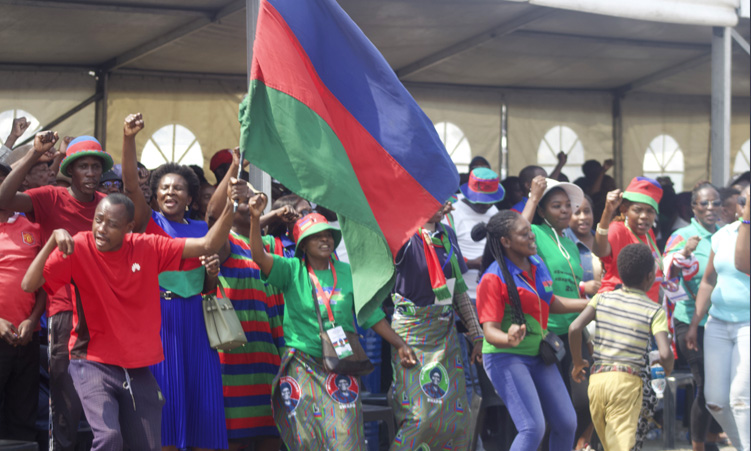
DESPITE losing ground in major local authorities and constituencies in the southern regions, Swapo continues to draw its strongest support from rural Namibia.
This is according to a new report by the Institute for Public Policy Research (IPPR), titled ‘Inside the Numbers: Fraying Dominance, Fragmented Opposition’.
The report indicates a decline in support for Swapo, from 80% in 2014 to around 50% in 2024, the party’s weakest performance since independence.
The party’s urban support, according to the report, has eroded particularly in the Erongo and Khomas regions, where it has lost nearly half its urban vote share over the last decade.
“This shift mirrors a broader trend observed across Africa and globally, where ruling parties are losing ground in rapidly growing urban centres,” the report reads.
According to the report, regional patterns also reveal early signs of erosion in Swapo’s northern strongholds.
“While Swapo remains dominant in these areas, even a small decline in support there has a significant impact on the national picture due to the large population in these regions,” the report reads.
It further attributes corruption scandals and internal party power struggles to its decline in support.
While Swapo has suffered reputational damage, opposition parties remain too fragmented to offer a viable alternative despite gaining traction.
“Younger voters, particularly those under 40, are increasingly aligning with opposition parties such as the Independent Patriots for Change, the Affirmative Repositioning movement, the Landless People’s Movement, and the Popular Democratic Movement,” the report reads.
Max Weyland, an IPPR researcher, says what is currently happening to Swapo is not new as ruling parties worldwide are struggling in urban areas.
He says Swapo’s challenge is due to Namibia’s urban population standing at roughly 50% currently and still rising.
“For all the talk about Swapo’s losses, they still get more votes than any opposition party in almost every constituency. If we’re ever going to see an opposition government, it will require much bigger numbers and stronger unity,” Weyland says.
Looking ahead, the IPPR stresses that the key question during the November regional council and local authority elections would be whether Swapo can regain its lost support, and whether opposition parties can prove their worth in areas where they have already made inroads.
“Elections are an accountability mechanism. If they work the way they’re supposed to, poor results should trigger better service delivery. It’s now up to parties to respond to what voters told them last year,” Weyland says.
Despite the challenges, he remains optimistic about Namibia’s democratic future.
“Namibia’s democracy is strong because people care. In 2024, voters waited in long lines in the heat to make their voices heard. That tells you something powerful about our democracy and why it’s worth protecting,” he says.