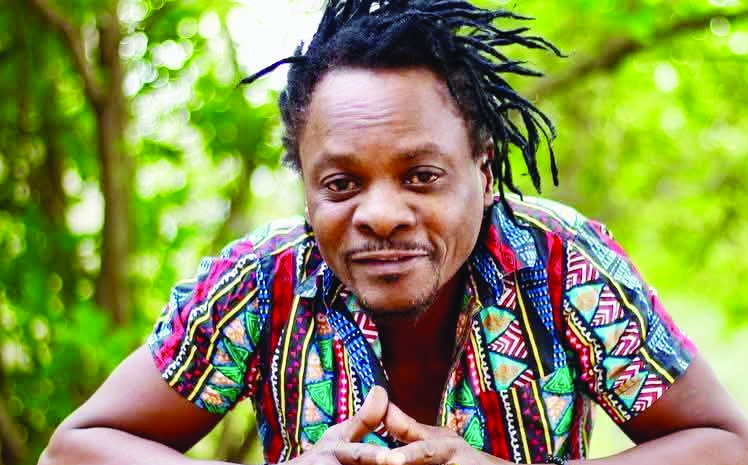
Saskia Sheehama, the wife of late reggae star Ras Sheehama, has shared details about the artist’s final days, saying he was working on a new song about love.
The ‘Cassinga’ and ‘Push n Pull’ hitmaker took his life in Windhoek on Friday. He was 59 years old.
Saskia, who is currently in The Netherlands, shared this with The Namibian yesterday.
“He had been spending some time in the studio lately, recording a song about the Congo. He also talked of a love song, but I’m not sure if he’d started recording it yet. He was also planning to record an album with Slickartie,” she said.
Saskia left for The Netherlands last Monday to visit her family and last saw her husband at home before she travelled.
“I can’t say for sure he didn’t see anyone after that, but his phone has been off, and I haven’t heard from anyone that had been in contact with him since I left. Because I couldn’t get hold of him and he didn’t make an effort to call me, I got worried and asked a friend to check up on him. She was there on Thursday evening but didn’t see him. On Friday morning he was found,” she said.
TRUE LEGACY
Saskia said her husband believed his true legacy lay in his music.
“Ras always said his legacy is in his music. I think he would love it if people would listen to his later songs as well. Apart from the real fans, most people just wanted to listen to his early hits,” she said.
The two were often seen at concerts embracing each other.

Apart from being Sheehama’s wife, Saskia often played the role of unsanctioned promoter of his concerts.
She posted a heartfelt message about the loss of her husband on Facebook over the weekend.
“Immensely sad and in shock that you could not feel there was any other way. I wish I was there with you in your final moment of despair, but will somehow have to accept and live with the choice you made,” she wrote.
“I’m in The Netherlands with close family and friends and choose to stay for now and deal with my pain surrounded by my loved ones. Rest in peace, Rasta na Onakayale. Love you always. X”
She said she would return soon to attend Sheehama’s funeral.
Baptised Hans Sheehama at Onakayale village near Ombalantu in the Omusati region, not many would deny that Sheehama was one of the country’s best reggae singers.
Contrary to popular belief, Sheehama in a previous interview with The Namibian revealed he was not a rastafari, explaining that his rastafarian influence came from the teachings of emperor Haile Selassie in Nigeria.
“Rastafari is neither a way of life nor culture for me. I don’t really practise the religion or go to a rastafari church, neither do I follow that religion,” he said at the time.
‘REBEL RASTA’
Sheehama considered himself a “rebel rasta” and not a “saint rasta”.
Sheehama was just 12 years old in 1979 when he joined a group of young boys from his village, crossing the northern Namibian border into Angola to join Swapo in exile at Lubango and later at Cuanza Sul.
Together with a group of young boys who could read and write, he was taken to a different camp for military training, but they were called back after six months and then sent to Nigeria for high school.

Sheehama used his allowance, which he was supposed to spend on food and cosmetics, to make his first demo tape in Nigeria.
He joined Ndilimani Swapo Cultural Troupe upon his return to Angola from Nigeria and would sing his own songs accompanied by his acoustic guitar.
Sheehama was in the first repatriation group led by former president Hage Geingob in 1989.
Ndilimani was tasked to provide music at the star rallies that started Swapo’s election campaign.
GOING SOLO
He said he, however, had to leave Ndilimani to pursue a solo career.
“I could only see myself as a solo artist and had my own way of doing things and my own plans. I wanted to grow as an artist and didn’t want to be caught in the web of advancing other people’s agendas while forgetting the realities of life.
“Ndilimani is a political band and I would be compromised to remain with the group, so I just opted to set myself free. There is no beef with the band members at all, and whenever they perform at national events I would walk up the stage and sing along,” he told The Namibian.
Since 1990, Sheehama has released several LPs and cassettes which are available in Namibia and South Africa only. From these tapes several tracks were continuous hits in Namibia.
Sheehama celebrated his first show in Germany together with the late Lucky Dube’s band, The Slaves, at the Africa Festival in Würzburg, Germany, in 1999.
He has performed in the United Kingdom, Cuba, Portugal and Switzerland, while he also opened for the legendary reggae superstar Don Carlos in Johannesburg, South Africa, in 2001, and for Manu Di Bango in Windhoek in 1995.
‘BROTHERLY GUIDANCE’
Award-winning musician Big Ben, who has also released a moving tribute song for Sheehama, says the reggae star played a positive role during his formative days.
“Stepping onto the stage with a band still figuring things out, Ras would turn up and, in his calm way, share advice on how to hold the mic, how to read the crowd and how to carry yourself as a musician. He didn’t make it feel like a lecture, he made it feel like a brotherly guidance,” the artist says.
“And sometimes, he wouldn’t say a word, he’d just be there in the audience, watching, supporting, letting his presence speak louder than anything. That’s the kind of selfless spirit he carried. He gave freely of his time, his wisdom, and his energy, not because he had to, but because he wanted the music to live on through others.”
Denmark-based Namibian artist Jackson Wahengo says Sheehama was one of his biggest inspirations.
“My elder brother Setson, upon his return from Cuba in 1992 . . . was inspired by a cassette of Ras Sheehama’s music of the 90s.
“He never looked back ever since. He came home and like a sponge I copied everything he did, which included his love for Ras, who became like an elder brother and would guide us. Those days the first songs I learnt on the guitar were either Bob Marley or Ras,” he says.
Wahengo says when he moved to Windhoek in 1998, he took his guitar playing seriously and started practising extensively. “The dream was to be as popular as Ras one day, and to play on stage with him,” he says.
In 2000, Wahengo finally stepped on the stage as part of the Ras Sheehama band. He says there are no words to describe how he felt from that day onward, adding that Sheehama’s death has left the lines of his music career blurred.
Songbird Patricia Ochurus, who has been Sheehama’s backup singer for quite some time, says it is not easy to accept his death.
“Never in my life had I imagined this day. As far and as long as I’ve walked this path with Ras Sheehama, never did it occur that I’ll have to talk about him as he was. It all started with Ras, Jackson Kaujeua Sr and Willie Mbuende. I am talking about the veteran iconic musicians now.
‘SOFT HEART’
“Ras has been and is still the most powerful lyricist I’ve ever met and known very closely in my life. You could feel and understand him through his lyrics, the brother who taught me the depth of songwriting and meaningfulness of a lyric,” she says.
“He was a top-notch performer and a great entertainer. Ras was the softest of hearts, even though stubborn and so straight … and very humble. I’ve had the most amazing, lovely, treasurable times with him on and off the stage.”