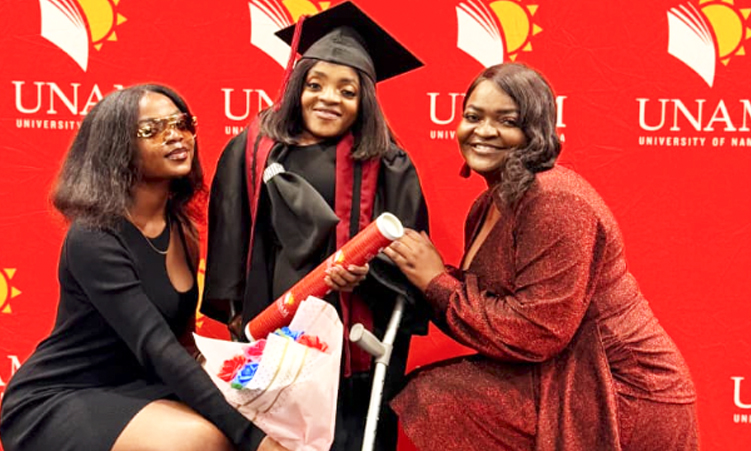
Sophia Ndjamba was 13 years old when she started Grade 1.
While the average age for Grade 1 pupils in Namibia is seven, Ndjamba, now 28, was forced to start school late because she was in and out of hospital.
She was born with a condition called osteogenesis imperfecta, also known as brittle bone disease, which causes bones to break easily, making life difficult for her.
Ndjamba started school in 2010.
After one week in Grade 1 she was transferred to Grade 3 as she was a fast learner.
She completed Grade 12 in 2020 at a school at Omaruru.
“The condition shaped my daily life.
I sometimes needed to approach tasks differently or take extra time to complete certain activities.
I could not complete some of my daily activities without assistance.
However, it has also taught me patience, adaptability and strength,” she says.
“Some pupils and people from my community used to mock me.
I ignored them and everything they were saying about me,” she says, adding that she was often mocked due to her age.
“Being the eldest in class made me feel like I was behind and late, doubting if I will make it, but I was still hopeful.”
It was that perseverance, she says, that earned her a place among 1 277 students who graduated from the University of Namibia (Unam) in Windhoek last week.
Ndjamba graduated with a diploma in library and information science
“Things were not easy, I had to carry my school bag myself when moving from one class to another.
Sometimes my school mates would help me,” she says.
She says when her name was called out during the graduation ceremony, she was filled with a mixture of joy, relief and gratitude as she went to collect her qualification.
“I was thinking about how far I have come with the grace of God, the challenges I overcame and the people who supported me along the way,” she says.
DREAM QUALIFICATION
Ndjamba says she chose her course because she values helping other people access knowledge.
“I was drawn to the idea of being part of a system that empowers people through information, whether in schools, communities or digital spaces,” she says.
Ndjamba, who is currently an assistant librarian, describes herself as a fighter.
“It is not just an academic milestone, but a symbol of resilience, that I am capable of achieving my goals despite obstacles,” she says.
She says family, friends, mentors from Unam and the Tulonga Foundation and her lecturers were her biggest support system.
“They encouraged me during difficult times, believed in my abilities and provided both emotional and academic support that helped me stay focused and motivated,” she says.
DISABILITY NOT INABILITY
One common misconception is that having a disability means you are incapable, she says, adding that navigating her studies with her condition made her more resilient and determined.
“It has also given me a broader perspective on inclusion and the importance of equal opportunities for everyone”.
She urges people with disabilities who wish to pursue their studies to believe in themselves and not let their challenges define them.
“I joined the Tulonga Foundation five years ago.
It’s a welfare organisation that provides tutoring, counselling, mentorship and coaching programmes to empower students with disabilities.
Ndjamba adds that after joining the Tulonga Foundation, she gained confidence which made her believe in herself.
“In the next two years, I see myself working in the field, gaining experience and furthering my studies.
I hope to grow both professionally and personally while making a positive impact in my community.”
Ndjamba’s elder sister, Veronika Shipengo, says she is proud and always believed in her sister, despite some people who doubted her capabilities.
“I am grateful she finally made it despite her physical challenges.
She is a very determined person,” Shipengo says.
Unam spokesperson Simon Namesho says Ndjamba’s journey is one of perseverance, courage and the life-changing impact of opportunity.
Ndjamba’s former lecturer, Anna Ngula, describes her as a hardworking and focused student who was always determined to succeed regardless of the circumstances she faced.
“She always asked when she did not understand the topic . . . and she never had self-pity; she would always find a way,” she says.
Ndjamba’s friend, Sofia Alberto, says she has known Ndjamba for two years and that Ndjamba was very serious with her studies.
“Sometimes she goes to her lecturer or to me when she needs additional help.
She always makes sure she completes all her assignments before the deadline,” Alberto says.