



On 16 APRIL 1994, at the age of 32, I nervously toed the line for the 98th running of the Boston Marathon. Massive crowds gathered in Hopkinton, Massachusetts, for the start of the annual event.
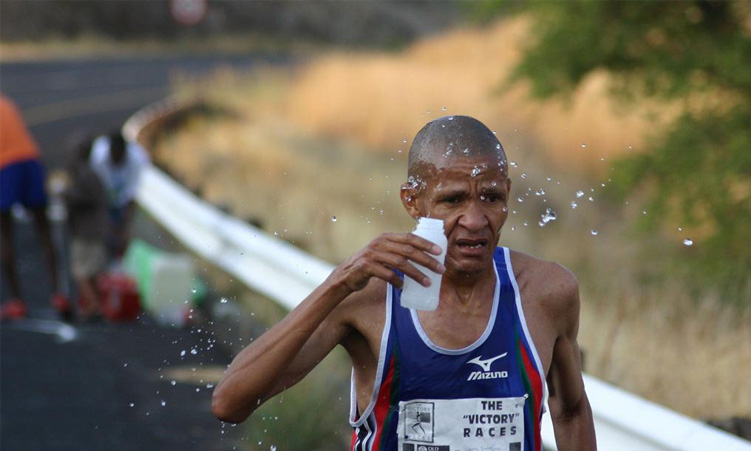
Standing 200 metres in front of me, a relaxed 28-year-old elite runner from Namibia shook out his arms and took some deep breaths with his powerful lungs. His name, I would later learn, is Luketz Swartbooi.
Both the given name and surname stuck with me. I had never heard either before. I grew up in East Providence, Rhode Island, just 80 kilometres south of Boston. He grew up at Rehoboth, Namibia, about 11 500 kilometres away. My country was 217 years old; his was four.
We were both entering our first Boston Marathon. It would be his last, but I would run nine more. It took me two hours to travel to the starting line; it took him 36. While Swartbooi listened, I sang the USA’s national anthem. With hands clenched, we anticipated the gun. He was going for the prize money; I was going for a cold beer.
At the sound of the gun, Swartbooi sprang forward. A thousand runners separated the two of us, and I couldn’t fully extend my stride due to the proximity of other runners.
Swartbooi went out fast with the lead pack and the defending champion, Kenya’s Cosmas Ndeti.
A bit farther back, I pressed the pace as well, but I was losing ground already. Swartbooi ran with a beautiful style, perfected on Rehoboth’s
1 385-metre-high, dirt roads.
I plodded along with an average sea-level length stride.
The TV announcers were asking questions about the impressive Namibian runner, but few answers came, as Swartbooi only recently burst onto the world-class marathoning scene.
My friends, sitting in bars along the Boston course enjoyed beers, and asked questions about their next round of drinks.
As the great, sinewy Swartbooi approached Wellesley College at mile 12,4, he heard the screams of 2 000 excited female undergraduates cheering. He had no idea what was going on. Growing up nearby, I knew the tradition of the female-student body of Wellesley coming out in full force to support runners.
Swartbooi pressed the accelerator and sped by the screaming hordes of beauties. Along local traditions, I stopped to kiss several undergraduates. Swartbooi’s split for the Wellesley mile was average. Despite the kissing breaks, I recorded my fastest mile of the race. I would pay for that adrenaline rush later.
Swartbooi remained poised. The leaders pressed on; I hung on.
Despite the second half of the Boston race featuring more hills than the first half, Ndeti was known for negative splitting (track lingo for running the second half faster than the first) the brutal course.
He surged near the infamous Heartbreak Hill around mile 20, where the race is often decided. With hopes of winning, Swartbooi attempted to go with the indomitable Kenyan. The slender Namibian and several others gradually fell off the leader’s torrid pace. Swartbooi thought of the podium. I thought of the lovely Wellesley undergraduates. We both stared at the passing ground, hoping the finish line would come soon. It did for Swartbooi. I suffered far longer, as the line came much later for me. We both enjoyed the roar and applause of the crowds on Boylston Street with roadside spectators standing 20 deep.
The bands played loudly. We smiled. Swartbooi crossed the line in 2:09:08, which 29 years later still remarkably stands as the Namibian record. I crossed the line in 2:52:25, which for a brief period was my personal record. He finished in eighth place; I finished in 684th.
There were 8 105 finishers that day. Swartbooi finished in the top 1%, while I was in the top 8%.
He was interviewed at the finish; I was handed an ice-cold beer by my buddies.
Swartbooi went on to become the top distance runner in Namibian history. Although I went on to win one marathon, my times were far slower than the great Swartbooi’s.
To this day, Swartbooi holds Namibian records for the 3 000 metre indoors, 5 000 metre track,
5 000 metre road, 10 000 metre road, 15 000 metre road, 10 mile road, and marathon.
Most of those records were set almost 30 years ago.
I don’t hold any running records.
Swartbooi suffered a career-ending injury to his ankle in 2009 at the age of 43. I set my personal record in the marathon at age 44. Swartbooi set his personal best at age 28. I continue to run and have won four marathons in the Masters division. I ran 25 ultramarathons, including two Comrades (silver medal) and the big four 100 milers (161 kilometers) in the Grand Slam of Ultrarunning. I went on to run a total of 55 official marathons and went that distance or farther 586 times.
The average time of Swartbooi’s 10 best marathons was in the 2:14 range, whereas my 10 best averaged 2:53:31.
Each time I raced a marathon, I recalled the great Namibian marathoner. Luketz Swartbooi. His name fa
scinated me.
Later in life, perhaps subconsciously, that name put Namibia in the forefront of my thoughts again.
In 2021, I entered Namibia for the first time in order to help the University of Namibia (Unam) develop a master’s degree in cybersecurity.
I’m continuing my work at Unam in 2023, where I hope to inspire students to strive for excellence, as Swartbooi inspired me in running.
When I visited the street named after Swartbooi at Rehoboth, I had chills on the back of my neck.
And with that experience, I close my tribute to one of the greatest Namibian athletes of all time, a brilliant runner whose records still stand despite vast improvements in training techniques, nutrition, and shoe technology.
It was a real pleasure to race against you, Swartbooi!