






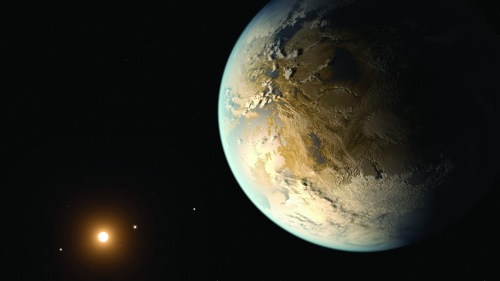
•MARIETTE LE ROUXThe discovery of an Earth-sized planet in the ‘habitable’ zone of a distant star, though exciting, is still a long way from pointing to the existence of extraterrestrial life.
The planet, dubbed Kepler-186f, is the first of this size found orbiting its star at a distance that would allow it to have liquid water – a prerequisite for the development of life, whether primitive or complex.
But whether it has any, we may never know.
“Unfortunately, the system is too far away and too faint to know more,” Heike Rauer of the German Aerospace Centre’s Institute for Planetary Research told AFP.
“We don’t know for sure whether it is rocky, we don’t know for sure that it has an atmosphere, what this atmosphere is made of, or that it has water,” she said.
“We know how we want to measure it: by taking a spectrum of the atmosphere, but with current and next foreseen technology, we cannot take this spectrum.”
Sean Raymond, an astrophysicist at France’s CNRS national research centre who was a member of the team that discovered the planet, agreed we won’t know how hospitable Kepler-186f is for quite some time. If ever.
“We are not even close to having the means with which to take these measurements,” he said. “We will have to wait for the next generation of space telescopes, in 10 or 20 years.”
The exoplanet, some 500 light years from Earth, shows that potentially habitable worlds can exist.
Other exoplanets found within their stars’ habitable zones have been gas giants – this one’s size may mean it is a rocky planet, another condition for life to take root.
Science has invested much time and resources into finding so-called exoplanets, which revolve around stars other than our Sun.
The quest is targeted mainly at answering the question: “Are we alone?”, but also to find clues as to how and why life on Earth began.
Rauer said the first dedicated searches started in the mid-1990s, with telescopes on the ground measuring the mass of distance planets.
This was followed in the next decade by satellites determining their radius.
Nasa’s Kepler space observatory, which spotted the new planet, was dedicated exclusively to the task of finding exoplanets – it has found 3 600 planet candidates of which 961 have been confirmed so far.
Future missions will seek to detect Earth-like planets orbiting stars that are brighter than Kepler-186f and closer to our own planet – which should make it easier to detect life, if there is any.
“In the next decades, we will be able to get answers, but in other systems” than Kepler-186f, said Rauer.
The search for a planet capable of hosting life remains an academic pursuit – there is no solar system close enough for mankind to ever reach it, unless we develop time travel.
– Nampa-AFP

