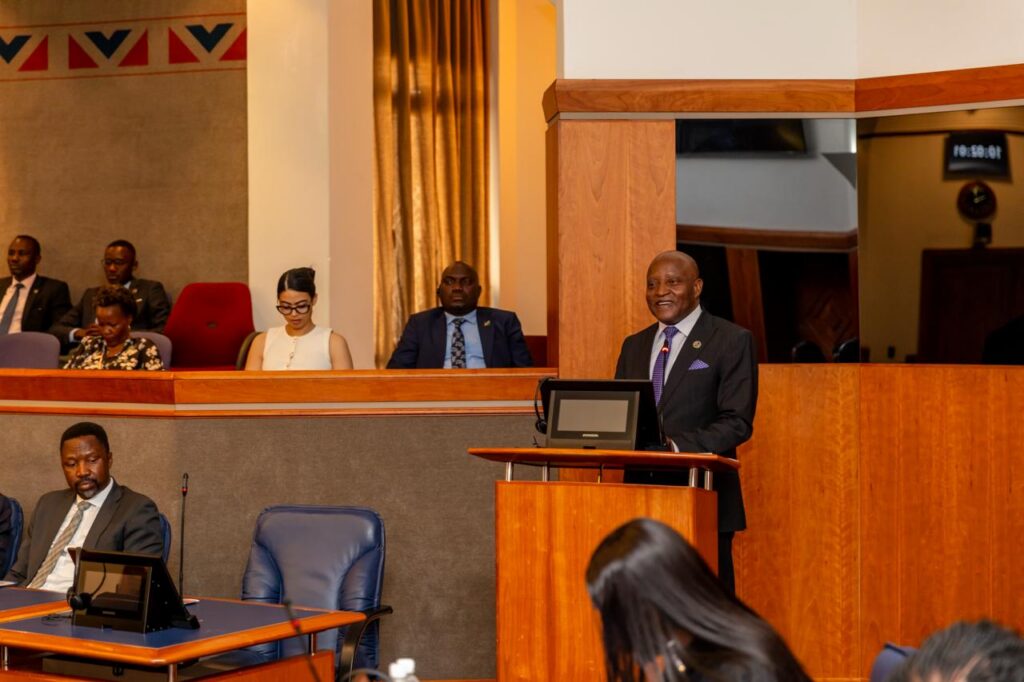
National Council Chamber, 31 August 2026
Keynote address by the Right Honourable Dr Tjitunga Elijah Ngurare, Prime Minister of the Republic of Namibia.
Chairperson of the National Council, Honourable Lukas Sinimbo Muha;
Honourable Members of the National Council here present;
Ms Toshiko Takahashi, Deputy Country Representative for UNICEF Namibia;
Secretary to the National Council, Advocate Tousy Namiseb;
Honourable Members of the 4th Junior National Council;
Distinguished Guests;
Members of the Media;
Ladies and Gentlemen;
Good Morning!
- I am very happy to join my Honourable youth today, as we open the 1st Session of the 4th Junior National Council.
- Right at the onset, I want to thank the Honourable Chairperson of the National Council for the invitation to address this important gathering.
- More importantly, I congratulate each of you, the young Honourable Members who have travelled from our fourteen regions to take a seat in this Chamber.
- Today, you are not visitors to Parliament. For the duration of this Session, you are participants in our parliamentary democracy. You have been entrusted with the responsibility to deliberate, to listen, to disagree respectfully, to seek common ground and, ultimately, to articulate the hopes and concerns of young Namibians. That is not a small responsibility.
- The Chamber in which you sit is a place where ideas are tested, where competing interests must be reconciled and where decisions affecting the lives of our people are subjected to democratic scrutiny.
- The Junior National Council is a project that affirms an important principle, that democracy is strengthened when young people are not only spoken about, but are given meaningful opportunities to speak for themselves.
Honourable Members,
- You belong to a generation that will inherit the Namibia that we are building today. But I want to challenge the idea that young people must simply wait to inherit the future. You are citizens of Namibia now.
- The challenges facing our country affect you now. The quality of our schools affects you now. The availability of opportunities affects you now. Climate change affects you now. Access to clean water and dignified sanitation affects children and communities now.
- It therefore follows that your ideas, your experiences and your voices must also matter now. This is why initiatives such as the Junior National Council are important. They allow young Namibians to experience democracy not simply as something described in textbooks, but as something practised.
- And democracy requires more than voting. It requires informed citizens. It requires people who can listen to views different from their own. It requires leaders who understand that public office is not a privilege to be enjoyed, but a responsibility to be discharged.
- During this Session, you will learn parliamentary procedure. You will debate. You will formulate arguments and respond to opposing views. But beyond those formal skills, I hope you will learn one of the most important lessons of leadership, that leadership begins with listening.
Listen to one another.
- Listen to the realities represented by the fourteen regions gathered in this Chamber. And when you return home, continue listening to the communities from which you come. Because the best public policy begins with understanding how people actually live.
- This year’s theme, “Towards Universal Access to Water, Sanitation, and Hygiene for Every Namibian Child,” speaks directly to one of the most fundamental questions of human dignity and national development.
- Water is life. Yet the importance of water goes beyond survival. A child needs clean water to drink. A learner needs safe sanitation at school. A family needs water to prepare food and maintain hygiene. A girl should never have to miss school because adequate sanitation facilities are unavailable. A community should not have to choose between travelling long distances for water and attending to education, work or family responsibilities.
- When access to water, sanitation and hygiene is inadequate, the consequences extend far beyond inconvenience. They affect health. They affect education. They affect dignity. They affect gender equality. They affect economic opportunity. And, ultimately, they affect the future of a Namibian child.
- For this reason, our discussion about Water, Sanitation, and Hygiene cannot be reduced only to pipes, boreholes, reservoirs or toilets, important as that infrastructure undoubtedly is. It is fundamentally a discussion about the kind of society we want to build.
- It asks whether the circumstances into which a Namibian child is born should determine whether that child enjoys the basic conditions necessary to live, learn and develop with dignity. Our answer must be unmistakably clear: it should not.
- This commitment is firmly reflected in our Sixth National Development Plan, NDP6, which is the final five-year national development plan towards the realization of Vision 2030. Under its pillar on Human Development and Community Resilience, NDP6 identifies improved access to potable water and sanitation as a national development priority.
- It sets concrete targets: by 2030, we aim to increase household access to potable water from 90.75 per cent to 94.8 per cent, and access to basic sanitation from 57.15 per cent to 64.2 per cent. To achieve this, we as the Government has committed to expanding water-supply infrastructure in urban, peri-urban and rural communities; scaling up sanitation coverage; strengthening coordination across the Water, Sanitation, and Hygiene sector; promoting sanitation and hygiene; and ensuring that water remains affordable for poor and vulnerable households.
- These are not simply statistics or targets contained in a national plan. Behind every percentage is a child, a household and a community whose quality of life must improve. That is why the theme you will deliberate upon during this Junior National Council is not separate from Namibia’s national development agenda; it places you directly within one of the important development conversations our country must resolve as we approach 2030.
- Whether a child grows up in an urban centre, an informal settlement, a village, on a farm or in a remote community, that child is equally Namibian and equally deserving of dignity, opportunity and protection.
- Universal access therefore means exactly that: we must continue working towards a Namibia in which geography, household circumstances and socio-economic status do not determine whether a child has access to safe water, sanitation and hygiene.
Honourable Junior Members,
- Since Independence, we have made significant progress in expanding public services and improving the lives of our people. But responsible leadership requires us to acknowledge that important gaps remain.
- There are still communities where reliable access to safe water is difficult. There are schools and households where sanitation infrastructure remains inadequate. There are areas where distance, drought, infrastructure constraints and population growth place pressure on available water resources.
- These realities are particularly significant in a country such as ours, where water is scarce and where climate variability increasingly tests the resilience of our communities.
- Government therefore carries a continuing responsibility to plan, invest and implement with urgency. But achieving universal access will require more than Government acting alone.
- It requires cooperation among national Government, regional councils, local authorities, communities, development partners, the private sector and civil society. It requires investment in infrastructure, but equally in maintenance, innovation, conservation and responsible use.
- And it requires us to think beyond the immediate problem. We must ask not only: How do we provide water today? We must also ask: How do we secure water for tomorrow? How do we make our communities more resilient to drought? How do we reduce unnecessary water losses? How do we deploy technology and innovation more effectively?
- How do we ensure that sanitation systems are appropriate for the different realities of our country? How do we educate communities about hygiene and responsible water use?
- And importantly for this gathering: what ideas can young Namibians bring to these questions? I encourage you during this Session not to approach the theme merely as a problem that somebody else must solve. Approach it as young leaders and problem-solvers.
- Some of the solutions Namibia will require over the coming decades may emerge from people sitting in this Chamber today. Perhaps one of you will become an engineer who develops more efficient water systems. Perhaps another will become a scientist working on water purification or climate resilience.
- One of you may become a teacher who transforms hygiene practices in a community. Another may become an entrepreneur who develops an affordable sanitation solution. Some of you may become councillors, parliamentarians, public servants, lawyers, doctors, farmers or community leaders.
- The professions may differ, but the responsibility of citizenship remains the same. You do not need to hold political office to contribute to nation-building. You need curiosity. You need courage. You need discipline. And you need a willingness to use whatever knowledge and opportunities you acquire in service of something larger than yourself.
- Our country needs young people who do not only identify what is wrong, but who are prepared to help imagine what can be done differently. That is the spirit I hope will define your deliberations this week. As you occupy these seats, I also invite you to reflect on the meaning of leadership.
- Leadership is often associated with titles, positions and authority. But titles alone do not make leaders. Leadership is service. It is the willingness to accept responsibility when responsibility is difficult. It is the courage to make decisions in the public interest. It is integrity when nobody is watching.
- It is recognising that the power entrusted to you belongs ultimately to the people you serve. And it is understanding that no leader knows everything. A good leader listens. A good leader reads. A good leader asks questions. A good leader is willing to change course when evidence demonstrates that another approach is better. Those habits can begin here.
- When another Member speaks, listen not merely so that you can respond, but so that you can understand. When you disagree, challenge the argument without diminishing the person. When you rise to speak, remember that confidence is most powerful when accompanied by knowledge. And when you make a proposal, ask yourself a simple question: Whose life will this improve? That question should remain at the heart of public service.
- The presence of delegates from all fourteen regions is particularly important. You come from different communities and different circumstances. The challenges experienced in Kunene may not be identical to those experienced in Zambezi. The realities of //Kharas may differ from those of Ohangwena. The experiences of young people in Erongo may differ from those in Kavango East, Omaheke or the Khomas Region.
- Yet each of those experiences forms part of one national story. Use this opportunity to learn from one another. A national institution such as Parliament teaches us that Namibia cannot be understood from only one village, one town, one constituency or one region.
- Our national solutions must be informed by the diversity of our national experience. That is particularly true when we discuss water and sanitation. A solution that works in one community may not necessarily work in another. Good policy must therefore be responsive to local realities while remaining anchored in our shared national commitment that no Namibian child should be left behind.
Honourable Junior Members,
- When this Session concludes, I hope the experience does not remain within these walls. Take it back to your schools. Take it back to your families. Take it back to your communities. Speak about the importance of conserving water. Speak about sanitation and hygiene without embarrassment or stigma. Encourage other young people to take an interest in public affairs.
- And, most importantly, demonstrate through your own conduct that citizenship carries both rights and responsibilities. The Namibia we want will not be built by Government alone. It will be built in classrooms and communities. It will be built by parents and teachers. It will be built by entrepreneurs and workers. It will be built by public servants and elected representatives. And it will be built by young Namibians who decide that they are not too young to contribute.
- As I conclude, allow me to leave you with this thought. The true value of this Junior National Council will not be measured only by how well you speak in this Chamber. It will be measured by what this experience awakens in you. May it awaken an interest in the affairs of your country. May it strengthen your confidence to participate. May it deepen your respect for democratic institutions. May it teach you that disagreement need not become division. And may it remind you that leadership is ultimately about improving the lives of others.
- I encourage you to be ambitious. Imagine a Namibia where every child can turn on a tap and access safe water. Imagine a generation that understands that our scarce water resources must be protected and used responsibly. Then go further than imagining it. Debate how we can build it. Challenge one another to propose solutions. Ask difficult questions. And allow the diversity represented in this Chamber to produce ideas worthy of the Namibia we all seek to build.
- To the Honourable Chairperson and Members of the National Council, I commend you for continuing to create platforms through which our young people can experience and participate in parliamentary democracy.
- To the parents, teachers, officials and all those who have supported these young delegates, I thank you for investing in their development. And to the Honourable Junior Members of the 4th Junior National Council: participate fully. Speak courageously. Listen carefully. Learn from one another. And never underestimate your capacity to contribute to your country.
- The future is not a distant destination that will one day be handed to you. The future of Namibia is being shaped by the choices we make today, and you already have a place in shaping it.
- It is therefore my distinct honour and privilege to declare the 1st Session of the 4th Junior National Council officially open. I wish you fruitful, thoughtful and spirited deliberations.
I thank you.