

Some of the world’s classic dishes are named after the pot or pan they are cooked in. Such dishes include: paella, tagine, sač, cataplana, pancake and nabemono. The latter originated in Japan and refers to ‘all things cooked in a nabe’ (pot). One famous version is chanko nabe or ‘Sumo stew’.
Our own potjiekos is another such dish; and it goes even further. Potjie also denotes the social event that brings friends and relatives together to socialise during the time it takes to cook the potjie.
The invitation to the get together often says: ‘Let’s make a potjie’ or ‘let’s have a potjie’. The potjie is a proper social gathering. Potjies can take an entire day to cook properly; low and slow is the way to go.
Most households in this country would most likely have one or more potjies; and although I have no statistics of how many potjies exist in Namibia – someone please collect that data – I am willing to bet good money that the household-to-potjie ratio is significant.
Of course the potjie, especially the three-legged variety, is now a feature in many southern African kitchens. This is not surprising; these pots are robust and durable, practical and versatile, and quite heat-efficient when used to cook outdoors over an open fire. In all respects it is the ideal cooking utensil for our part of the world.
But have your ever wondered where our beloved cast iron potjie come from? If we can agree that without the potjie, there would not have been potjiekos, then we have to trace the origins of the potjie to find the origins of the dish.
The use of the English word ‘pot’ dates back to about 1180, but the use of cast iron cookware predates that significantly. The Dutch dish hutspot is the direct ancestor of our potjiekos. Hutspot originated during the war between Spain and the Netherlands (1566 to 1648). During the siege of Leyden and the resultant food shortage, people contributed food to be cooked in large communal pots. People added whatever ingredients they had, and everyone enjoyed the hutspot. Hutspot is still cooked to this day to commemorate the Siege of Leiden.
Not long after the invention of the hutspot, Jan van Riebeeck set sail for the Far East and reached the cape of Good Hope in April 1652. These early European settlers brought the cast iron potjie (and also the hutspot) with them. They also baked bread in them, which led to the name Dutch oven still being used to describe cast iron pots in the USA.
The original potjies were hung from hooks over open fires and were small enough to be taken on trips inland to explore the Cape Colony. The indigenous population came into contact with the cast iron pot and that soon replaced their clay pots. As more and more groups left the Cape Colony to move inland, the potjie became more popular and more people came into contact with it. For some, like the Voortrekkers, the potjie was an entire kitchen, and all meals were cooked in it. It was ideal for the outdoor-over-open-fire cooking style of the frontier culture where cookware had to be strong and durable enough to survive the rough, long journeys.
Today many people still use the traditional, three-legged potjie to cook at least part of their daily meals in. They have little other option.
For others the stove, and modern pots and pans made from lighter materials, have for most part replaced the potjie. For these more affluent people, potjies and potjiekos became a nostalgic affair; a modest yearning back to the time when the frontier was wild and rough.
For nearly 70 years Falkirk was the sole manufacturer of potjies in Southern Africa. These days the pots are made in China.
Potjies consist of iron (95%), carbon (3,5%) and silicone (1,5%). Its shape is deliberate. The round belly keeps liquid at the bottom of the pot and allows for the even distribution of heat, which makes for more efficient cooking.
Modern pots no longer require elaborate ‘seasoning’ before use. A thorough cleaning with soap and water before sealing it with oil is all that is required. If you regularly cook over an open flame, and want to avoid heavy soot on the outside, try covering the pot with a thin spread of dishwashing liquid before using it. Once you have finished cooking and the pot has cooled down, it will make it easy to rinse off the soot.
Potjies accumulate their unique taste over time, and if properly maintained it should last a lifetime.
Potjies come in different sizes and each size is represented by a unique number. It starts with ¼ (0,7 liters), ½ (1,2 liters), ¾ (2,7 liters) and goes right up to a size 25 (70,5 liters). Sizes three and four are most common and feed between six and eight people as a main meal without side dishes.
To make a rough calculation of how many people each pot will feed, it is suggested that the size of the (e.g. three or four) is multiplied with the number of rings on the pot. For example, if the pot is a number three and has four rings, then it should feed about 12 people when filled up. If you have a smaller group of say six people, then the pot should be filled only to the second ring.
Traditionally, potjies have been made with tough cuts of meat, but anything goes really: Chicken, fish or vegetarian potjies are not uncommon.
The potjie is assembled in layers. The protein is first seared, then seasoned with aromatics such as garlic and onions and spices. A little liquid is added, before the next layer – usually the hard vegetables that take the longest time to cook – is added. The final layer of softer vegetables that require much less cooking is added on top (usually at a later stage) before the lid is closed and the food is simmered and steamed until it is done. This could take a few hours, and potjie connoisseurs recommend that the food should be left alone, and the pot not be stirred.
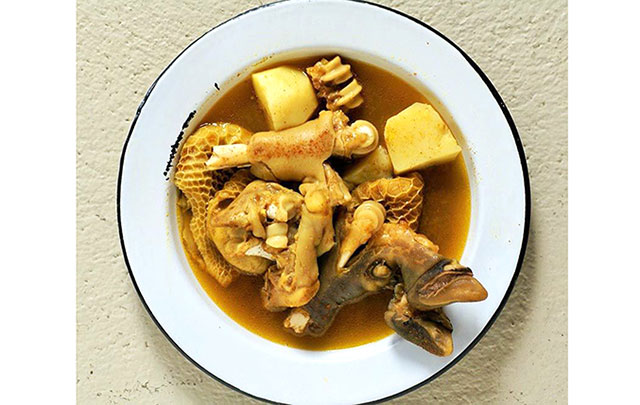
• 1 kg cleaned sheep’s tripe
• 4 lamb trotters
• 4 onions, finely chopped
• 6 to 8 garlic cloves, peeled and finely grated
• 2 tablespoons vinegar
• 1 teaspoon sugar
• 2 teaspoons turmeric
• 2 tablespoons mother-in-law curry powder, (or more to taste)
