







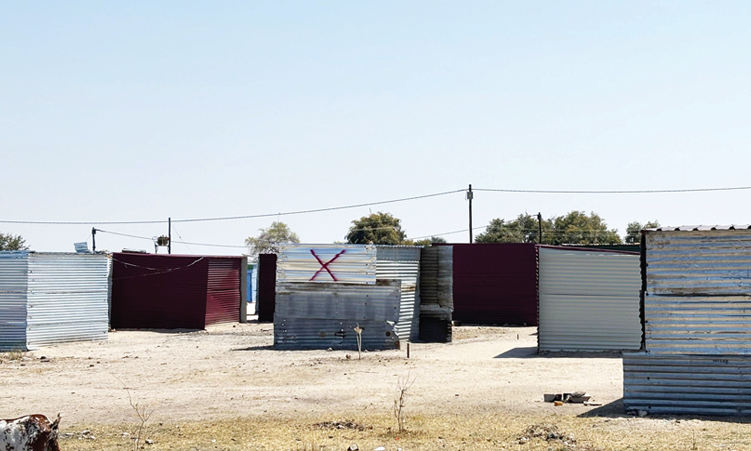
Around 112 shacks at Oshakati’s Onawa Extension 7 face demolition after the town council allegedly gave households 14 days to vacate the municipal land.
The affected residents, some of whom said they had lived in the area for only four months, are preparing to submit a petition to the Oshakati Town Council, appealing against their removal. The residents are estimated to be around 300 individuals.
In the petition, the residents are asking the council to take into account their social and economic circumstances before proceeding with the eviction.
They say removing them would leave some families without shelter. The families have allegedly been given until 28 September to vacate the area.
“We did not construct and occupy these structures because we wanted to disrespect the law or the authority of the Oshakati Town Council. We did so because we are poor, unemployed and unable to afford formal rental accommodation,” the residents say in the petition.
They say some of them survive on temporary jobs and daily hustles, with the little income they earn largely spent on food and supporting their children and other family members.
The residents say they are occupying the municipal land because they need somewhere to live and protect their families.
“For people without permanent employment, finding affordable accommodation has become extremely difficult. When families cannot afford rent, they are forced to find alternative ways of keeping their children safe and sheltered,” the petition reads.
The group is asking the council to reconsider the eviction and engage with them on possible alternatives.
They argue that the situation is rooted in poverty, unemployment and a shortage of affordable housing opportunities.
The residents also question why their structures are being targeted after only a few months when other informal settlements at Oshakati have existed for years.
“What specific circumstances have triggered the decision to remove our structures after only four months? If other informal settlements have remained for years, is it fair and reasonable to remove our structures within 14 days without first providing us with a realistic alternative?” they ask.
The residents further want the council to clarify where they are expected to go if they are removed from the area.
They say they had not been given a clear alternative and fear that eviction would leave vulnerable families homeless.
A visit to the affected area yesterday found that some of the shacks had been marked with large red crosses, while others had numbers written on them.
The markings have heightened anxiety among residents, who fear that demolition could be imminent.
Some residents yesterday said if they were evicted without being provided with alternative land, they would have no option but to camp at the Oshakati mayor’s home.
‘ILLEGAL’
Oshakati Town Council spokesperson Martin Kapuka says the council has instructed the occupants of about 112 unauthorised structures at Onawa Extension 7 to vacate the illegally occupied land and remove their structures.
He says the occupation is unlawful and was undertaken without the council’s approval.
“The occupants were given until 28 September 2026 to comply with the notices. This followed previous written warnings and engagements, including a meeting held with the affected persons on Saturday, 12 September 2026. Failure to comply may result in council pursuing appropriate legal action,” Kapuka says.
He says the council will not allocate the illegally occupied land to the affected group merely because they have occupied it without approval.
“All land allocations must follow council’s approved procedures and requirements. The numbering of the structures was conducted solely for identification and administrative purposes and did not constitute an allocation or regularisation of the illegal occupation,” he says.
Kapuka says Onawa Extension 7 is a primary reception area the council has formalised in an effort to eradicate informal settlements and promote orderly development.
“The unauthorised occupation of land in this area has undermined and delayed these efforts,” he says.
Kapuka says the town council’s records indicate that many of the affected individuals had previously benefited from land allocations.
In some cases, allocated plots were sold or transferred outside the approved procedures, after which the individuals concerned occupied additional land without authorisation, he says.
He says such conduct is unlawful and unfair to applicants who follow the prescribed procedures and wait to be allocated land.
“The council cannot reward illegal land occupation or the deliberate circumvention of its procedures, as doing so would encourage further land grabbing and derail efforts to address informal settlements fairly, systematically and sustainably.”