



Namibian perceptions on media freedom (2024)
According to Reporters Without Borders, Namibia is one of only three African countries ranked among the world’s top 30 for media freedom, alongside South Africa and Cape Verde.
Following a sharp decline in 2024, when Namibia’s press freedom score fell from 80.91 in 2023 to 74.16 and its global ranking dropped by 12 places, the country regained some ground in 2025 with a modest improvement to 75.35, placing it back within the top 30.
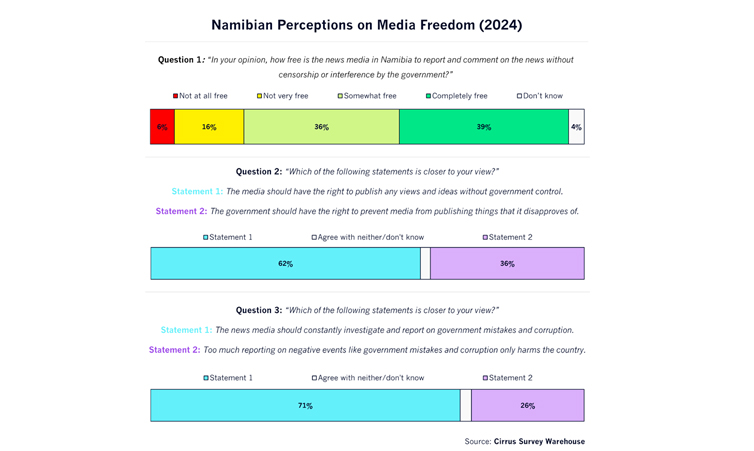
When Namibians were asked about their perceptions of media freedom in the 2024 Afrobarometer survey, four in 10 said the news media is ‘completely free’ to report and comment without censorship or government interference, with a further 36% considering it ‘somewhat free’.
Younger and urban respondents were more likely to view the media as constrained by government influence, whereas those aged 56 and above expressed greater confidence in a fully free press.
Reporters Without Borders notes the media’s role in strengthening Africa’s democratic trajectory and enhancing public sector accountability by exposing political and economic issues, as well as government malpractice. Yet in recent years, political uncertainty and growing pressures have threatened press freedom across the continent.
In Namibia, 62% of respondents believe the media should have the unrestricted right to publish any views and ideas, with support broadly consistent across age groups and regions. Respondents with tertiary education, however, are significantly more likely to support a free press.
More than 70% of Namibians believe the media should actively investigate and report on government mistakes and corruption, though a quarter think that excessive focus on such reporting harms the country. Rural residents and older respondents are especially inclined to see critical reporting as damaging.
Reporters Without Borders further observes that Namibian media outlets are “sometimes attacked by ministers who accuse them of being too negative in their reporting, which can sometimes lead to personal intimidation”.
A free press in a democracy enables competition of ideas and strengthens civic participation. At the same time, an unethical press can undermine democratic stability.
Both journalists and governments, therefore, share a responsibility to safeguard media freedom and guarantee the public’s right to information.
– Tannan Groenewald is the head of data and analytics at Cirrus Capital.