



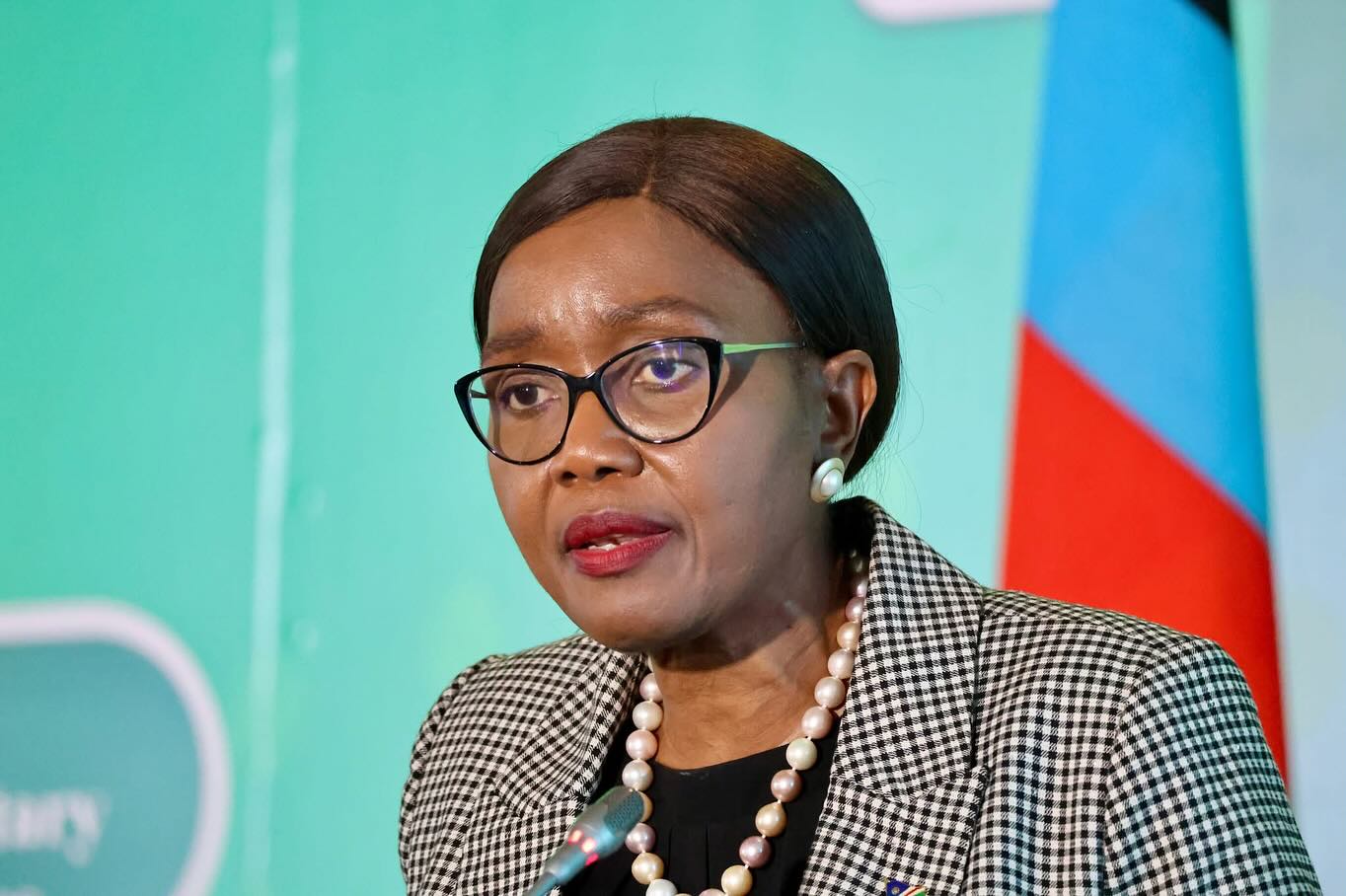
Saara Kuugongelwa-Amadhila, speaker of the National Assembly, at the Seaside Hotel, Swakopmund, 16 July 2025
It is such an honour for me to be invited to speak at this auspicious occasion, which promotes women in politics and decision-making roles, organised by the Ministry of Gender Equality and Child Welfare, in collaboration with the International Institute for Democracy and Electoral Assistance (Idea).
The objectives of this roundtable include strengthening the capacity of women in understanding democratic processes and the role of women in leadership and decision-making through transformative social gender norms, as well as enhancing the understanding and knowledge of women parliamentarians through peer-to-peer learning and the sharing of good practices.
I am informed that this engagement will also provide women parliamentarians with opportunities for mentorship and coaching, among others.
Your role as women in decision-making at your party levels, as well as those who are lawmakers in parliament and in society in general, is to create a conducive environment for women’s participation in the political space to thrive, and to mobilise women to optimise their contribution to society.
The participation of women in the management of all aspects of societal affairs is not only important for inclusivity – which is necessary for fairness and justice – but also ensures that society fully deploys the talents and energies of all its people towards development and prosperity for all.
Therefore, when women are appointed to public positions, this is not a favour done to them, or only a matter of justice for them, but also a recognition of the tremendous value that women bring to society. This value is evident at the level of homes and families, where they are compassionate and resilient caregivers – and must be harnessed for the common good of communities, nations and the world.
The UN Convention on the Elimination of All Forms of Discrimination Against Women (Cedaw) is a comprehensive instrument to address women’s human rights. By ratifying Cedaw, countries like ours have embraced the obligation to eradicate all forms of discrimination against women by adopting measures to respect, protect and fulfil all of the rights contained in Cedaw at the national level as stipulated in Articles 1 and 2. Article 7 is particularly relevant to the rights of women to political participation, including their right to vote, the right to be elected to public office, and the right to fully participate in the public functions and service of their countries.
The principles of the right to equality and the prohibition of discrimination – which are the basis of gender equality and women’s political participation and representation – are enshrined in the United Nations Charter, which reaffirms faith in fundamental human rights, in the dignity and worth of the human person, and in the equal rights of men and women.
Furthermore, Articles 1 and 2 of the Universal Declaration of Human Rights (UDHR), which form the basis of bills of rights, also enshrine the entitlement of all persons to non-discrimination, including on the basis of sex. Article 10 of the Namibian Constitution speaks to equality and freedom from discrimination.
Women’s political participation and representation is not only a fundamental human right, but is indispensable for democracy and sustainable development. Women are not only entitled to participate and represent themselves in processes and institutions where decisions that affect our lives are made – they are also entitled to all the rights and protections that are guaranteed under our laws and international conventions, including the right to dignity, the right to reproductive health, the right to education and to practise their professions, the right to justice, to participate in the economy, and to protection from violence – including gender-based violence at home, in the workplace, and in society in general.
Women’s representation in the 8th parliament of Namibia is currently at 38% in the National Assembly and 14% in the National Council. During the 7th parliament, women in the National Assembly stood at 50%. The emphasis should be to grow upwards and not downwards. There is, therefore, a need for more to be done to preserve our achievements and further build upon them.
Apart from numerical strength, women have been occupying strategic positions in Cabinet and parliament. We must ensure that this representation is impactful in terms of the influence it brings to policy and law-making, and to the transformation of society.
Women constitute half of the world population. Women’s participation in leadership is therefore critical for development and prosperity, as it ensures that political agendas and development policies prioritise issues that are of strategic interest to women, children and the girl child, and that development is inclusive. Empowering women and men is not a zero-sum game. Gender equity and equality is not about prospering women at the expense of men – it is about justice and prosperity.
As speaker of the National Assembly, I look forward to continued collaboration with the female and male members of parliament and the Ministry of Gender Equality and Child Welfare on efforts relating to capacity-building for women – but more importantly, to set up and/or strengthen structures, systems and policies to enhance the participation of both women and men in decision-making at all levels.
Currently, women in parliament are benefiting from efforts in empowering women at different regional and international parliamentary fora such as the Southern African Development Community Parliamentary Forum (SADC PF), the Inter-Parliamentary Union (IPU), and the Commonwealth Parliamentary Association (CPA).
I look forward to the establishment of the Women’s Parliamentary Caucus, which will serve as a platform where women can continuously develop skills – individually and collectively – and coordinate efforts to influence the legislative processes where women, children and family issues are progressively addressed
As women, we face many challenges. This requires that we are conscious of the issues affecting women and gender equality in society, and of how to work with other women and also with men to transform society positively. The enactment and amendment of laws must be extended to include the prohibition of cyberbullying and deepfakes, which must urgently be addressed as they undermine women’s confidence and progress in leadership.
I was informed that one of the key outcomes of this workshop is to share the experiences of women parliamentarians, and how we can inspire transformative leadership and decision-making at all levels.
I hope that through our continuous efforts of creating platforms for women, you will draw inspiration to take up positions in the political and public space and to be impactful.
The core, game-changing promise of Agenda 2030 for Sustainable Development and its Sustainable Development Goals (SDGs) is to “leave no one behind”. Therefore, attaining gender equality and empowering all women and girls, as outlined in SDG 5, is essential to promoting sustainable development and representative democracies in both individual nations and the global community.
SDG 5 outlines the necessary group efforts to bring about change and establish conditions that lead to real equality for all women and girls.
It is essential to address the major causes of gender inequality – such as violence against women and girls, uneven access to education, and gender-based discrimination in law and practice – in order to take on the challenge of bringing SDG 5 to life for women and girls worldwide.
The issue is not whether women are capable of performing an active role in development, democracy and peacebuilding. The complexity lies in uncovering and redressing the entrenched systemic discrimination and marginalisation of women and girls in order to translate women’s participation into critical influence and decision-making in development and democracy-building, because they have always contributed and are currently contributing at all levels in both the private and public spheres.
Namibia is a great country. This is our country – we need to take hands, pull together in one direction and pave the way for generations to come. If we work hard – both men and women – Namibia shall continue to prosper and overcome these challenges.
Having said this, director of ceremonies, it is now my distinct honour to declare this workshop on women in politics and decision-making officially open.
I wish you constructive deliberations.