



• Who’s in charge debate take centre stage at parastatal forum
• ‘Remember, I am your minister’ – Hangala says young ministers are bossing CEOs.
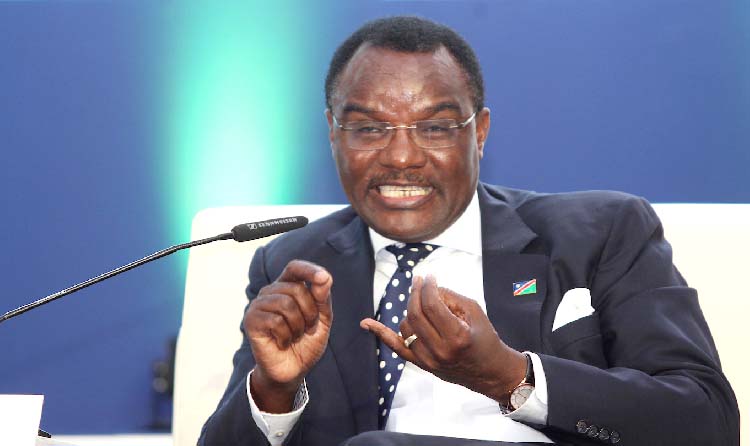
Businessman Leake Hangala says Namibia’s new Cabinet ministers are young, brilliant and well-educated, but they often remind board chairpersons or parastatal leaders who is in charge.
Hangala, who chairs the Namibia University of Science and Technology council, made the accusation in the presence of president Netumbo Nandi-Ndaitwah at a breakfast with public enterprise chief executives yesterday.
“When a chairperson goes there, the first thing the minister tells you is: remember, I am your minister. I am a Cabinet minister. I don’t need to be told that,” he said.
Hangala said Namibia has young, dynamic, good and brilliant ministers.
“At the beginning the discussions were not constructive,” he said.
He said this is because of personalities, citing the importance of creating institutions that do not depend necessarily on personalities.
He acknowledged the role line ministers play in the public enterprises but what he wants is for all parties to elevate the public entities.
Approached for further clarity by The Namibian yesterday, Hangala explained that sometimes personality clashes come into the line of doing business and it can contaminate discussions, adding that during his time in the 1990s, personalities were different but things worked.
Hangala said a holistic review of challenges faced by public enterprises must be taken to prescribe a prescription that would cure the disease.
He said the public enterprise forum must also have the courage to change what no longer works and align themselves with changing times.
“There is nothing more dangerous than a medical doctor prescribing wrong medicines and that analogy cuts across the stream of the public and the economy.
“We all know many public enterprises are facing structural, governance and strategic challenges, “ he said.
He said difficult discussion must be held to analyse if all the public enterprises created 36 years ago are still needed and whether it is necessary for them to be styled in the manner they are now.
Financial challenges also contribute to the ability of some public enterprises to grow to meet growing service delivery demands.
“If there is one factor that we have been struggling with and that will ultimately determine the success or failure of our public enterprises, it is governance,” he said.
Hangala said sustainable institutions are built on effective governance systems that provide strategic direction, accountability, ethical leadership, transparency and prudent stewardship of public resources.
In response to Hangala concerns, Nandi-Ndaitwah says: “The way you put it, it is necessary to make the reforms because if the issue is personal whereby we are saying we have this young minister who can tell people I am your minister.
“Those young ministers are going to be there. Imagine now putting all the state-owned enterprises under this one young minister. What is going to happen?” the president asks.
She says the current Public Enterprise Governance Act (Pega) amendment bill under discussion in the National assembly seeks to address all these shortcoming as the previous act did not fulfill the desired outcomes.
Pega, passed in 2019, provides rules for the governance, restructuring and monitoring for the country’s 77 state-owned enterprises.
She says it’s best to have the state-owned enterprises (SOEs) where they are now and overhaul them to bring them under the Office of the Prime Minister once the Pega bill is passed, while day-to-day affairs of the SOEs will remain under their respective line ministries.
Former finance minister Carl-Hermann Schlettwein says if ministers override the boards of state-owned enterprises, then there is little purpose in having boards at all.
“If that is the case, then you don’t need a board. It would be completely unlawful,” he says.
Schlettwein told The Namibian yesterday that the law provides that boards, not ministers, are responsible for overseeing chief executives.
“They are accountable to their boards, and the board is then accountable to the minister. So it is uncalled for to have a direct interface between the ministers and the chief executives. It’s not foreseen in the law that I remember,” he said.
He said ministers appoint boards, which are then held accountable through performance agreements.
“That’s why there are boards.
The boards are accountable, and they are appointed by the minister.
There are supposed to be performance contracts between the board and the minister.
It is according to those targets and objectives in the performance agreements that their performance is measured.
The minister should react to that non-performance or good performance, whatever the case may be,” he said.
Schlettwein warned that ministers who bypass boards, undermine the governance structure of public enterprises.
“If a minister says, ‘Do as I say,’ then actually the board would be redundant, which would be a very untenable situation,” he said.
He notes that many SOEs are registered as public companies and are legally required to have boards, making it important that ministers respect the roles assigned by law.
Finance minister Ericah Shafudah says titles are temporary and there’s no need to remind others that she is a minister.
She calls for collaboration.
As a collective, the Cabinet agreed to establish an agency that will be responsible for managing public assets.