


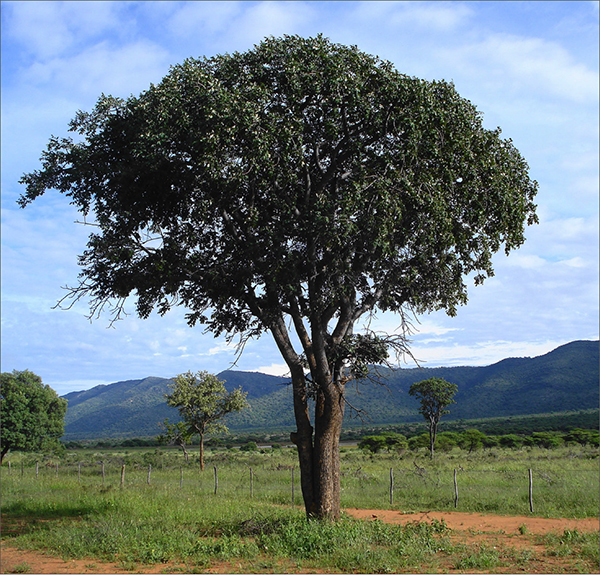
• LUISE HOFFMANN DURING windy weather in summer the silvery-white shimmering undersides of the leaves of this tree attract attention while in autumn they turn a rich russet red.
During the dry season the fairly thick, very upright branches ending in a blunt point are quite noticeable. This tree is confined to the Karstveld and isolated occurrences in West Caprivi and along the Linyanti and Chobe.
Names: G. Baumtraube; A. Dikbas, klein maroela, bakhout; H. & G. omundjimune, omunyamuna.
The scientific name Lannea is derived from the Latin word “lana” meaning ‘wool’ and probably refers to the woolly hairs on young growth of these trees. The specific name discolour means ‘bi-coloured’, describing the leaves, which are dark green above and silvery-white below.
The tree on the photo grows along the D2820, the district road parallel to the B8 between Otavi and Kombat. More live-longs are visible from the B8 near Uchab.
The trunk of the live-long may fork fairly low down but this tree typically grows very upright, reaching a height of up to 15 metres. The twigs are also borne quite erect. The straight trunk is covered with rough, dark grey bark, the underbark is red and young branches are velvety brown-green to red-brown.
Borne on long furry leaf stalks, the coarsely divided leaves are quite variable. When young, they are soft, pink and furry; older leaves are smooth dark green above and silvery grey below due to tiny velvety hairs on the underside.
Greenish-yellow, sweetly scented flowers are crowded at the ends of short, densely hairy branches, male and female flowers on different trees. They appear in September/October before the new leaves.
The fruits are similar in shape to those of the marula tree, hence the Afrikaans common name. However, they are only about 10 mm long and reddish to purple-black when ripe. The thin layer of flesh enclosing the stone tastes grape-like according to some sources and is tasteless according to others; nevertheless it is popular with humans, monkeys, baboons, elephant and kudu.
The skin should not be eaten. The fruit is therefore traditionally pressed between two fingers and popped directly into the mouth.
The soft light wood does not crack easily and is used for carving plates and bowls, hence the Afrikaans common name “bakhout” meaning ‘bowl-wood’. It is also used for pounding blocks. Being light, it serves as floats on fishing nets. Twine or string may be made from the inner bark. When tapped carefully, the bark of a straight section of a branch can be slipped off in one piece to be used as a blow gun as is commonly done by children in Zimbabwe.
The bark and the roots of the live-long are used to treat various ailments from fever to constipation, particularly in children.
Propagation: The name ‘live-long’ has its origin in the fact that fencing poles cut from this tree and stuck into the soil strike easily. The tree is therefore easily propagated by cuttings or truncheons.
The live-long does not grow as large as the marula tree. It would therefore be a lovely tree for smaller gardens and along roads where the varying colours of the leaves would mark the seasons and the fruit would attract birds.