


MEDICAL Aid Funds have been found to be discriminating against one of their two groups of members, by offering discount to members in groups who are then subsidised by individuals who are not part of a group.
This has resulted in individuals paying N$2 453 more than group members with the same risk profile.
This was revealed by the Namibia Financial Institution Supervisory Authority yesterday, as they called for the suspension of the discriminatory practice by Medical Aid Funds (MAF).
The non-banking financial institution regulator issued a notice on Government Gazette No.7224 that the practice of various MAFs was undesirable in terms of the Medical Aid Funds Act.
“Under section 4(9) of the Medical Aid Funds Act, I hereby declare the following practices by registered Medical Aid Funds as undesirable practices, which must be eliminated,” said Kenneth Matomola, Namfisa chief executive officer.
MAFs operate on the principle of shared risk and cross-subsidisation – meaning that the health risks of all the members in the fund – the young, the old, the healthy and the sick, should be shared equally.
Members (in groups and individuals) pool funds and MAFs safeguard the pool to be used to pay member claims and to ensure that all members are treated equally and fairly given their choice of benefit.
However, Namfisa revealed an undesirable practice in terms of discounts on contribution rates, loading of contribution rates, and differentiated contribution rates granted by medical aid funds to individual members, group members, and different sized groups.
The contribution rates charged to members classified as individuals and members who are part of participating employers are different despite that clients share health risk profiles.
“Members that join medical aid funds as individuals contribute higher rates than that paid by members that join a medical fund as groups,” Matomola said.
Furthermore, MAFs could previously offer members discount on rates, but on condition that the discounts were only granted to all members who had low and/or acceptable claim histories.
In return, the fund would obtain underwriting efficiencies from the lower healthcare claims.
However, Namfisa found that the funds are offering subscription discounts to members in a group (employer groups) and not to individual members.
“It is evident that the discounts are being granted by the funds in order to retain and attract the membership of the groups (e.g employer groups) to the great disadvantage of members that are not part of groups,” revealed Namfisa.
The regulator said the practice has created great disparities in the contributions by members.
“One individual pays a lower rate purely because they are part of a group (employer),” stated Namfisa.
Namfisa elaborated that “two members of the same age and the same health profile are currently on different contribution rates, because of their affiliation to a particular group”.
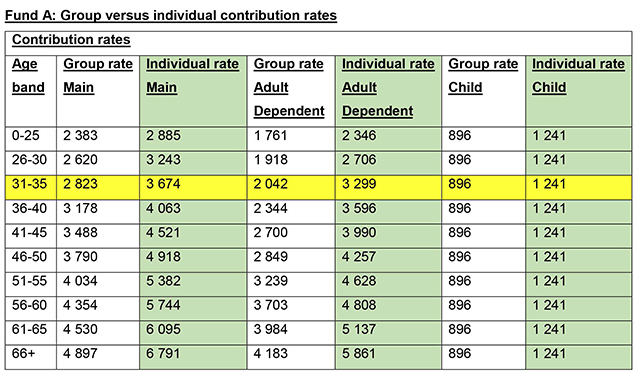
According to Namfisa, the unfairness level of discounts is clearly shown in different rates paid by an individual member aged 31-35 years and a group member of the same age and same health status.
An individual member of a medical aid fund will pay N$851 more than a member affiliated to a group.
If the two individuals enrol their spouse and a child as dependants, individuals cumulatively pay N$2 453 more than group members.
It is important to note that these two members have the same risk profile and the only reason for the disparity in contributions is their classification of the two individuals.
Furthermore, the discounts granted by the respective MAF to the group affiliated members are financed by all the other members of the fund who do not pay discounted rates.
“This means the contributions of members classified as individuals and all other groups that do not receive discounts include a mark-up that is used to pay for the discount given to groups that receive discounts,” Namfisa concluded.
The regulator explained that discriminatory discounts are granted in an unjust and inequitable manner, and they do not encourage responsible claims behaviour.
“This ultimately prejudices certain members of medical aid funds,” said Namfisa.
Matomolo explained that in their responses as the regulator, declaring an undesirable practice is aimed at addressing and eliminating the unjust and inequitable practice which prejudices some of the members of the funds.
Namfisa also directed the medical aid funds to stop by 1 January 2021 determining an individual’s contribution rate on the basis of the age of the oldest beneficiary and designate the said beneficiary as the principal member.
erastus@namibian.com.na