




WITH the progression into the digital age, society and culture are moving and evolving at a faster pace.
Although this has led to new challenges too, the Ovahimba and San people’s traditions have survived the odds despite persistent pressure from civilisation.
The Aawambo too have jumped on the wagon to preserve their culture as shown by celebrating the Olufuko festival, first revived in 2012 with founding President Sam Nujoma as its patron.
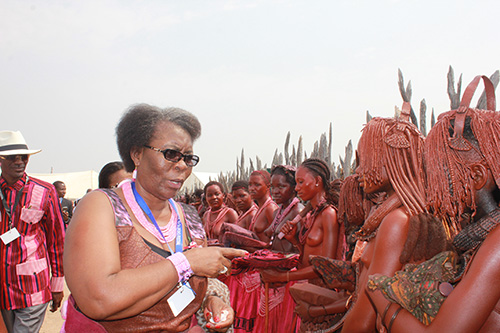
The Olufuko cultural festival endeavours to preserve cultural heritage, tradition and national pride, with over a hundred maidens ready to be initiated into adulthood.
This female initiation ceremony that young women between the ages of 13 and 20 and above go through in order to become mature and suitable for marriage was practised for generations back in the day.
Although the practice is said to have children from age 15 participating, others as young as 13 are also taking part. One such person is Kalipula Kominge, who is part of the Ovahimba ethnic group of about 50 000 people who live a nomadic life and are dependent on cattle, goats, other livestock, maize and veld food.
They live in Kunene region in north-western Namibia, largely isolated from modern society. One would argue that such a life has not benefited the closely-knit community.
As Kalipula pounds the mahangu, her body is covered in a red ointment made of animal fat-based powder and hematite. This ointment helps protect the Ovahimba from the heat of the sun, dry air, and insects which explained why they wear it all the time.
A fascinating simple truth is that the Ovahimba never bath. Instead, they have a cleaning ritual, which usually takes an hour or two. They start off cleaning themselves early in the morning by burning wild herbs and sit in the smoke. They also clean their leather outfits with the smoke. They believe it is healthy and makes them form a part of the beauty of nature.
When Kalipula grinds the mahangu, she uses a small rock crushing the grain against a bigger one. She eventually stands up to give a chance to the next maiden and silently joins the others in line.
The Namibian interviewed a few initiates as they were standing in procession waiting to be inspected by dignitaries and visitors in front of the homestead in which the initiation ritual is performed.
The main objectives of Olufuko are to inform, educate, entertain and enhance traditional cultural identity. The seven-day event of initiation rituals will be performed by women called Oonamunganga. These elderly women prepare the initiates for womanhood or possibly marriage.
No pregnant women are allowed to participate in the festival and the Oonamunganga (the overseer) see to it that participating maids are sexually inactive.
On Friday, most girls seemed more relaxed baring their chests as compared to the first day of the festival on Monday. One of the supervisors even had to remind some of the maidens to cover their faces with their ‘cow’s tail’ as per custom.
Although Olufuko is said to keep girls away from school, eighteen-year-old Gloria Kandapo says she will return to school to complete her electrical engineering degree at the Industrial Education and Training Institution in Cape Town.
Smiling broadly and exuding confidence, Gloria says she feels happy and proud to be part of Olufuko. She wants to keep her tradition alive and thus has followed her parents’ advice to take part in the initiation.
“It is good for the youth to enjoy tradition”, says Maria Petrus (19) from Elombo Combined School in Oshikoto. Although she says she decided to take part in the ritual herself without pressure from her parents, she does not sound convincing.
“ I have learned more about how to cook and to do things in the home”, she says about her experience during the initiation. Maria says her grandmother who also went through the ritual inspired her to do the same.
Ndapandula Jerobeam from Mariental is 16 years old. She is talkative and quite content to be the centre of attraction. Having seen Olufuko on TV has made her become interested in her tradition and to go through with the ritual, she tells the paper. “The girls looked so pretty and I just wanted to be part of that. I am not shy to show my breasts. I feel proud to wear (the traditional attire) like this,” she says smiling.
She tells The Namibian that the most important thing she has learned from the initiation is to respect herself and her elders. She encourages young girls to do the ritual, as it is part of their culture.
Rebecca Kandjekelela from Ongandjera at the age of 42 also decided to do the Olufuko initiation. Although she is probably the oldest of the maidens, she is surprisingly shy and only reluctantly shares her experience with The Namibian. When asked why she is only taking part now, she says that her mother was of the opinion that she should only do it once she is older and more mature to fully understand it. “ I felt I was too young when I was still in school, but now I feel I am ready for it”, she says, adding that she enjoyed learning about the traditional way of life and wishes others to do the same.
Marketing manager Luke Terrence (20) of Self Sealing Tyre Technology, a company based in Windhoek, which is exhibiting its product, tells The Namibian that Olufuko has lost its relevance. “They are just doing it for the show. I certainly would not encourage my daughter to partake in such an initiation”, he says. Terrence adds that his parents did not teach him much about cultural practices and that he has lost touch with that side of his heritage.
He expresses general disappointment with the festival, saying that his business did not enjoy the exposure he hoped for. “People are more interested in the food stands as opposed to anything else. We as a business will certainly not come back next year”, he says.
Mother of four Maria Ndaudako, who is the owner of the Likondjela project, who has been exhibiting traditional necklaces, bracelets, incense and other artifacts since the festival’s inception in 2012, says she is grateful to the Outapi Town Council for enabling her to showcase and promote her traditional merchandise to the nation. “Each year the visitors are becoming more and more and my business is also picking up”, a delighted Ndaudako says.
She tells The Namibian how proud she was when she participated in an Olufuko initiation at the age of 16 and remembers people saying that she was one of the prettiest brides in her time.
A woman working for Outapi Town Council who wished to remain anonymous tells The Namibian that most of the young girls at the initiation are not doing it out of their free will but due to pressure from their parents, even if they claim otherwise. “These girls are simply too young to fully understand the meaning of the ritual. They should first finish school”, she says. She further says that the initiation is like a passport for the girls to get pregnant and invites men to propose marriage even if the girls are not ready for it.
Nghipondoka says that since the inception of the festival in 2012, all previous brides continued with their education, and some have since graduated. She further says former maidens have testified that the initiation has strengthened their understanding of traditional chores, roles of men and women in society, including sex education and issues of gender-based violence.
“Let us therefore preserve our cultural heritage and let our people use their discretion to decide what is right and good for them in a bid to overcome cultural imperialism”, she says.
Although Nghipondoka supports the practice, she admits that she and her children have not undergone the initiation ritual, stating that that was due to them growing up in the city.