



FOR those who’ve only experienced the continent through the eyes of the West, Perivi Katjavivi’s ‘The Unseen’ (2016) will seem as though it were shot in Alt-Africa.
A parallel dimension where Africa’s cliché cinematic contingent of bright colours, crime, hunger, corruption, oppression and white saviours are entirely desaturated and jettisoned in favour of compelling explorations of the post-colonial psyche.
Shot on location in Namibia in 2015, ‘The Unseen’ debuted at Los Angeles’ Pan African Film Festival before embarking on an ongoing festival circuit that led to its Windhoek premiere at the Alte Feste (Old Fortress) in August.
Screened astride a bronze equestrian statute honouring the German soldiers who died during the Herero and Nama genocide and below the towering facade of the new Independence Memorial Museum, the film premiered as an unequivocal reclaiming of a space in which colonialist Curt von Francios and his cronies plotted an extermination which is yet to be suitably atoned for.
The aftermath is traversed in ‘The Unseen’. Frank and fleetingly via archival images of decapitated heads, Germans examining Herero skulls and emaciated captives but largely and more subtly through its three main characters simply living in the land post-war, colonialism and independence.
Less an offering of historical elucidation than a grappling with the contemporary, ‘The Unseen’ contemplates Namibia and indeed Africa through a lens not often used to consider the continent. One that mutes the spectacle and zooms in on the subtle to present a film that unfolds more as a conversation than a conventional narrative.
Cutting between Marcus, an American actor (Antonio David Lyons) in Namibia to begin a film in which he plays Mandume ya Ndemfayo; Anu, an esoteric local rapper (Mathew Ishitile); and a suicidal Sara (Senga Brokerhoff), the film alights on characters in silence or in the middle of exchanges discussing ‘The Unseen’s’ themes of identity, language, belonging, life, death, God, art and authenticity.
Though the characters in Katjavivi’s film’s literal links are tenuous, the director creates connection through the similarly fraught nature of their mental spaces. Marcus needing a pit stop from his marriage while defending his right to portray a Namibian hero, Anu attempting to lay claim to his divinity as he struggles to separate himself from his influences and Sara mostly silent, eating pineapple slices in a dark room.
Never catapulting his characters into circumstances that push their personal narratives forward, Katjavivi gives his subjects time to breathe, be silent and to speak. Anu about teleportation when not using a mixture of English, Afrikaans and Oshiwambo to confirm to fellow Namibians that his dreadlocks, accent and alternative views are indeed born and bred in the country. Marcus about the double standards of portrayal when it comes to black and white actors.
Sara considering whether she ever truly existed. Introducing one, maybe two moments of levity including an unscripted scene in which Malkovich Music presents a short intro to hip-hop interspersed with truth bombs about the global loss of language and culture and Africa’s perception as “the world’s ghetto”, the film continues in ruminative tones unconcerned about drawing conclusions or navigating towards a decisive denouement. Cleverly considering the nature of itself in the inclusion of real life local director Cecil Moller as the director of Marcus’s film, ‘The Unseen’ underscores its intention to be nothing like the Hollywood films Katjavivi was weaned on through Moller and ardent discussions about artistry by a convincing Lyons.
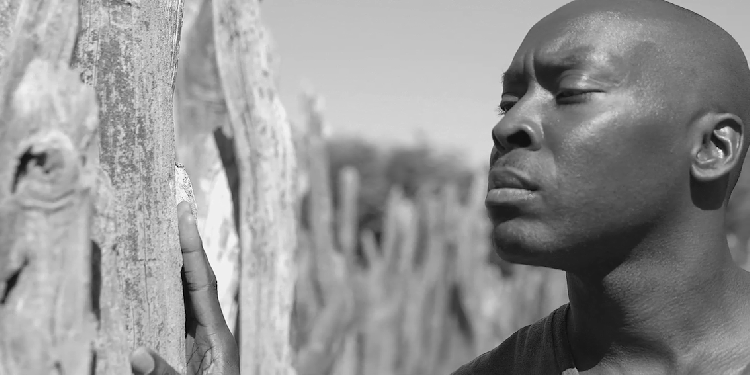
Described as “the black French new wave” in terms of aesthetics, the experimental film’s swaying trees, sun winking through kraals, lone galloping giraffes and invitations to consider textures below an often elegiac score by Tiago Correia-Paulo creates an atmosphere as intense as it is sparkling.
Sublime with regard to look, feel and gravitas but with the unscripted scenes overshadowing the actual acting, ‘The Unseen’ makes up for the distraction of erratic, sometimes awkward performances through the weight of Katjavivi’s words which posit “only poor people know true magic” before considering African “dreams we stole right out of the sky”.
A coup for the crowdfunding and an intimate exploration of the here and right now, Katjavivi’s first feature film leaves much to be anticipated in its introduction of Africans in Africa as complex and artistic beings in opposition to tired, predominantly negative character constructions. A feat and continued focus best expressed in a line near the end of the film:
“We got a raw deal. But it’s cool, though. We’re making a comeback”.