





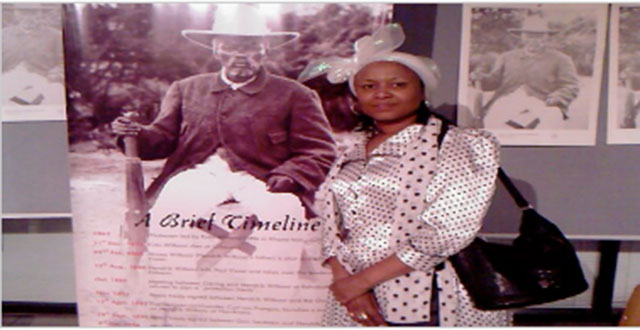
• Annarine JacobsThese were the last words of Hendrik Witbooi (1830 – 1905), on 29 October 1905, after he was wounded during guerilla war operations around Vaalgras, //Kharas Region.
These visionary words keep me awake, pondering what it could have meant to the offspring, descendants and nation at large in an independent Namibia.
The Founding President, Dr Sam Nujoma, recognised Hendrik Witbooi, along with other national heroes at the inauguration of Heroes Acre in Windhoek on 26 August 2002.
In his statement at Heroes’ Acre, Nujoma said “Kaptein Hendrik Witbooi was the first African leader who took up arms against the German imperialists and foreign occupiers in defence of our land and territorial integrity. We, the new generation of the Land of the Brave, are inspired by Kaptein Hendrik Witbooi’s revolutionary action in combat against the German imperialists who colonised and oppressed our people. To his revolutionary spirit and his visionary memory we humbly offer our honour and respect.”
Nujoma used all platforms to remind the Namibian nation not to forget sacrifices made by these national heroes. His popular and commonly used phrases goes something like “we remember sacrifices made by Hendrik Witbooi, Jakob Marengo, Samuel Maharero, Mandume ya Ndemufayo, Ipumbu ya Tshilongo, Nehale Lya Mpingana and other gallant sons and daughters…”
Hendrik Witbooi’s revolutionary spirit and visionary memory requires us, the offspring, to highlight some of the milestones he achieved while fighting to free Namibia from the colonial yoke.
When coming into contact with German imperialists, Witbooi immediately recognised the danger posed by these invaders and fiercely opposed them.
He warned other tribal chiefs, with whom he had differences, that their differences were nothing compared to the dangers of German invasion. On 30 May 1890, he wrote to Chief Maherero that “I learnt from the letter that you have given yourself into German Protection and that… (they had)… thus gained power to tell you what to do…. You will eternally regret that you have given your land and your rule into the hands of white men, for this war between us is not nearly as heavy a burden as you seem to have thought when you did this momentous thing.”
Witbooi also wrote to Chief Joseph Frederiks of Bethanie community saying “the white men’s laws are quite unbearable and intolerable to us… I see the Germans quite differently. They claim that they want to protect you against other mighty nations, but it seems that they themselves are the mighty nation seeking to occupy our country by force… I must tell you my dear Captain that the Germans want me too to sign their protection treaty. But I cannot accept that.”
He wrote to other Nama chiefs urging them to unite against the German imperialists’ invasion: “Come brothers, let us together oppose this danger which threatens to invade our Africa… The emperor of Germany has no business in Africa whatsoever.”
Hendrik Witbooi raised the matter of land occupation with the authorities in then British South Africa. He told the British governor of the Cape Colony that conflict and war would be imminent if Germans continued to occupy their lands and settlements by force. In his words: “We cannot tolerate that. We did not give our land away, and what has not been given by the owner, cannot be taken by another person…”
That Witbooi was already using these words around the 1890s speaks volumes about his vision for Africa, foreign policy, conflict resolution and mediation, on colonialism and Pan-Africanism, long before the Organisation of African Unity (OAU) was born on 25 May 1963.
Hendrik Witbooi appears on currency notes, but no roads or buildings are named after him.
The Hendrik Witbooi Avenue in Windhoek is Dr Hendrik Witbooi Avenue, named after our respected Reverend Dr Hendrik Witbooi, the first deputy prime minister of Namibia, also a struggle icon and a nationalist.
The younger Hendrik Witbooi opposed Bantu education and introduced the Cambridge system school at Gibeon, taking a brave stand against the mighty apartheid system just like his great grandfather.
Many Namibians benefited from that school and are playing a meaningful and developmental roles in an independent Namibia.
During the scramble for Africa around 1885, Witbooi – in a meeting with Curt von Francois on 9 June 1892 – declared that the great Namaqualand belonged to them. “This part of Africa is the realm of the red chiefs…,” he said. The arbitrary distribution of land should therefore be dealt with very carefully and with the sensitivity it deserves.
When looking at Naukluft, the area regarded as the Sperrgebiet, a no-go area until recently, and tourists’ route, is where Hendrik Witbooi surrendered to German imperialist forces and signed a peace treaty on 15 September 1894.
Conservancies could be set up in the area for the youth and offspring of Hendrik Witbooi to promote the culture and share the history of his legacy.
Hoornkranz – where the first bullet was shot – is another place. I visualise a shrine of Outa !Nanseb at this site. All Namibians, irrespective of race and ethnicity, could come and display and celebrate these heroes.
Such places would instil unity and appreciation and acceptance of differences, and foster a united striving for economic freedom.
This is where we need to tell the nation about the bloodshed that watered our freedom, and to instil the lost dignity, self-actualisation, belonging and worth to our children.
The offspring of Hendrik Witbooi have been branded and labelled as drunkards, lazy and without morals.
Witbooi has been projected as having a complex nature and his actions as relentless, violent, and cunning, but yet merciful, religious and forgiving.
Some writers said that “the price that leadership brings with itself is that a …leader’s life always finds itself scrutinised, criticised and magnified”. Today’s leaders should heed this statement.
Theodor Leutwein, the colonial administrator from 1894 to 1904, wrote the following tribute when Witbooi died: “The name of the little Captain will, however, remain engraved upon the history of South West Africa forever. His stubborn resistance against the mighty German empire at the head of a small warlike band, ragged and poor… I still see him before me… never deviating from what he considered his duty or his right…”