







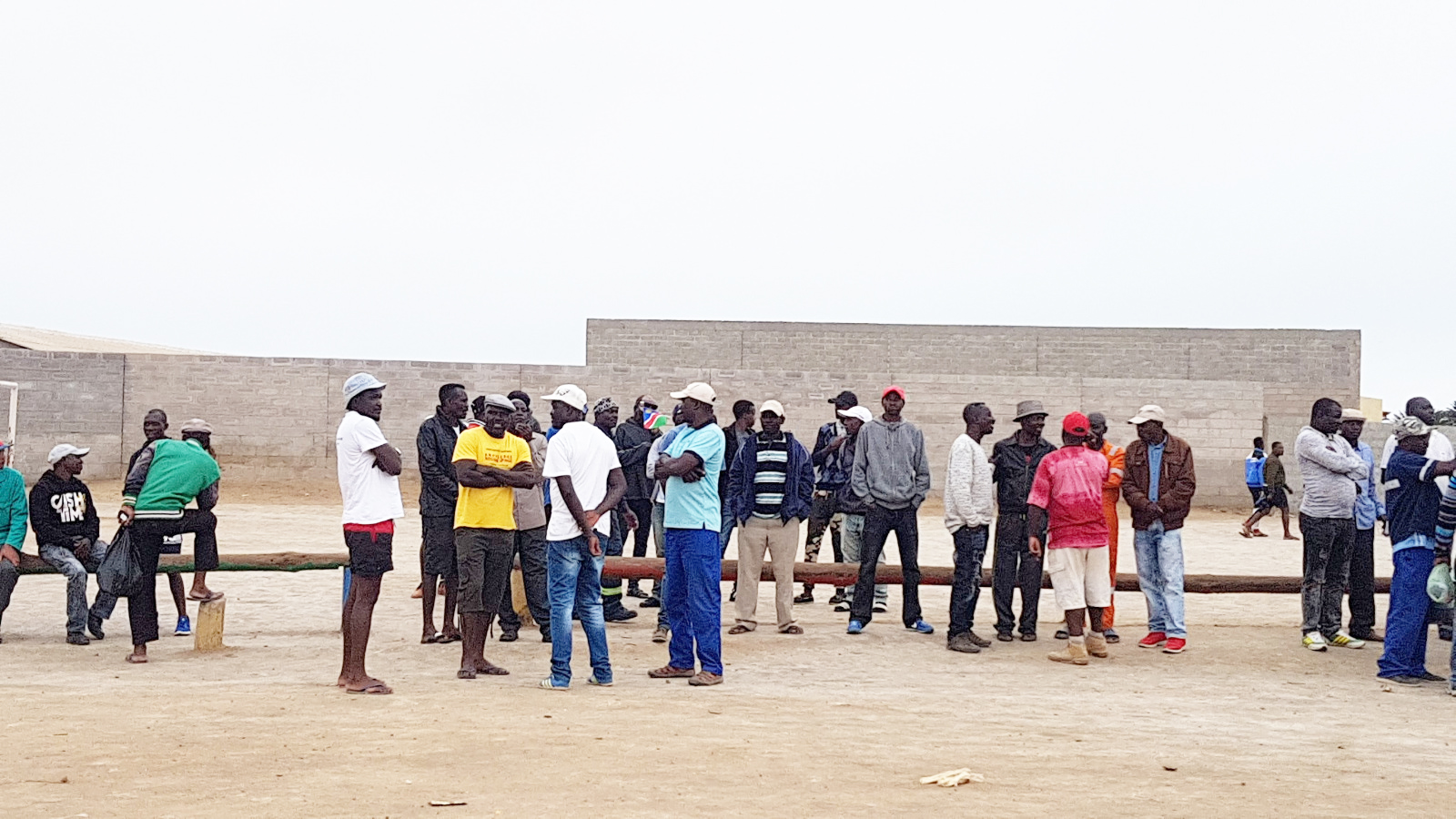
The government has admitted that 912 beneficiaries under the Government Employment Redress Programme are not actively employed, following experts’ criticism.
This admission comes after the Institute for Public Policy Research (IPPR) criticised the programme, saying the initiative has failed to deliver meaningful employment for fisheries workers affected by job losses linked to the Fishrot corruption scandal.
The Ministry of Agriculture, Fisheries, Water and Land Reform has confirmed that the programme currently has 2 255 beneficiaries of whom 1 343 are actively employed, while 912 are not.
Ministry spokesperson Romeo Muyunda, however, says: “While acknowledging that some implementation challenges have existed, the ministry maintains that the Government Employment Redress Programme (Gerp) achieved its primary purpose as an extraordinary government intervention.”
The ministry rejects the IPPR’s description of the programme as a governance failure, saying it was introduced to protect jobs, preserve livelihoods and provide relief to workers who lost their employment following the 2015 industrial strike and subsequent company closures.
As part of winding down the programme, Muyunda says the government would integrate workers into permanent employment where possible and provide once-off exit packages where sustainable employment cannot be secured.
“Where sustainable employment opportunities exist, employees will be integrated into the permanent structures of companies that have demonstrated the capacity to provide long-term employment,” he says.
The ministry says assessments have been conducted on designated companies to determine their ability to sustain employment beyond the Gerp.
The programme was launched in 2020 after the Fishrot scandal and widespread job losses in the fishing sector. It used fishing quotas allocated to designated companies as a mechanism to create employment opportunities for affected workers.
However, an IPPR report, titled ‘The Gerp – A Critical Overview and Assessment’, has found that the programme had been affected by disputes, poor transparency, weak oversight and implementation challenges.
“Gerp risks going down in the history books as an expensive Namibian government programmatic and governance failure,” the report states.
It says the programme was intended to create and secure meaningful fisheries jobs, but evidence from IPPR assessments, media reports and interviews with workers, unions and fishing companies shows it had fallen short.
“The Gerp was purportedly aimed at creating and securing meaningful fisheries jobs, but the evidence . . . has revealed the programme has fallen significantly short in this objective,” the report states.
One of the institute’s key concerns is that some workers were counted as employed despite not having active work.
The report says the government has previously stated that more than 2 000 former fishermen and fisheries workers were employed through the programme.
However, many beneficiaries interviewed by the IPPR have said they were receiving payments while waiting for employment opportunities.
“Almost all of them are stuck in cycles of idle employment, without opportunities to increase their earnings through active employment,” the report states.
It says some beneficiaries who were not actively employed received a monthly payment of about N$4 000.
Former Merlus Cormorant Fishing worker Natanael Andreas says losing his job has affected his livelihood, forcing him to lose the assets, valuables and livestock he had acquired while working.
“This has affected my livelihood.
“We’re paying for things, and some of our valuables have been repossessed. One really does not know what to say about this programme any more.
“The government needs to pronounce itself properly,” he says.
The IPPR report also questions why former United Fishing Enterprises (UFE) workers were excluded from the programme, despite arguing that they were also affected by job losses linked to the Fishrot scandal.
The ministry says the Gerp was initially established for workers affected by the 2015 industrial strike and was later extended to former employees of Seaflower Pelagic Processing, Heinaste, Namsov, Saga Seafood and Pemba Bay.
It has not provided an explanation for UFE workers’ exclusion.
The IPPR has called for stronger accountability systems, improved transparency, long-term employment pathways and support measures for fisheries workers affected by job losses.