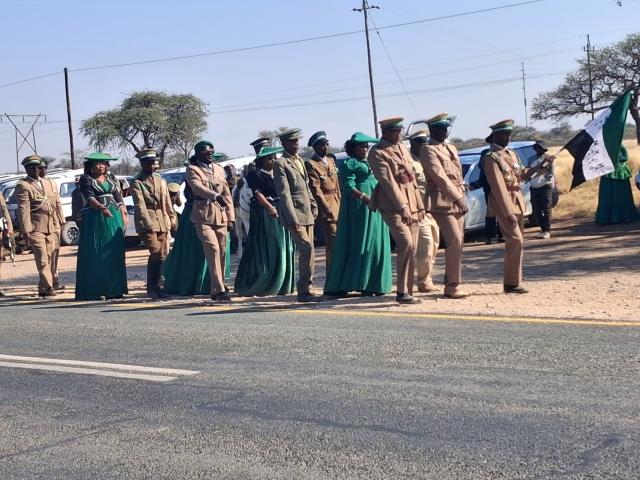






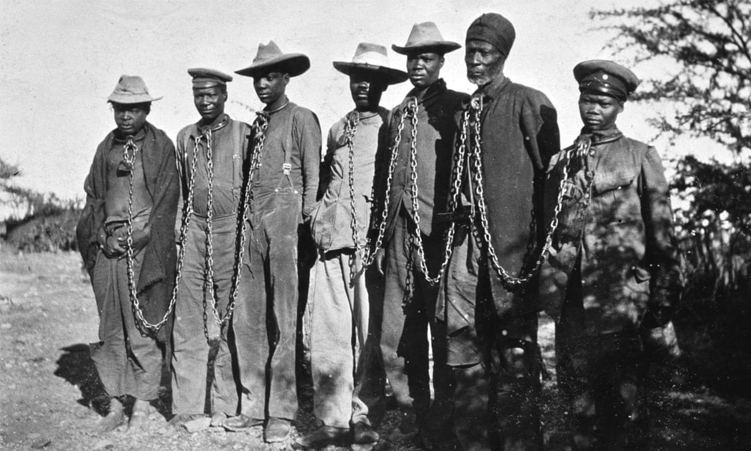
A Coalition of applicants are mounting a legal assault in an effort to force the German government into a Namibian court over the 1904-08 Nama and Ovaherero genocide.
The applicants, led by Bernadus Swartbooi, the Ovaherero Traditional Authority, Nama traditional authorities and the Landless People’s Movement, are arguing that the German government must be compelled to appear as a party in the Namibian High Court in a case set to be heard on 7 October.
The applicants want the German government to be joined as a respondent in the case, regarding the joint declaration of Namibia and Germany on the 1904-08 genocide.
Current respondents cited in the case are the speaker of the National Assembly, the National Assembly, the president, the Cabinet and the attorney general.
Analysts earlier predicted that Germany would be a no-show at the hearing.
The applicants want to have the genocide joint declaration that Namibia and Germany concluded in 2021 declared as unlawful and invalid.

In final written arguments filed with the court, it is argued on behalf of Swartbooi and the other applicants that Namibian courts possess unequivocal jurisdiction over a foreign government concerning the colonial genocide and subsequent reparations dispute.
It is argued that Germany’s joinder as a party to the case is indispensable because it is the perpetrating state and a signatory to the disputed joint declaration.
The applicants are submitting that state immunity, while arising from customary international law, is not absolute.
The applicants are arguing that atrocities committed between 1904 and 1908 against the Nama and Ovaherero people amounted to genocide.
They are also arguing that the 1948 United Nations Convention on the Prevention and Punishment of the Crime of Genocide, known as the Genocide Convention, to which Germany is a party, expressly removes any claim to immunity for genocide committed in the forum state.
The applicants are further arguing that Germany has already submitted to the jurisdiction of the Namibian courts, both implicitly and expressly. The express consent is under the Treaty of Versailles.
Moreover, Germany’s voluntary and active participation in the political and legal processes leading to the joint declaration, and its continued engagement even after the commencement of legal proceedings, constitutes an implied submission to the court’s jurisdiction, the applicants are arguing as well.

The legal adviser of the Nama Traditional Leaders Association (NTLA), Lucius Murorua, explained yesterday that the NTLA and Ovaherero Traditional Authority are at this stage quietly confident of the force of their argument and are hopeful to persuade the Namibian government to appreciate its stance and approach to the matter.
“The government though not opposing joinder of Germany is advancing an argument that the Federal Republic of Germany like any other sovereign state enjoys sovereign immunity and is not capable of being subjected to domestic courts of Namibia,” Murorua said.
“The affected communities are arguing that the sovereign immunity principle is not a shield in circumstances of a major breach of customary international law and where genocide has been committed, such as in this case, the forum state where the genocide has occurred has jurisdiction,” Murorua said.
“We are hopeful that government respondents will eventually appreciate our arguments and join hands with the affected communities to fight against Germany. We are not there yet but hope to realise unity of purpose and action with the government going forward until realisation of our quest for justice,” he added.
Political scientist Henning Melber also said yesterday that although the written arguments filed at the court include some interesting arguments, they will not be sufficient to enforce a direct German involvement in the case.
He explained that the German side would argue, if they engage in arguments at all, that this is a civil case by non-state applicants in a foreign country’s court.
“There is in terms of international law no legal obligation for the German state to respond, as it will claim that it falls outside of the jurisdiction of the court. It is, therefore, highly unlikely that Germany will comply, even if the court would reinforce the order to respond,” he said.
Melber said if the German government should respond at all, it might be tempted to argue that the Genocide Convention, adopted by the United Nations in 1948 and ratified in the early 1950s, was not applicable for a case 50 years earlier.
“This is the reason why the joint declaration admits to genocide ‘from today’s perspective’. While the intertemporal legal principle is disputed and controversial in international law and current debates, it remains a strong argument by those who seek to avoid responsibility for earlier crimes committed. That moral and ethical principles and restorative justice remain ignored is another matter,” Melber said.
The intertemporal legal principle is that an action is governed by the law in force at the time of its occurrence, and not by the law that applies later.