





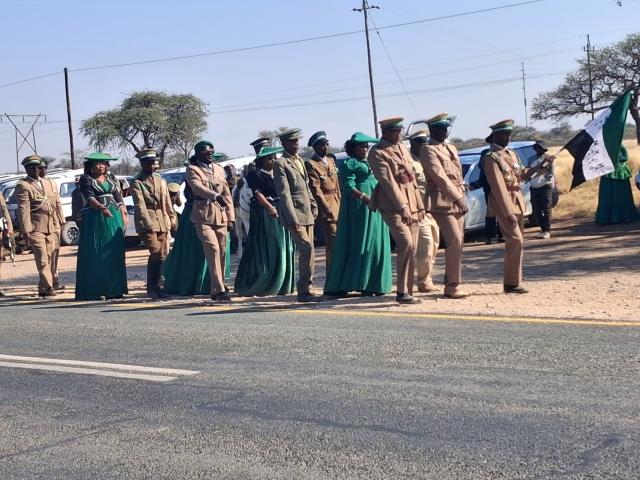
Hundreds of people across the country flocked to Gobabis in the Omaheke region to witness the official unveiling of the Chief Munjuku II Nguvauva Military Base on Saturday.
The government honoured former Ovambanderu chief Munjuku II for the pivotal role he played during the colonial period, and renamed the 126 Battalion after him.
Speaking at the event, the current Ovambanderu chief, Tjozohongo II Nguvauva, expressed his appreciation to the government for recognising his father and naming a military base after the late chief.
“This is indeed a good gesture bestowed on us as the family and the entire Ovambanderu community. This is signifying the bravery of our elders,” he said.
Nguvauva said his father’s contributions included welcoming founding president Sam Nujoma in Botswana when he went into exile to liberate the country.
He urged his community to remain united and concentrate on their development agenda to become self-supporting.
Ovambanderu community historian Asaria Tjozongoro-Kandjou touched on the hardships the community experienced during the colonial period.
“This honorary event is a symbol of the past achievements of the Ovambanderu leaders. They were targeted by the colonisers,” he said.
Tjozongoro-Kandjou said the late chief had strong ties with chief Hosea Kutako while in Botswana as he was sending money to assist in the plight for Namibia’s independence.
“His contribution is self-explanatory and require such recognition. Chief Munjuku also attended the historical Lusaka Conference in 1984 in Zambia,” he said.
During this time, Tjozongoro-Kandjou said Munjuku II attended the event as an observer on the invitation of then Swapo, a move that led to tensions with the South African administration.
“After the conference, the chief named one of his sons ‘Swapo’, and his grandchildren ‘Uakahaama’ and ‘Lusaka’,” he said.
Senior Ovambanderu Traditional Authority councillor Arnold Tjozongoro thanked the government for honouring the late chief.
“This is indeed a significant step in the community, as the Ovambanderu never wavered in the fight against colonialism,” he said.
Nguvauva, who was born in Botswana, led the Ovambanderu people there since 1951, and continued to Namibia where he remained the chief until his death in 2008.