


•Henning MelberThe Independence of Zimbabwe (1980), Namibia (1990), and the first democratic elections in South Africa (1994) marked the end of Apartheid and settler colonial minority rule in Southern African societies.
The anti-colonial liberation movements of Zanu-PF, Swapo and the ANC had turned into political parties maintaining political control and power over the societies ever since being elected by the people. Not always – as the case of Zimbabwe shows – without being under siege.
Their liberation gospels and heroic narratives created a new litany, which maintains that as true liberators they remain the one and only legitimate representative of the people. So far, this has admittedly been, at least in Namibia and in South Africa, to some extent also reflected in the election results. Both the ANC and even more so Swapo continue to be the choice for at least an absolute majority of those who vote at the polls. Since 1994, Swapo has obtained a two-thirds majority in Namibia, and can safely cruise into the forthcoming elections without being too bothered about any meaningful opposition.
But the success story of these liberation movements as governments has some flaws when the results of their governance is looked at. While privileges have shifted and include new elites in the shadow of the governments, the socio-economic disparities have to a large extent remained.
The limits to liberation are documented in a lack of meaningful redistribution of wealth to the benefit of the general citizenry. To a large extent, the economic gains were barely modified by including a new (often parasitic) elite.
On the other hand, civil liberties such as the right to vote, freedom of speech, and a range of other constitutionally anchored human rights (as well as duties, which should in responsible democracies not be ignored) have been institutionalised. These also serve the collective wellbeing, and are no little achievement and need to be recognised. In South Africa and Namibia the governments have, so far, not resorted to open physical repression and violence on a broad scale (with the exception of the Marikana massacre committed by the police against striking miners some two years ago, causing the biggest bloodbath since Sharpeville in 1961).
In the light of the sobering realities, however, the number of critical analyses exploring post-colonial forms of domination have increased over the years.
The choir of solid scholarly voices includes that of Roger Southall, who has long been a household name. He held a prestigious chair in Sociology at the University of the Witwatersrand and was the first van Zyl Slabbert Visiting Professor at the University of Cape Town (during 2013).
On the basis of his long-standing accumulated intimate knowledge, Southall has applied his analytical skills to present a seminal work comparing Zimbabwe, South Africa and Namibia.
While it becomes obvious that he knows South Africa best and Namibia least (which reflects some disparities in the depth of the case studies), this comparison offers a fruitful new approach.
In contrast to many other critical analysts, who (including this author) often tend to focus on the mindsets of the liberators in the tradition of the critique already levelled by Frantz Fanon in his book, ‘The Wretched Of The Earth’, Southall presents a much deeper and nuanced historical perspective. He digs thoroughly into settler colonial rule, its social engineering and its unfolding impact before delving into post-colonial settings embedded in, and largely influenced by, erstwhile colonial interests and social determinants.
In doing so, this pioneering work – based on a vast amount of empirical references – manages to give the case studies a slightly different context to most other analyses presented so far. This is a major achievement. Particularly striking is the conclusion that the equation between the party, government and state, and the direct involvement in the economies has turned the movements’ nature largely into party machines executing control over their societies.
This casts doubts on the much-emphasised popular character of these organisations and demystifies their policies. That Southall, while dismantling the parties, abstains from moral finger wagging adds more credibility. His dissection of the political character and impact of the post-colonial systems is sociological and political analysis par excellence.
Not everyone is keen to delve into a 400-page volume to gain further enlightenment about the way these parties operate in post-colonial settings, where they apply similar practices and where they differ. But those interested and willing enough to do so will be rewarded by a wealth of information that help better understand and come to terms with some Southern African realities.
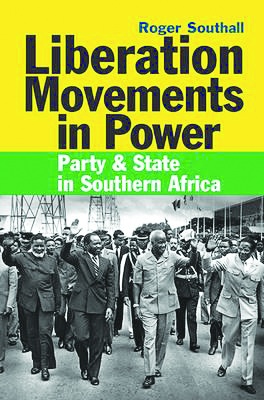
– Roger Southall, Liberation Movements in Power. Party & State in Southern Africa. Scottsville: University of KwaZulu Natal Press 2013, pp 400