For more than 60 years, Namibia’s commercial livestock heartland did not confront what it is confronting today.
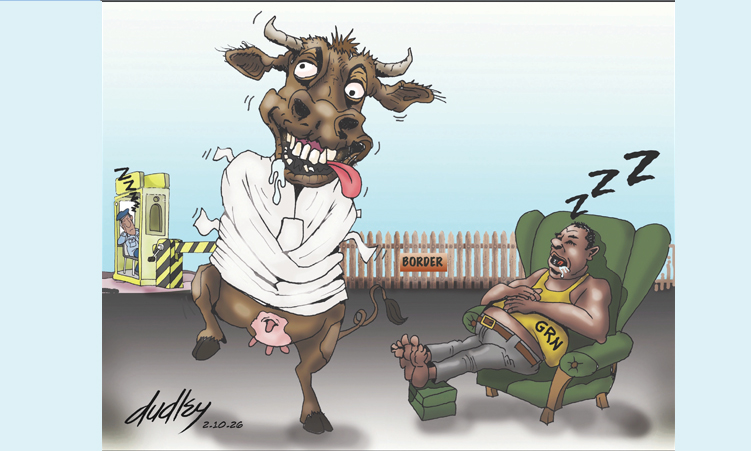
In September, foot-and-mouth disease (FMD) was confirmed within the country’s internationally recognised disease-free zone.
The consequences were immediate. Livestock movements were restricted, export trade was disrupted and uncertainty travelled quickly through farms, abattoirs, transport networks and markets.
To see this only as a story of crisis, however, would miss something important about how Namibia participates in international trade.
When Namibia exports red meat, it exports more than meat. It exports institutional reliability.
Behind every consignment entering a demanding market stand systems consumers rarely see: veterinary surveillance, animal identification and traceability, laboratory science, certification, border controls and abattoir standards.
Together they turn an animal raised on Namibian rangeland into a product distant markets are prepared to trust.
I have described this intersection of livestock production, institutional credibility and market access as red meat diplomacy.
The outbreak puts that proposition to an important test. Economic diplomacy must maintain credibility when circumstances become difficult.
A SYSTEM BEING TESTED
On 23 September, the day FMD was confirmed, Namibia imposed a nationwide livestock movement standstill. The Namibian Livestock Identification and Traceability System (NamLITS) enabled the authorities to identify cattle that had moved from the affected farm to the Otjozondjupa region before detection.
Disease does not by itself demonstrate the failure of an animal-health system. No credible veterinary regime can guarantee the absence of biological risk.
Institutional capability is measured by what happens next: can the country detect, trace, contain, communicate credibly and demonstrate control?
A traceability system proves its value at precisely such a moment. Its purpose is not simply to record animals in normal times, but to reconstruct movements when something goes wrong and show where animals originated, where they moved and which risks require investigation.
NamLITS is, therefore, more than an administrative tool. It is part of the infrastructure of economic diplomacy, enabling Namibia to demonstrate to trading partners that its systems work.
TRUST UNDERPINS MARKET ACCESS
Market access is ultimately an expression of institutional confidence between states. An importing country accepts Namibia’s veterinary certificates because it has confidence in the institutions issuing them.
It accepts our traceability because it trusts the integrity of the underlying system. It accepts representations about animal health because they are supported by surveillance, science and internationally recognised procedures.
This is red meat diplomacy in practice. The product is commercial, but the credibility that carries it across borders is institutional.
The industry assessment describes Namibia’s functioning national livestock traceability system as a significant national asset.
In diplomacy, predictability is power. In agricultural trade, it comes from knowing where animals originated, where they moved, how disease is detected and whether institutions can respond according to established rules.
LIVESTOCK ECONOMY INCLUDES SMALL STOCK
Beef is one of Namibia’s most recognised agricultural exports, so discussion of FMD understandably gravitates towards cattle.
Yet the red meat economy is broader than cattle.
According to the industry assessment, Namibia marketed approximately 250 000 head of cattle during the first six months of 2026.
During the same period, it marketed 447 299 sheep and 47 286 goats. In total, nearly 745 000 cattle, sheep and goats entered the livestock marketing system in only six months.
Those figures should broaden the way we think about the livestock economy and its exposure to animal-health disruption.
In the ||Kharas region and other important production areas, small stock are not peripheral to agriculture.
They sustain farmers, workers, auctions, transporters, abattoirs, processors, traders and supporting services.
Movement restrictions, therefore, reach beyond the farm gate. FMD should not be understood only as a cattle-health or beef-export problem.
It is a shock to an interconnected livestock system.
The veterinary assessment also notes that FMD infection can be less clinically apparent in sheep and goats than in cattle. That should not be a source of alarm. It should be a basis for better science. For a country with a substantial small-stock economy, surveillance should reflect the structure of that economy and draw appropriate evidence from cattle, sheep and goats.
RESILIENCE MEANS LEARNING
Namibia already generates data on animal identification, movement, slaughter, producer prices, exports and disease surveillance.
Linking those datasets could reveal how many animals would normally move during a standstill, which regions and value chains carry the greatest exposure and how quickly markets absorb the shock.
The immediate task remains clear. Biosecurity is essential, surveillance must be rigorous and producers and industry must cooperate fully with veterinary authorities.
Decisions on movement and market access must remain grounded in science.
Namibia can meet these demands with disciplined confidence. It has functioning veterinary institutions, an internationally recognised animal-health architecture, a national traceability system and a livestock sector accustomed to demanding standards.
Those assets give the country both the capacity and the responsibility to learn.
The outbreak should leave Namibia with sharper small-stock surveillance, better-integrated data and closer coordination across the livestock economy.
The objective is to improve the evidence on which future decisions will rest.
Trading partners will ask difficult questions. Namibia’s strongest answer will be evidence that movements were traced, risk was contained and lessons were applied.
Red meat diplomacy rests on trust in the system behind the product. A resilient system preserves that trust by learning from the test.
– Albertus Aochamub is the interim chief executive of the Meat Corporation Namibia. He writes in his personal capacity.