





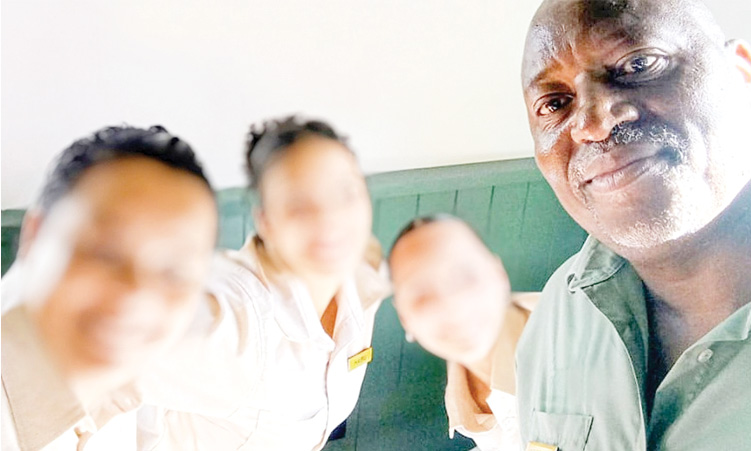
At least 74 Zimbabweans fled Mossel Bay in early June following the killing of foreign nationals. One of them told us his story.
By May, Langton Gumira liked his life – but it hadn’t always been that way.
He and his wife were two of an estimated one million Zimbabweans who had fled to South Africa in the mid-2000s.
When Gumira and his wife arrived in 2006, the situation in Zimbabwe had become desperate.
Inflation had passed 1 000%, the shops were empty of food, fuel and electricity were only sporadically available, and hundreds of thousands were still living with the consequences of the previous year’s operation Murambatsvina – the Mugabe government’s campaign of forced evictions.
“No one leaves home unless home is the mouth of a shark,” the British-Somali poet Warsan Shire famously wrote.
Gumira says something similar, if less poetic.
“I loved my country. I loved Zimbabwe. But it was not a place we could survive.”
And so they fled – for the first time, but not the last.
Arriving in Johannesburg, Gumira and his wife found a place to stay in the Johannesburg suburb of Malvern, east of the central business district.
They were then in their mid-30s, and Gumira had experience working in the restaurant industry from when he was a boy.
He found a job at a restaurant within days, worked his way up, moved to another restaurant, and worked his way up there too.
Despite the job success, Gumira describes those early years in wrenching terms. South Africa (SA) might offer better economic prospects, but it was no paradise.
“Coming from a peaceful country like Zimbabwe, where you can walk free even at midnight…
To come to SA, you know you are maybe sacrificing your life. In a way it is like being a soldier: sometimes you just feel like: ‘I’m going there not because I’m safe, but because I have to.’”
He still vividly remembers the first time in his life when a gun was pointed at him. It was in Johannesburg.
THE ROAD TO DOCUMENTATION
Many of Gumire’s Zimbabwean cohorts originally entered SA as asylum-seekers.
Due to Zimbabwe’s economic collapse, widespread political repression and a severe backlog in processing asylum applications, SA’s government in 2009 introduced a special dispensation for Zimbabwean nationals, allowing them to live and work legally in SA.
“The government has urged South Africans to tolerate the situation of Zimbabwean refugees until such time [as] the economic situation improves in that country,” SA’s government had said.
The Documentation of Zimbabweans Project gave Gumire, and around 245 000 other Zimbabweans, permits to live and work in South Africa in 2010.
When that expired in 2014, Gumire obtained the replacement Zimbabwean special permit, and when that expired in 2017, he obtained the Zimbabwean extension permit, currently valid after government extensions until May 2027.
In August 2014, then home affairs minister Malusi Gigaba gave reasons for the granting of these permits.
They were, Gigaba said, “a significant gesture of support and solidarity with our neighbouring country Zimbabwe”.
Gigaba said SA’s approach to immigration was informed by pan-Africanism and the knowledge that SA’s stability and prosperity were intrinsically linked to that of the rest of the continent.
“We are committed to manage immigration in a way which treats all visitors humanely, in an efficient manner and according to our own deeply-embedded human rights ethos,” Gigaba said.
THE CHANCE FOR A QUIET LIFE
When Gumire and his wife obtained the legal right to live and work in SA in 2010, it seemed like a chance to start making a home in the country.
Gumire was offered a job as a restaurant manager in the Garden Route town of Mossel Bay, and he jumped at the chance of a slower, safer life away from crime-ridden Johannesburg.
They found a home in the Giyani informal settlement in the township of KwaNonqaba.
“For me, Mossel Bay was the most peaceful town in South Africa,” Gumire says.
“I’m not a person who goes to pubs and does those things. I go to work, come home, and stay indoors. Even when I have two days off, I spend them in the house.”
Gumire thrived as a restaurant manager and was trusted implicitly by the restaurant’s owner – an account attested to by restaurant staff Daily Maverick spoke to this week, who spoke of Gumire in glowing terms.
Gumire liked his life. But all of that changed on the night of 29 May.
MOSSEL BAY’S NIGHT OF SHAME
Nobody seems sure exactly what ignited the violence in Mossel Bay’s township in the last days of May this year.
But by the end of that weekend, hundreds of people would be fleeing for their lives from burning shacks, and at least three people would be dead: Tomas Chunguane (27) and Danilo Muainga (43), both Mozambican; and South African teen Nhlamulo Sambo, whose murder remains contested.
Sambo’s family claimed he was caught up in the same deadly wave because he spoke Xitsonga and was mistaken for a foreigner, but the police have suggested that his stabbing was unconnected and linked to an attempted robbery.
Gumire didn’t know any of this at the time. He was on duty at the restaurant, closing up, when he received a message from a waitress colleague: “Mr Langton, are you okay?”
“She sent me photos of people being killed and assaulted. She warned me: ‘You must be careful because it’s not nice in the location’.”
Gumire “started panicking”. There was a guesthouse opposite the restaurant, and he decided to stay there for the night and assess the situation in the morning.
His boss arranged for a flat in town where he and his wife could stay until things blew over. They took only their clothes from home.
The town, surely, would be safe. So they believed – until Gumire received a call from another colleague warning him that he was being followed. They moved to another flat that night.
“When I woke up the next morning, I learnt people had gone into our house [in the township]. They grabbed everything: our couches, fridges, TV. We only had our clothes,” Gumire says.
“My boss said, ‘No, I don’t want you to go back to Zimbabwe. You should just stay in the flat [in town] until you are safe, and then we’ll see what we can do.’ I said, ‘Okay, it’s fine’.”
Early that morning, Gumire risked leaving the flat to buy bread. Given the hour and the location of the flat, he felt sure he would be safe.
“As I was coming down from the supermarket, holding my loaf of bread, I saw that there were people following me. As I turned to face them, I was attacked by knobkerries. I thought
I was the next victim, that I was going to be killed right there,” he says.
Gumire was felled by the three men’s blows. He tried to run, fell, and was beaten again.
He had never seen his assailants before, and they said nothing to Gumire before or during the attack. Neither did they ask him to produce papers or prove his legal right to be in SA.
They spoke isiXhosa to each other while beating him.
Gumire shouted for help, and the attackers turned and ran.
A month later, Gumire is still ruminating over how he was targeted and how people knew he was being followed.
“That’s the R20-million question,” he says.
“When you’re a manager, not everyone likes you.”
‘WE HAVE NOTHING’
Gumire and his wife were among 74 Zimbabweans and 300 Mozambicans who decided that they had no safe option but to flee Mossel Bay – and SA – for their countries of origin.
On 9 June, Gumire and his wife arrived back in Zimbabwe.
He spoke to Daily Maverick this week down a crackly line from Harare, where they are temporarily staying with family.
“We have nothing. No money, no nothing.
And we are trying to start a life in a country that we do not know.
We had been in SA for so many years. Now you come here, you’re stuck, and you have nothing. No property, nothing.
“How do you start a life in a place you’re not used to at 57 years of age?” he asked.
Gumire doesn’t try to hide his bitterness.
“You turn on the radio in SA, and all that’s being said is ‘illegal immigrants, illegal immigrants, they’ve done this’.
Over and over again, as if there are no other things. You end up turning off the radio because they are talking about you – and I am not even an illegal immigrant!
I have my passport, I have my visa!”
There’s one thing Gumire says he’s been thinking about a lot during these weeks back in Zimbabwe.
“I don’t understand why our fellow black people in SA treat other black people like that. They see white people who don’t have permits, and they don’t even care; they are scared to even approach them,” he said.
“You know, at my age, I’ve seen a lot. I’ve seen so many Malawians and Mozambicans who were working here in Zimbabwe when the economy was right, even going to the farms, working for Zimbabweans. But Zimbabweans are so peaceful; they don’t care about foreigners. Nobody attacked foreigners. Nobody thought bad about foreigners.”
But SA?
“SA is a completely different country,” Gumire says.
“I’m sorry, I just don’t understand.”
– Daily Maverick, REBECCA DAVIS and SIYABONGA GONI