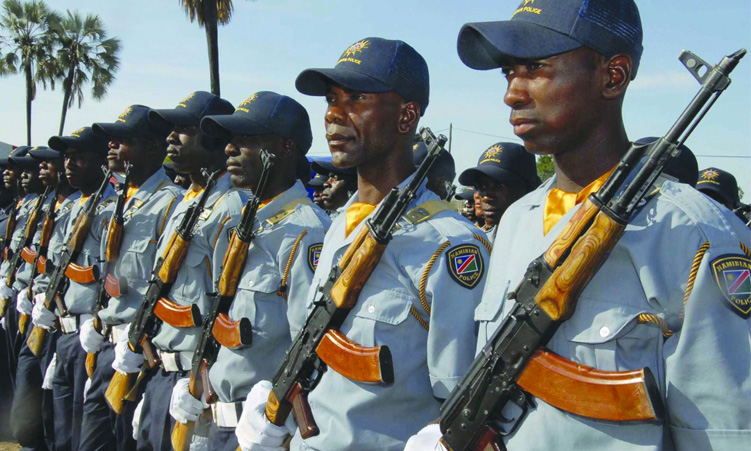
Experts have raised concerns about reportedly inhumane and disrespectful treatment of the public by members of the Namibian Police, stating that it has led to a significant erosion of trust.
According to sociologist Ellison Tjirera, police officers no longer serve their purpose.
“Members of the public have no trust in the police. Sometimes the way police officers speak to members of the public is disrespectful, and you get the sense that maybe their duty is not really to serve and to protect but to belittle and humiliate,” he says.
This comes at a time when the prevention of torture bill, introduced in 2019 by former justice minister Sacky Shanghala, remains unpassed seven years later.
The bill aims to criminalise torture and other forms of cruel, inhumane or degrading treatment by public officials instead of relying on existing charges, such as attempted murder or assault.
Under the bill, any official who commits such an offence would be liable to imprisonment for a period not exceeding 15 years, and an official who is convicted of treating someone in a cruel or even degrading manner will be liable to a fine not exceeding N$15 000.
According to Tjirera, the police are no longer protecting the public, and citizens need to exhibit fear rather than asking questions.
“Whenever you are talking to the police, don’t try to be smart. You must suck up to them and that is unhealthy.
He says the police need to start tackling issues in the community such as housebreaking, rather than prioritising traffic offences.
Ministry of Justice and Labour Relations executive director Gladice Pickering, in an interview with The Namibian last week, confirmed that the bill is still under review and on the legislative agenda this year.
“It was tabled previously but returned for revision of the penalty clause.
“Torture and any inhumane or degrading treatment are prohibited by the Constitution, and victims of such conduct may institute legal action on that basis,” she said.
POLICE BRUTALITY
Recent police actions have raised concerns.
On Monday the police confirmed the arrest of an officer who allegedly shot and killed a truck driver at Onhuno in the Ohangwena region in the early hours of the morning.
Eliud Hamukwaya (38) and his co-driver stopped at the Onhuno roadblock when he was asked by the police for his driving licence and weighbridge documents.
In another case, police deputy commissioner Kauna Shikwambi has confirmed the recent murder of a driver for a ride-sharing service.
Officers from the Serious Crime Subdivision approached a blue vehicle, believed to be connected to a robbery incident that took place on 3 May in Khomasdal.
According to the report, a police officer approached the driver of said vehicle with his sidearm drawn and identified himself. The driver allegedly aggressively opened the door of the vehicle, knocking the officer to the ground. It is alleged that, in the ensuing scuffle, the officer fired a warning shot. A nearby officer allegedly approached to assist their colleague and also fired a shot in the driver’s direction.
“It is reported that the assailant subsequently stood up and walked a distance away before he collapsed to the ground and subsequently succumbed to the injuries. The deceased is not yet identified,” says Shikwambi.
At Uis in the Erongo region, residents have accused the police of brutality following recent arrests linked to ongoing disputes over illegal mining activities and traditional leadership. Andrew John-Kelly (48), one of the arrested community members, alleges that he was beaten and kicked at the police holding cells.
PREVENTION OF TORTURE
Media ombudsman John Nakuta has also raised concerns regarding the lack of legislation criminalising torture as a statutory crime, despite being a state party to the United Nations Convention Against Torture.
Nakuta says that most police officers accused of committing torture cannot be charged.
“Police brutality includes intimidation and using excessive force, but torture is a much more serious crime which requires greater intervention. Currently we do not have torture as a crime defined in our legal framework, so police officers who are allegedly committing such crimes cannot be charged.”
According to Nakuta, the recent incidents in which two drivers were killed highlight the need for the torture bill to be passed, although they do not constitute instances of torture.
“There is a distinction between general police brutality and the crime of torture,” he says, adding that in cases where people could have been charged with the crime of torture, “lesser crimes” such as attempted murder had to be charged.
He says police officers need human rights education and the state has a responsibility to educate its officials, adding that he has extended an invitation to the police to do so.