






Meat is expensive.Messing it up by cooking it badly is near sinful. Yet, most of us have little control over the quality of the meat we consume. We buy our meat from suppliers who also know nothing about the animal we’re about to consume, as he or she is just a middleman operating between the abattoir and the consumer.
We also buy our meat already portioned and packaged in a way that reveals little about the life of the animal we are about to consume.
Without any idea of how old the animal was, or the quality of its life before it was slaughtered, we may end up with a tough, dry piece of meat for which you have paid a premium.
Brining is a very old technique that has recently been rediscovered by modern cooks. Traditionally, cooks used brining to preserve proteins, but these days brining is used to add flavour to and tenderise tough meats and other proteins.
Brining and curing are two closely related techniques. Both involve the application of salt. Brining is essentially a wet process, while curing is achieved by applying a dry, salt-based rub.
Brines work on the principle of diffusion whereby salt and moisture is drawn into the product to restore equilibrium and thereby adding moisture, salt and flavour to the product. All types of meat protein – fish, chicken, turkey, beef, pork, lamb and game-benefit from brining.
The brine strength and brining times must be adapted for various cuts of meat, poultry and fish. Large cuts often require more time and a weaker brine to prevent over-brining. Delicate meats like flaky fish require only 30 minutes of brining time and something like prawns even less.
The core ingredient for every brine is salt. The ratio of salt to water determines the strength of the brine. For example, a 7% brine consists of 70 grams of salt per litre of water. In addition to salt, a brine may contain a number of flavouring agents, such as sugar and spices like peppercorns, star anise, chili flakes, fennel and coriander seed, which are among the most popular. Commonly used all-round brines fall in the 3% to 5% range, but some go up to 10%.
Other, more controversial ingredients are curing salts, also known as saltpeter (potassium nitrate), and Prague powder, or pink salts (which is sodium nitrate combined with ordinary kitchen salt, or sodium chloride).
Curing salts are added to prevent botulism and add some flavour and a reddish pink colour to the cooked, brined product.
The primary disadvantage of over-brining is that it makes the meat quite salty. Also, because the salt breaks down the protein filaments, it may transform the texture of the meat and make it mushy.
With the hunting season in progress, now may be a good time to start experimenting with brining as a technique to add value to tough, lean cuts of meat, or a delicious tongue or two. After all, you are already curing meat to make biltong.
Happy hunting.
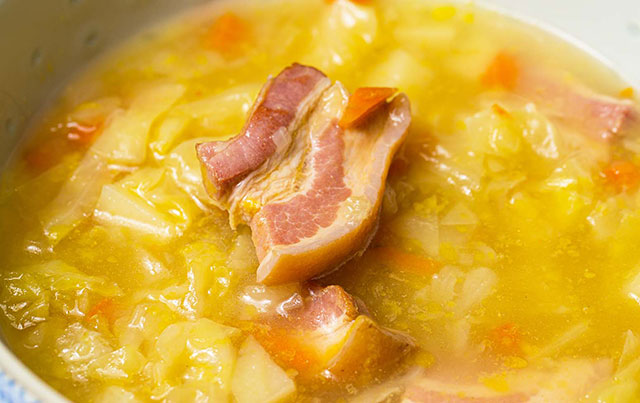
• 1 medium-sized cabbage • 2 litres chicken stock
• 300 grams smoked pork belly • 1 large carrot
• 1 large onion • 3 cloves
• 1 tablespoon butter • Salt and pepper to taste
Clean the cabbage by removing all the hard outer leaves. Cut it in quarters and rinse under cold water. Cut out the hard stems from each quarter, then slice each quarter into medium-sized chunks. Set aside. Cut the smoked pork belly into medium-sized squares about 1 cm thick. Peel the carrot and cut into medium-sized cubes. Peel and cut the onion in half. Stud one half with the three cloves and cut the remaining half into medium-sized dice.
Put a large enough pot or stockpot on the stove over medium heat. Add the butter and let it melt. Add the chopped carrot and the diced onion. Let it sweat for about two minutes. Then add the cabbage and cook for about 5 minutes. Then add the pork belly, as well as the onion studded with cloves. Add the stock and seasoning. Partially cover the pot with a lid and let the soup cook for about 90 minutes. Taste for seasoning and adjust if necessary. Serve with toasted bread.