



Most people have seen ‘The Last Supper’. Leonardo da Vinci’s celebrated depiction of the night before Jesus Christ was betrayed for 30 pieces of silver. Lauded as the most reproduced piece of religious art of all time, ‘The Last Supper’ forms part of a wealth of Christian art produced mostly within the Renaissance period of visual art history.
Though today religion themed paintings are often viewed solely as works of art, in Italy during the Renaissance, paintings that spoke of the happenings in the Bible were used to focus the mind on the spiritual as well as to illustrate Bible scenes for those who could not read. Bible-themed paintings and sculptures were also employed to arouse emotional devotion for those uninspired by words and to aid in the recollection of Bible stories.
At the time, Christianity was central to European culture and the life of Christ was essential to Christian teachings. Stressing the humanity of Christ and the need for Christians to live life with the same values that Jesus did, religious Renaissance art celebrated the son of God’s human existence with a focus on his earthly birth and death.
As artists constantly needed to depict Christ, Mary and his disciples, they became particularly adept at painting and sculpting the human form.
During this time frescos, altar items and small pieces for private worship were popular, though perhaps no religious art was as popular as Da vinci’s ‘The Last Supper’ and Michelangelo’s ‘The Creation of Adam,’ with a special shout out to ‘Caravaggio’s ‘Deposition’.
Located on a dining hall wall in the Convent of Santa Maria delle Grazie in Milan, ‘The Last Supper’ is perhaps the most famous religious painting in the world. By the behest of Ludovico Sforza, Duke of Milan, ‘The Last Supper’ was painted by Leonardo da Vinci between 1495 and 1498 and depicts the moment after Jesus announced one of his disciples would betray him as told in the gospel of John 13:21.
The painting is fascinating in its presentation of the disciple’s reactions and there has been much speculation of who is thinking what, the possible presence of Mary Magdalene to Christ’s left and a dark haired Judas holding a bag – perhaps of silver.
‘The Last Supper’ was painted on a stone wall. Da Vinci first used a layer of pitch, gesso and mastic and then painted over that layer with tempera. The mistaken belief that the painting was a fresco resulted in inappropriate restoration attempts and, sadly, ‘The Last Supper’ started deteriorating a few years after it was completed.
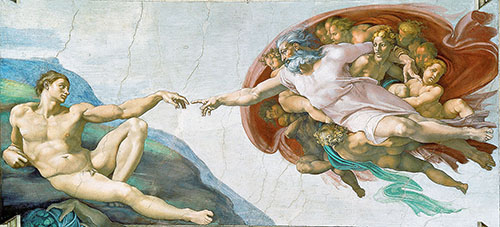
Depicting a Bible story further back in the text is Michelangelo di Lodovico Buonarroti Simoni’s ‘The Creation of Adam’.
The painting tells the Christian story of Genesis and presents God creating the first man in the moment before the Lord transmits the spark of creation.
The painting was completed in 1511 and resides on the ceiling of the Sistine Chapel in the Vatican city. The iconic image of God and Adam’s almost touching fingers has been replicated countless times and it joins ‘The Last Supper’ as one of the most reproduced religious paintings of all time.
‘The Creation of Adam’ is generally thought to be inspired by Genesis 1:27 which states that God created man in his own image. Michelangelo’s ‘The Creation of Adam’ is considered a fresco. This means that Michelangelo’s paint was made of water and pigment which was then rapidly applied to wet plaster.
Giving birth to Baroque and its dark shadows, Michelangelo Merisi da Caravaggio’s style can be spectacularly seen in ‘Deposition’. A painting that depicts Nicodemus, Joseph of Arimathea and Mary Magdalene placing Christ’s body in the tomb after his crucifixion.
Though Caravaggio’s depiction of Christ is similar to Renaissance paintings in subject, the artist jettisons the Renaissance’s beautiful and ethereal representations to portray dark, stooping and mourning figures.
Infamously bad tempered and often criticised, Michelangelo enjoyed unanimous praise for this painting which is usually housed in the Vatican museum.
The painting is said to depict three men and three Marys, namely Mary Magdalene, the Virgin Mary and Mary Cleofas, as well as Jesus, Nicodemus and Saint John. ‘Deposition’ also known as ‘Entombment’ is oil on canvas and was painted in 1603.
All striking and all created in the service of spreading the appeal of Christianity while celebrating its stories and providing visual interpretations of the weighty Bible text, these paintings are just some of the art pieces produced with these goals in mind during the Renaissance and on the brink of the Baroque period.
Other Renaissance works of note, among many others, include ‘Wedding at Cana’ by Paolo Veronese where Jesus is said to have turned water into wine and Raffaello Sanzio da Urbino’s ‘Madonna del Prato’ or ‘Madonna of the Meadow’, which depicts Virgin Mary looking at baby Jesus and his cousin John the Baptist.
Google theme of the day: Search your favourite Bible stories and see whether they have been depicted in visual art.