





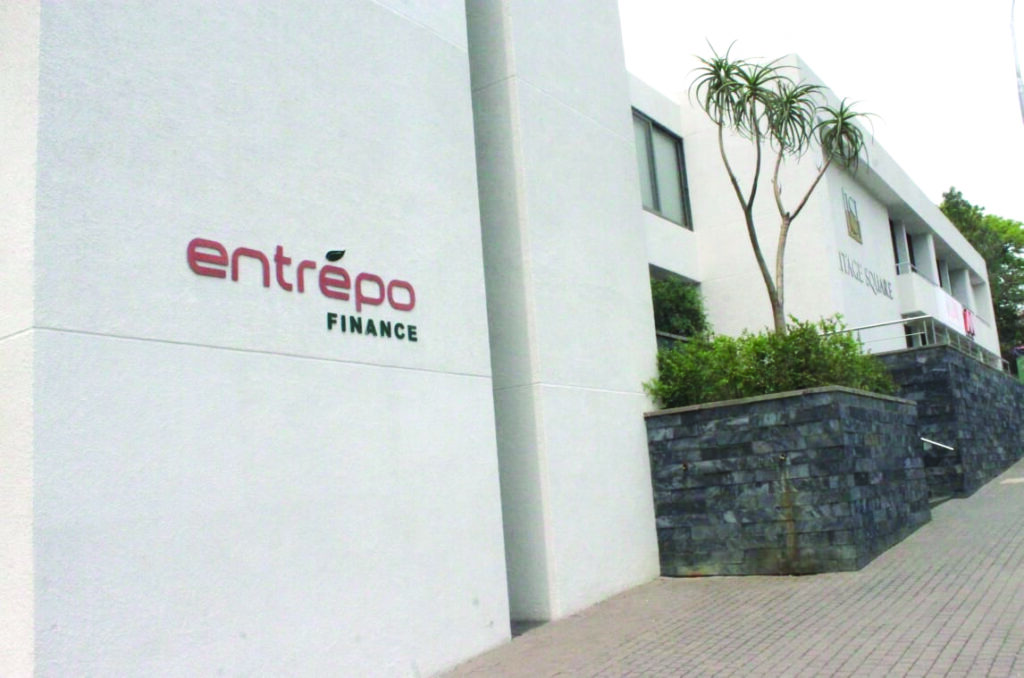
Entrepo Finance’s loan book shrank by N$500 million in the 2026 financial year as changes to the government’s payroll deduction system disrupted the microlender’s ability to issue new loans to civil servants.
The microlender, however, still managed to increase profit by 6% and contribute 14% of Capricorn Group’s total profit after tax, according to the annual results released yesterday.
The Capricorn Group subsidiary’s loan book fell from N$2.2 billion in 2025 to N$1.7 billion at the end of June 2026.
The decline followed the government’s decision not to renew its contract with Avril Payment Solutions (APS), which had administered payroll deductions for government employees.
The system was an important part of Entrepo’s business because it allowed the company to onboard government employees as borrowers and collect repayments directly through payroll deductions.
Entrepo’s profit after tax equates to approximately N$261.1 million
Capricorn Group chief executive David Nuyoma says the end of the APS contract has directly affected Entrepo’s business model.
“Entrepo faced disruption following the government’s announcement in August 2025 that its contract with APS to administer government payroll deductions would not be renewed on expiry at the end of November 2025,” Nuyoma says.
Following the expiry of the contract, the Ministry of Finance introduced a manual process for onboarding new business and maintaining existing customers.
Nuyoma says the temporary arrangement had kept the system operating but was making it harder for Entrepo to grow its lending business.
“While this provides a temporary solution, it is operationally inefficient and has constrained new business origination,” he says.
This means while existing customers could continue making repayments, Entrepo was issuing fewer new loans, contributing to the N$500 million reduction in its loan book.
Capricorn financial director Johan Maass says uncertainty around the payroll deduction system had reduced the number of new loans being issued.
“Entrepo was impacted by uncertainty regarding the government payroll deduction management system, which reduced origination volumes given the business’s reliance on payroll-linked lending,” he says.
Despite the smaller loan book, income from lending rose by 10.5%, while credit impairment charges fell from N$22 million to N$18 million.
Entrepo contributed 14% of Capricorn Group’s total profit after tax, compared with 12% in the previous financial year.
The results suggest that the immediate impact of the payroll disruption has been felt more strongly in new lending activity than in the company’s ability to generate profit from its existing business.
Nuyoma says the company was now looking at how it could operate under a changing payroll system.
“Despite this disruption, Entrepo delivered profit growth, which evidences the resilience of the underlying business,” he says.
He says management was working with Capricorn’s executive team and board to adapt the business model to the changing regulatory and operational environment.
Maass says management was considering alternative approaches while the broader microfinance market remained an opportunity.
“Management is actively assessing alternative approaches, while the underlying microfinance market opportunity remains intact, albeit under constrained circumstances,” he says.