






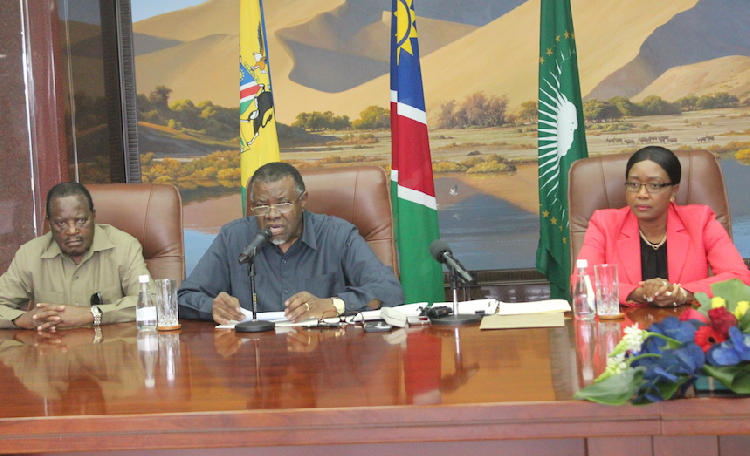
PRESIDENT Hage Geingob has urged the public to support government efforts to combat corruption and other improper conduct by disclosing the correct information.
Geingob said this on Friday at State House after he signed the Whistleblower Protection Act and the Witness Protection Act into law.
The two laws will become important weapons in Namibia’s anti-corruption arsenal, and their promulgation is part of the country’s obligations under various international instruments, most notably the United Nations Convention against Corruption (Uncac), which calls for signatories to put such frameworks in place.
Government, under the new laws, will establish procedures for making disclosures of improper conduct, to allow for investigation of such inappropriate conduct and to protect whistle-blowers.
According to the Whistleblower Protection Act, the disclosure of improper conduct can be made when a person believes a crime has been committed or is likely to be committed. The government can also be tipped off when an institution is wasting, mismanaging or misappropriating resources. Threats to the health and safety of an individual or a community and environmental degradation are also listed as improper conduct that can be reported under the new law.
To ensure the safety of witnesses, the new legislation calls for the establishment of the witness protection unit to protect and assist witnesses and related persons and establish witness protection programmes.
Geingob said it was essential to establish witness protection avenues “so that genuine people who are concerned about mismanagement of our resources can be protected”. “They should not be punished,” he said.
The President, however, added that the new law must not be used for the wrong reasons, meant to tarnish other people’s names or character.
“If you blow the whistle to say I took my whole family to New York as corruption, that is wrong whistle-blowing. We are talking about blowing the proper whistle; then you will be protected,” he said.
The Namibian Time Act was also written into law. The act brings an end to the annual time change from summer to winter time, with Namibia reverting to summer time only. This means there will just be one standard time for Namibia.
“As we established the principle of transparency, by signing this, I declare these acts as law in Namibia,” Geingob said at the signing ceremony.
Justice minister Albert Kawana said the Whistleblower Protection Act will propel Namibia to the league of countries that promote transparency and accountability, because he said, it was a joint venture between government and the private sector aimed at the promotion of the code of conduct at institutions.
This was because the law was divided into two parts. One is the promotion of transparency and accountability “good ethics”, and the other the cooperation of the public to give correct information.
“This law will go a long way for the informants to come forth to report to us and we will refer the information to relevant institutions to take action while ensuring the safety for the informants,” he said.
Kawana said the new laws could also be useful in the fight against drug abuse, human trafficking and terrorism.
Prime Minister Saara Kuugongelwa-Amadhila, (also at the signing ceremony) called on the full cooperation of the public towards government’s efforts, saying the latter will not be able to win the battle against corruption without the cooperation of the public.
“Now that there is confidence that there would be no negative consequences for informants in supporting the efforts of government, we hope that the public can now come forward with information so that the perpetrators will be held to account,” she said.