





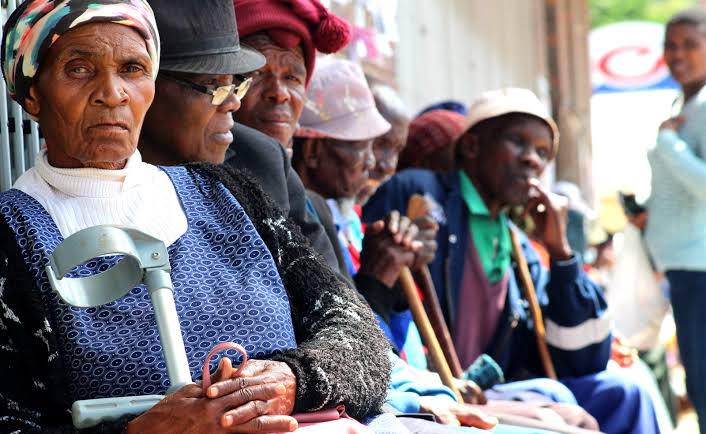
For nearly 380 000 Namibians, a government grant is not simply an additional source of income, but the money they rely on to get through the month.
The 2025 Namibia Financial Inclusion Survey shows that 20.8% of Namibia’s eligible adult population depend primarily on government social transfers, including old-age pensions, child grants and disability grants to survive.
The figure translates to about 378 000 people, based on an eligible adult population of 1.82 million.
The old-age pensions make up the largest share, with 14.6% of adults relying on them as their primary income. A further 4.1% depend mainly on child grants, while 2.1% rely on disability grants.
Old-age grant currently stands at N$1 700 monthly, child grants stand at N$350 and disability grants are N$1 600 monthly.
The survey also shows where much of that limited income goes.
For 90.1% of respondents, food and groceries are the main priority when income is received.
Water and other utilities account for 34.1%, while 32.9% put money towards general household expenses.
For many households, making income last through the month remains a challenge.
About 75% of respondents say they seldom, rarely or never manage to stretch their income until the next payment cycle.
FOOD ON THE TABLE
Economist Abraham Eita says the figure shows the financial pressure facing many Namibian households, where social grants have become an important source of household income rather than simply an additional benefit.
“It shows us that a lot of adults and households are not earning much to support themselves and those close to them.”
Eita says social grants should not be viewed as the problem, noting that Namibia’s grant system was largely designed to support pensioners, orphans and people with disabilities.
However, he says the reality in many households is that grants are often shared among several people.
“Nowadays, one pensioner receives a grant of N$1 700, and it is shared by several people,” he says.
“For many Namibians, this grant is not extra money, it is the money that keeps food on the table.”
Eita says the level of dependence also points to weaknesses in the broader economy, including unemployment, low household incomes and inequality.
He says social grants are carrying a burden that should also be shared by the labour market.
“It is of great concern that grants are carrying too much of the burden that should also be carried by jobs, better wages and stronger household incomes,” Eita says.
On the sustainability of the grant system, Eita says the focus should not be on cutting social protection, but on strengthening it while addressing the economic conditions that create dependence.
At the same time, Eita says the government should not become comfortable with a situation where one in five eligible adults depends primarily on social grants.
“The grant system is helping people survive, but the economy must do more to help people stand on their own,” Eita says.
A LARGE DEPENDENT POPULATION
Economist Nghiinomenwa Erastus says the figure is not solely evidence of a weak labour market.
“The first thing is that it shows that you have a large number of dependents,” Erastus says.
He says a significant portion of government transfers goes to people who are not expected to participate in the labour market, including pensioners, people with disabilities and vulnerable children.
“It does not really say so much about the efficiency of our labour market and the level of wages,” he says.
Erastus says the large dependent population nevertheless places significant pressure on the national fiscus and creates vulnerability if government revenue comes under strain.
“There is such a high vulnerability if the government does not generate enough monthly, or the government fails to actually pay out such on a monthly basis, because the bigger population depends on it,” he says.
He warns that inadequate revenue could force the government to borrow to meet its social obligations, potentially increasing debt levels.
Erastus says grants should also keep pace with rising living costs, particularly for vulnerable groups.
“Especially for the vulnerable and for people with disabilities, all the grants need to reflect the inflation level and the cost of living,” he says.
Both economists agree that social protection remains necessary, but Erastus says the longer-term solution lies in expanding the economy and tax base.
“The most important part is to ensure that we do what needs to be done to grow the economy, to increase the tax base, and support entrepreneurs to ensure that they create jobs,” he says,