





Eighteen months after securing 58 seats in Parliament to become South Africa’s official opposition, Jacob Zuma’s uMkhonto Wesizwe party is in debt and riddled with factionalism and chaos.
In the same week that member of Parliament Duduzile Zuma-Sambudla faced charges of terrorism and incitement to commit violence in the high court, the continuing factional battles in Jacob Zuma’s uMkhonto Wesizwe (MK) party spilled over as a potential international incident with Russia could be brewing.
President Cyril Ramaphosa’s office said on 6 November that it had received “distress” calls from 17 South African citizens who had been lured into fighting in the Russia-Ukraine war “under the pretext of lucrative employment contracts”.
“President Cyril Ramaphosa has ordered an investigation into the circumstances that led to the recruitment of these young men into these seemingly mercenary activities,” the statement said.
It referred to the country’s Foreign Military Assistance Act of 1998, which prohibits South African citizens and entities from offering or providing “military assistance to foreign governments or participate in armies of foreign governments unless authorised by the South African government”.
The statement said the men were aged between 20 and 39. Sixteen were from KwaZulu-Natal and one from the Eastern Cape. It “strongly condemned the exploitation of young, vulnerable people by individuals working with foreign military entities”.
Paramilitary structure
Senzo Mchunu, the police minister who’s been placed on special leave in the wake of serious allegations of corruption and political interference in the criminal justice system, briefly touched on intelligence he had received about a paramilitary structure in KwaZulu-Natal while testifying on 22 October before Parliament’s ad hoc committee.
ANC MP Mdumiseni Ntuli quizzed Mchunu about the “recruitment of intelligence to strengthen a certain structure” in the province, as Mchunu mentioned in his affidavit to the committee.
Mchunu responded: “I had picked up information that there were such intentions in KwaZulu-Natal. I won’t be able to talk in detail.”
Although there is no evidence to connect the stranded recruits with the “paramilitary structure”, News24 obtained a letter reportedly penned by Zuma that conveys his wish “that they may one day return to Africa as capable leaders and steadfast champions of our common cause”.
News24 reported on Tuesday, 11 November, that Zuma, after being contacted about the plight of the men, had written to Russian Defence Minister Andrey Belousov pleading for them to be removed from the combat zone to safer surroundings.
MK party spokesperson Nhlamulo Ndhlela confirmed Zuma’s signature on the letter to News24, but he did not deny or confirm its authenticity.
The two-page letter, which is dated 19 September, notes that the recruits had been sent to Russia “to learn from the finest”. It said they had been recruited by a former Russian soldier through Zuma’s MK party for security training programme.
They were “patently” misled, however, and instead found themselves signing on for a “standard basic infantry contract” in the Russian town of Pskov, near the Estonian border. There they received only “three weeks’ training” before being sent to the combat zone in the Donbas region, where they were now trapped.
Hlophe under fire
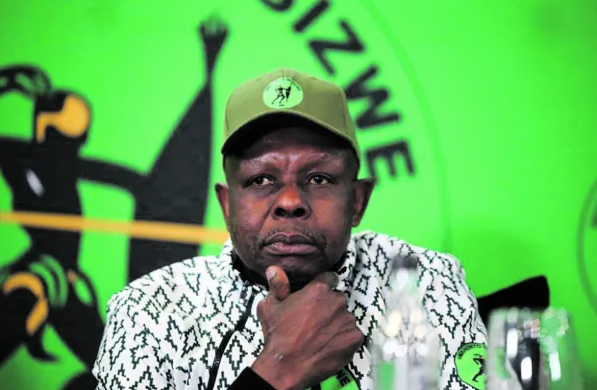
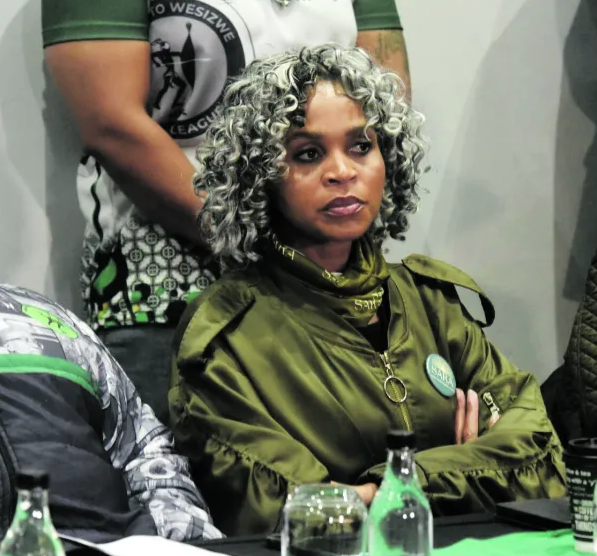
Meanwhile, it emerged recently that MK’s chief whip in Parliament, Colleen Makhubela, had accused former MK deputy president John Hlophe of harassment and intimidation in a formal complaint sent to the party’s national disciplinary committee last month.
Zuma suspended Hlophe last week after the former Western Cape judge president had axed Makhubele from her position and installed MK MP and State Capture accused Des van Rooyen in her place.
Hlophe did this while Zuma was on a pilgrimage to Burkina Faso’s autocratic military leader, Captain Ibrahim Traoré, who seized control after a coup in September 2022. On his return 24 hours later, Zuma restored Makhubela to her position and suspended Hlophe for exercising his agency.
MK said Hlophe would be subject to “an internal investigation”, but he has since asked Zuma to terminate his MK membership rather than suspend him.
Makhubela’s complaint about Hlophe was written a month after an MK whippery meeting about her alleged push to award a R1.8-million contract to a company in which her husband is a director.
An internal MK whippery report discussed in September identified Makhubela as trying to channel party funds to the company, which is what triggered Hlophe’s decision to axe her as chief whip.
In her 39-page complaint, as City Press reported, Makhubela said Hlophe had tried to pressure her to spend “personal time” with him on his farm in Paarl and then “unleashed false claims” against her after she had rebuked him.
She also said Hlophe was “convening meetings” in hotels and plotting to create a “parallel structure” in MK.
Live on social media
Much of this drama and internal disintegration has taken place live on social media, where MK issues its press statements and posts videos.
Zuma-Sambudla, who accompanied her father to Burkina Faso, has been an avid user of social media. As researcher and data scientist Kyle Findlay has noted, she proudly pumps her pro-Russian sentiments online and is one of the “prime influencers in the #IStandWithRussia campaign, which she amplified from Russia around the time of its invasion of Ukraine”.
The visit to Burkina Faso, writes Findlay, was “the public flowering of seeds that have been quietly cultivated for years – through political grievance, economic despair and a sophisticated campaign to normalise authoritarianism as a legitimate, even patriotic, alternative to democracy”.
US President Donald Trump’s attempts at this type of authoritarian regime in his country are lifted from the same playbook, but they’re without the localised revolutionary rhetoric and penchant for camouflage, if one discounts US Immigration and Customs Enforcement.
Factions in MK, particularly those aligned to Zuma-Sambudla and spokesperson Ndhlela, use the same platform – Elon Musk’s X – to “fight back” against perceived “enemies” in the party.
This includes EFF founder Floyd Shivambu, who jumped ship to join the camouflage party but exited swiftly in June, seven months after being installed as MK’s eighth secretary-general. Shivambu and Zuma-Sambudla had clashed openly.
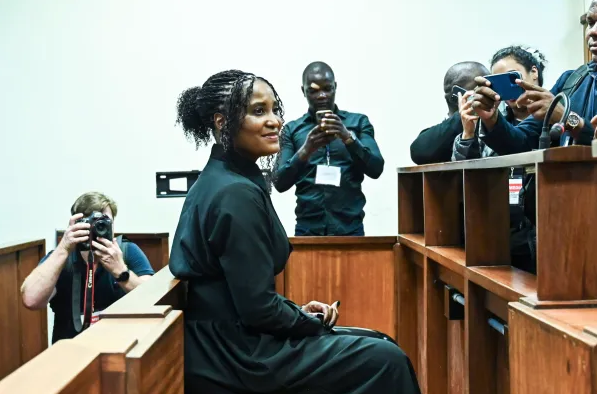
This week, her posts on X in July 2021 – the night her father was driven from his Nkandla home to serve a prison sentence at the Estcourt Correctional Centre – landed her in the dock in the High Court in Durban. She has pleaded not guilty.
The violent unrest claimed the lives of 350 people and caused infrastructure and other damage worth billions in KwaZulu-Natal and Gauteng.
Zuma-Sambudla was supported at her court appearance by her father, Ndhlela, newly minted secretary-general Bongani Mncwango, former eThekwini mayor Zandile Gumede and Van Rooyen.
As MK’s chief whip, Hlophe also clashed with Zuma-Sambudla. In a letter to Zuma circulated on social media, he complained that she undermined his authority as party leader in the National Assembly.
Hlophe also suspended Ndhlela from MK’s whippery team for divisive behaviour and said he was “engaging in factional activities” – in a letter posted on social media.
Palace politics and missing millions
Over and above the party’s palace politics, members of the MK caucus in Parliament have written to Zuma and second deputy president Tony Yengeni, who now becomes deputy president after Hlophe’s termination of membership, demanding a forensic investigation into millions that are allegedly missing from MK’s parliamentary purse.
Then there is the not-so-small matter of the party’s R28-million debt hole, which its treasurer-general, Mpiyakhe Limba, confirmed in August, blaming it on Shivambu’s mismanagement during his time as secretary-general.
The Mail & Guardian reported that some MK MPs claimed R70-million has been “siphoned off” from funding meant for constituency offices for its 58 MPs and five members of the National Council of Provinces. Instead, they allege, money has been spent on travel and accommodation.
This is not the first time such accusations have been made. Shivambu also claimed after his departure that R7-million was being “looted” from party coffers each month. Vanessa Calvert, chief of staff and administration for MK’s caucus, has been fingered by MK caucus members.
Calvert, however, has stated that she did not work with “any moneys” and merely allocated staff to portfolios in Parliament and made travel and accommodation arrangements “for people”. She had been suspended for three months after allegedly refusing to approve the awarding of a lucrative contract to the company of which Makhubele’s husband is a director, but she has been reinstated.
Zuma reiterated in August that MK would not hold an elective conference – something is has never done – and said it was his prerogative to hire and fire members.
“We are only going to meet as a party to discuss how we are taking the party forward. If you can’t listen, we’ll remove you,” he warned.
He said that “national leadership” had informed him about those who were plotting, but he had been advised to “wait a bit and they will fix it”.
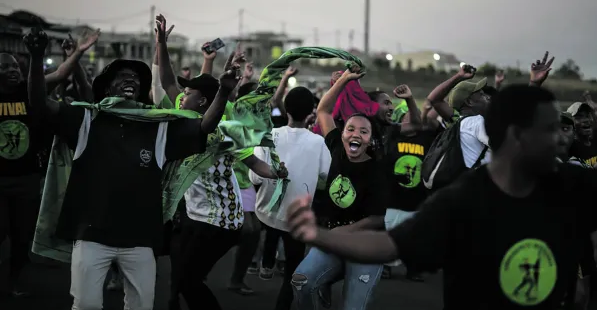
Implicated members and more woes
MK has been mired in intrigue, conspiracy and squabbling since its launch in 2023 and even prior to the 2024 elections. In August 2024, 15 MPs were fired shortly after they had been sworn in in July.
New MPs were parachuted in, including former Eskom chief executive Brian Molefe, former Passenger Rail Agency of South Africa boss Lucky Montana and former Transnet head Siyabonga Gama. So, too, was disgraced former public protector Busisiwe Mkhwebane, who lost the job after being impeached.
Molefe and Gama, kingpins in the State Capture organogram, have since been charged with fraud, corruption and money laundering linked to the Transnet locomotive scandal. The duo handed themselves over to the Investigating Directorate Against Corruption in June.
Montana, meanwhile, is dealing with a R55-million bill from the South African Revenue Service tied to R4.5-billion in dodgy contracts for security and service upgrades at train stations.
Mkhwebane, MK’s chairperson in Mpumalanga, has opened a criminal case against the party’s provincial secretary, Abednego Mkhatshwa, who was recorded threatening to set her alight using a tyre. This was known as a “necklace” in the apartheid era and used to punish impimpi (spies). Mkhatshwa also labelled Mkhwebane a “spy” or “askari”.
In the meantime, Zuma is haemorrhaging legal fees fighting a court ruling that he repay R28-million in legal fees forked out by the government for his protracted “Stalingrad” strategy in the courts while he was president of South Africa. He was ordered to repay the amount in 60 days.
But his lawyers argue that the state should identify the officials who had given Zuma advice and had signed off on the payment of the legal costs. Zuma signed an agreement in 2006 in which he undertook to refund “all costs incurred by the State Attorney in connection with my defence should the court find that I acted in my personal capacity and my own interests in the commission of the alleged offences”.
A full bench of the Supreme Court later found that Zuma had indeed acted in his personal capacity.
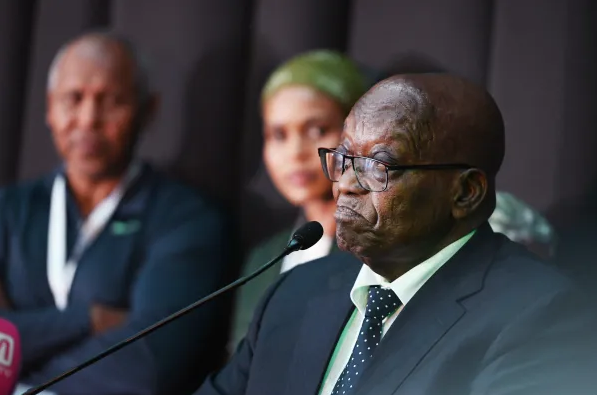
Opaque funding
In 2024, MK declared about R2.8-million in income from membership fees and donations, as recorded in the Independent Electoral Commission’s 2024 Annual Political Funding Report.
MK hit the political landscape with a highly visible campaign, party regalia, posters, conferences and travel to election meetings across the country. R2.8-million would hardly touch sides.
For the year, MK handed in an unaudited report which indicated R705,000 in donations above R100,000, R53,205 below that threshold and R2,043,409 in membership fees, totalling R2,801,614.
Many have alleged and suggested that MK is being funded by Russia, but there is no concrete evidence of this.
Russian President Vladimir Putin certainly supports MK’s political mission and is a close comrade in revolutionary capitalism, just like Trump, but perhaps the R28-million hole in the party’s finances reflects its true bank balance. It is bankrupt.
As political analyst Prince Mashele has noted, MK is a “stokvel” that will continue to crumble while Zuma, its leader, remains alive.
“It has no future,” Mashele told podcaster Sizwe Mpofu-Walsh nine months ago.
The power that Zuma-Dambudla wields in the party points to the possibility that she might very well lead MK into that future. DM