




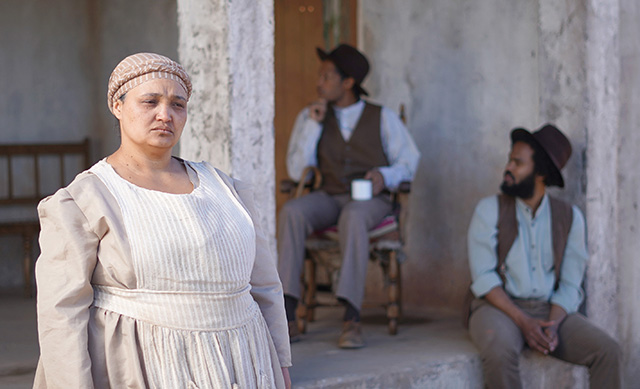
Langarm tunes flowed through the air as the community crowded to celebrate the success of Namibia’s very own Zenobia Kloppers – the only way they knew how.
Friendly faces, familiar smiles and pride was the order of the day last week Friday when the Namibian premiere of the remake of the classic ‘Fiela se Kind’ screened at the Grove Mall of Namibia. The atmosphere was jolly and the cinema erupted with applause when lead actress Kloppers made her way up the escalator to her waiting supporters. It was a magical moment.
With two theatres sold out, supporters made their way to their designated spots anticipating the start of the film. The cinema went quiet…
Late at night on one side of the Knysna Forest, a white family is looking for their lost boy Lukas. Through the forest and over the mountains in the Karoo, a Coloured woman hears a child crying in front of her door. Fiela and her husband Selling Komoetie take in the Afrikaner child, feed him, bathe him and name him Benjamin. Their son Tollie, a toddler at the time, watches in the distance as his mother cares for another baby.
Growing up as a family for nine years, Fiela and Benjamin are torn apart when government officials show up for census and encounter the white face amongst brown ones – an abomination at the time.
Benjamin is taken away to the magistrate and is given to a family of woodcutters living in the forest – the people believed to be his real family.
While young Benjamin struggles to accept his new parents, name and siblings, he forms a bond with his sister who agrees to keep calling him by his preferred name in exchange for him doing her share of the field work.
Over the next 20 years, Fiela’s home falls apart as she neglects her family while struggling through a deep depression, leading her children to resent her, and Benjamin, while having grown accustomed to his life, still feels a pull between his two identities – Lukas van Rooyen and Benjamin Komoetie.
Kloppers is no stranger to playing the character and this familiarity came across on the big screen. The character of Fiela has been 10 years in the making. In 2008, Kloppers played the role under the direction of Sandra Prinsloo. Ten years later, she was asked to relieve Shaleen Surtie-Richards, the actress of the 1988 film, for a two-week run of the play at Carnival City. The role is her first lead in a feature film.
“As an actor, we are vehicles through which the character’s story is told. And we honour the character by letting them ‘speak’ through us. There can therefore be no ego or fear involved – the character chooses you, not the other way around,” Kloppers previously told The Weekender on taking over from the iconic Surtie-Richards.
Fiela is a strong woman with high standards, she makes sure that her home and family are clean and well taken care of. Kloppers portrayed the strength of the character flawlessly with the transition between sorrow and anger being impeccable, capturing the true essence of Fiela.
The body language, vernacular and style of running her household is reminiscent of many Coloured homes, and Kloppers’ depiction of the character was nostalgic and stirred up emotions.
A Grade 5 pupil of Wonderboom Primary School in Pretoria, Luca Bornman, took on the role of young Benjamin and was charming in his characterisation of the white child amongst a family he doesn’t see to be different from him. Bornman offered comedic relief with his strong, flat Coloured accent and lines that were influenced by the family he grew up with. With Benjamin being a curious, strong-willed yet sensitive soul, Bornman captured the essence well.
Benjamin, now Lukas, as a grown-up has learnt to hide his empathy from the rest of his family while still feeling torn and only having a close connection to his sister, Nina. Under the hand of his tyrant father, Elias, ‘Lukas’ is obedient and hardworking, retreating into his imagination when life in the forest gets too hard. He is torn between his heart and his mind in more ways than one and eventually finds the courage to defy the authority figures in his life and find his truth.
Wayne Smith – actor, singer, voice artist and freelance writer – carried the weight of the role well, which was previously played by Jan Ellis.
Antagonist throughout the film, Benjamin’s father is a loathsome man with a plan of a better future, yet no ambition to carry it out. An abusive character, he sees himself as a good father and blames his family for the wrongs in their lives. Drikus Volschenk, who has worked on over 60 film and television productions, played the villainous character so well, the audience hated him throughout.
These actors carried the plot and contributed to the mood of the film and its emotional development. The dialogue was limited compared to other features, but words did not drive this film – sensitivity to the various emotions did. The quiet moments flowed through the cinema and held the audience in a captive grip.
“In the ‘background’ or the ‘edge of frame’ of this story, we have a social commentary on race relations in pre-apartheid southern Africa as well as the formation of the ‘Coloured identity’ at the hands of Dutch and British colonial authorities. This is a very specific experience that could only have taken place in South Africa at this time and the camera will flirt with these themes while not diverting attention from the primary themes,” says director Brett Michael Innes, adding that he opted to explore Fiela’s dark side in this rendition.
“Something that has never been approached in the novel, film or stage adaptations. White guilt has led many of the white storytellers to place her on a pedestal, deeming her as a saint or victim who can do no wrong and is purely a victim of white cruelty. I find this problematic because it is in her shades of grey that we find her humanity and in her wrongdoings that she becomes more interesting.”
Mentioning that the novel by Dalene Matthee is made up of various storylines and interactions, Innes opted to focus on Benjamin and his Coloured mother’s relationship. “This is the one that resonates most with audiences so we gave it time to breathe instead of trying to cram as much information into it as possible.”
In an age of information overload, Sunrise is The Namibian’s morning briefing, delivered at 6h00 from Monday to Friday. It offers a curated rundown of the most important stories from the past 24 hours – occasionally with a light, witty touch. It’s an essential way to stay informed. Subscribe and join our newsletter community.

The Namibian uses AI tools to assist with improved quality, accuracy and efficiency, while maintaining editorial oversight and journalistic integrity.
Stay informed with The Namibian – your source for credible journalism. Get in-depth reporting and opinions for
only N$85 a month. Invest in journalism, invest in democracy –
Subscribe Now!