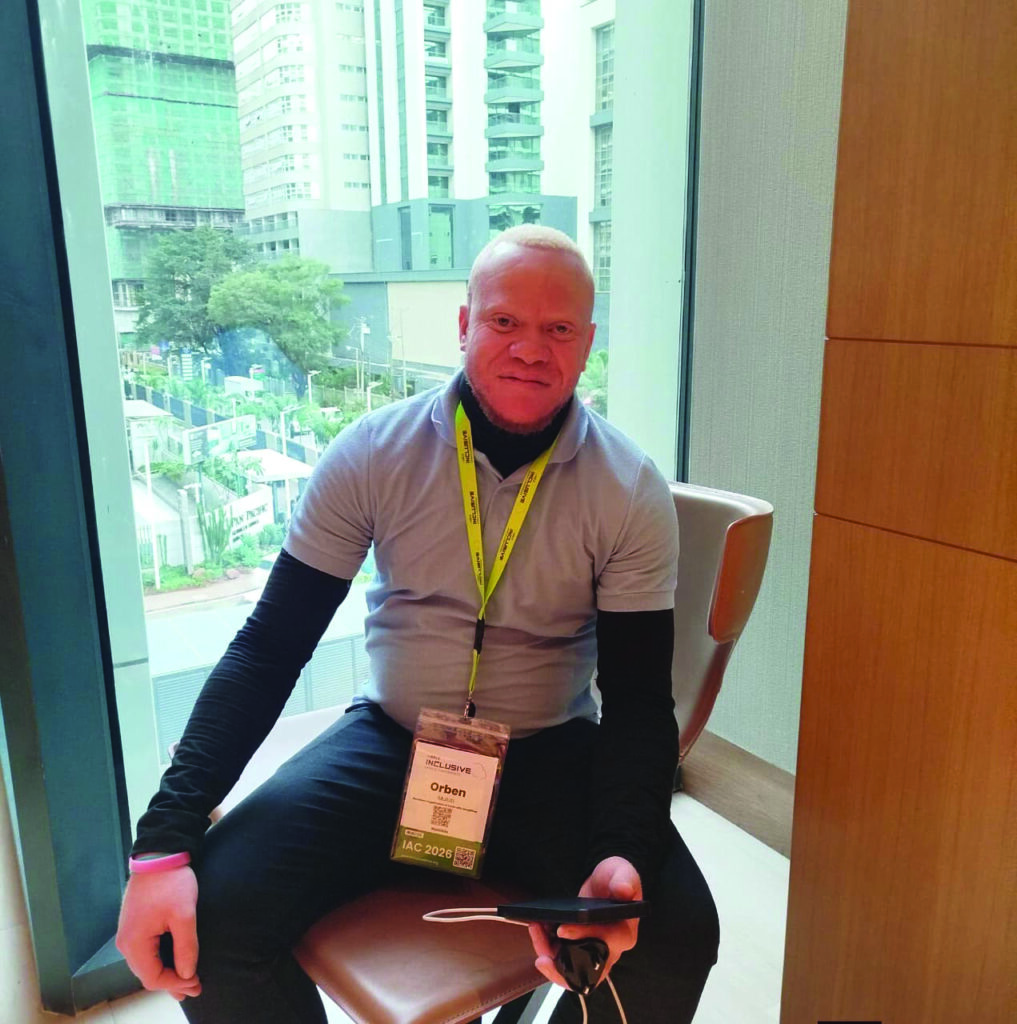
Nothing about persons with disabilities should be decided without their voices.
That message has shaped Namibian Organisation of Youth with Disabilities (NOYD) chairperson Orben Muluti’s work for years, from challenging discrimination as a schoolboy to representing persons with disabilities in some of Namibia’s highest decision-making spaces.
Muluti has become one of the country’s leading disability rights advocates, using his leadership roles to push for greater inclusion, equal employment opportunities and stronger partnerships between the government and organisations of persons with disabilities.
Beyond the boardrooms and policy debates, he is also a father, a football fan and someone whose own life has been marked by close encounters with prejudice and danger, including surviving an attempted trafficking incident as a child.
The Namibian spoke to Muluti on the ‘WeSpeak’ podcast, a platform that gives persons with disabilities the opportunity to tell their own stories under the slogan, ‘Nothing About Us Without Us’.
Q: You hold important leadership roles in disability advocacy. What drives your work
A: These are not jobs I applied for.
I found myself in spaces of advocacy with people who shared the same vision of inclusion. Others believed I could help carry the message, so they asked me to lead.
I accepted because I believe in service and in being a voice for people who are often not heard.
Q: Who is Orben Muluti beyond advocacy?
A: I was born at Katima Mulilo and raised in Windhoek. My roots gave me a strong cultural identity.
Many people do not know I love hip-hop music and football – real football. I am a Manchester United supporter.
People often expect advocates to fit a certain image, but I am not traditional in that sense. I am a colourful person with many interests.
Q: When did you realise you could be a voice for change?
A: At school, I often found myself speaking out against unfair treatment, even before I understood words like discrimination or exclusion.
Later I learnt that laws and policies existed to protect the very things I was fighting for. That made me more intentional.
I also found myself elected into student leadership groups. Over time, I realised I am naturally drawn to speaking against injustice.
Q: You have shared that as a child you were almost trafficked. Can you tell us more?
A: Yes. When I was young in the Zambezi region, I was approached by a man who offered me sweets. I ended up near the Namibia-Zambia border. Luckily, someone recognised me and stopped the situation.
Only later did I understand the danger. Persons with albinism are sometimes targeted for trafficking and ritual killings in parts of Africa.
I believe I was fortunate to survive that.
Q: Is trafficking of persons with albinism a real issue in Africa?
A: Unfortunately, yes. Countries like Tanzania, Zambia and South Africa have reported serious cases.
Some people believe persons with albinism have supernatural powers, but that is false. Albinism is genetic and natural. Even animals and plants can have forms of albinism.
Namibia has had fewer reported cases, but that does not mean the danger is not real. We need laws and prevention measures now, not after tragedy happens.
Q: Is enough being done to raise awareness about disability in Namibia?
A: The government is doing some work, but it cannot do everything alone.
Organisations of persons with disabilities must be treated as key partners. We are on the ground. We know the real issues people face.
Too often, institutions work in isolation. We need a united strategy where the government, civil society and disability organisations work together.
Q: What have been some milestones in your advocacy journey?
A: One of my first national leadership roles was serving as a youth with disabilities representative on the National Youth Council board.
That taught me a lot about policy.
Now I serve on the Employment Equity Commission, where we push for fair opportunities in the workplace.
But I do not only look at personal milestones. I look at movement milestones – like disability units at universities, the National Disability Council, and stronger government structures dealing with disability affairs.
Q: Persons with disabilities make up less than 5% of Namibia’s workforce. Why is that?
A: Many employers say they cannot find qualified persons with disabilities. I disagree.
There are many skilled and educated persons with disabilities ready to work. So we started creating lists and databases of qualified candidates to help employers recruit.
That has helped somewhat, but more needs to be done.
Q: Are government institutions leading by example?
A: Honestly, many are not. Some ministries and agencies are not compliant with employment targets for persons with disabilities. That is concerning.
The government cannot point fingers at the private sector while failing at home.
We must clean our own house first.
Q: What personal challenges have you faced?
A: Discrimination and stigma are still common.
Sometimes people say things like, “You are so well spoken for your kind,” or “You are so clean for someone like you.”
They may not realise it, but those comments are harmful. They come from low expectations about persons with disabilities.
Some people simply need education. Others choose ignorance.
Q: What is the biggest issue facing persons with disabilities today?
A: Unemployment is one of the biggest.
Education has improved.
More persons with disabilities are getting degrees, honours, master’s and even PhDs. But many still cannot find work because systems are not inclusive.
Accessibility is another issue – not only in schools and hospitals, but also in malls, entertainment spaces and social places. Persons with disabilities also deserve full lives.
Q: How do you balance advocacy, family and personal life?
A: To be honest, I have not fully mastered that balance.
I am a father, I have personal goals, and I also carry many responsibilities. But this work is one of the hats I wear proudly.
If I am needed for the cause, I will show up.
Q: What legacy do you hope to leave behind?
A: I want to be remembered as someone who contributed, not someone who chased fame or status, but someone who worked for the cause.
One example I am proud of is when disability advocates pushed for disability grants for children to match adult grants. That change happened after years of engagement.
Those are the victories that matter.
Q: What message do you have for policymakers?
A: Take organisations of persons with disabilities seriously.
Nothing about persons with disabilities should happen without persons with disabilities.
We have qualified, experienced people who can sit at decision-making tables and help shape policies.
Representation is not charity. It is common sense.
Q: What would you say to young Namibians with disabilities?
A: Your disability does not define you.
That is why we say a person with a disability – the person comes first.
There are politicians, athletes, professionals and leaders with disabilities across the world and here in Namibia too.
Once barriers are removed and support is in place, there is no reason you cannot become what you dream of becoming.
Stand up. Speak up. We are listening.
– This article is produced as part of a partnership between The Namibian and NMT Media Foundation. Check out our YouTube channel for the full interview.