




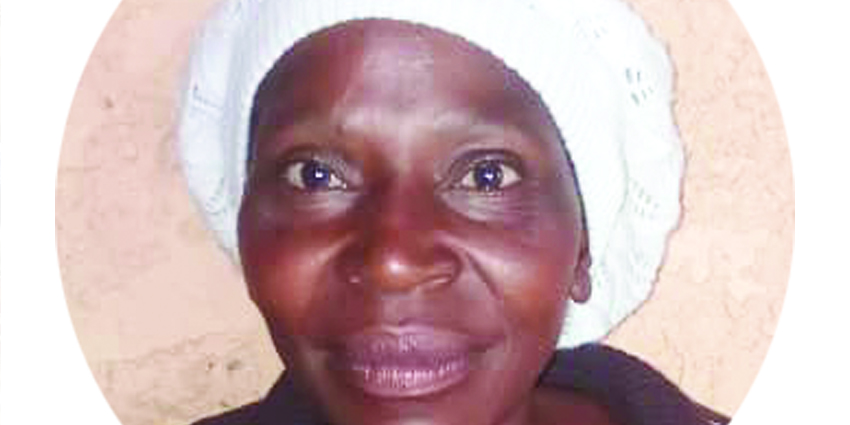
An Okahandja woman is appealing for help to bury her partner after efforts to trace his identity and relatives hit a dead end.
Else Kharuxas (44) says her partner, who she knew as Jackie Mulalo, died in a hospital on 9 March.
He has not yet been buried, as social workers are still trying to establish his identity and where he came from.
Kharuxas says another complication came during the registration of plots at Okahandja, when Mulalo allegedly told committee members that he was from Zambia and not Namibia, although this has not been established since.
Kharuxas says she met Mulalo in 2017 and they lived together at Okahandja until 2020, before briefly separating and later reuniting in 2021.
She says she became his main caregiver as his health worsened, often taking him to hospital in Windhoek and covering transport costs because he could no longer work consistently.
“He was asthmatic and his hips were in pain.
He was supposed to be operated on,” she says.
According to Kharuxas, Mulalo made a living by repairing shoes and occasionally entertaining people with dancing dolls and music devices at bars and from his house.
Despite years together, she says he never introduced her to any relatives or friends.
“The only people he told me about were his parents and one sister,” she says.
Kharuxas says Mulalo claimed to have been born near Gobabis before later moving with family to Katima Mulilo, but she now doubts parts of the story due to a lack of supporting records.
She says she had urged him to obtain a birth certificate and national identity document, especially after the hospital advised him to apply for a social grant.
However, he never followed through.
The uncertainty deepened after his death when Ministry of Home Affairs, Immigration, Safety and Security officials reportedly found no record of him, even after fingerprint checks.
“My concern actually is, I just want him to be buried,” she says.
She adds that social workers are still investigating by speaking to people who knew him through his shoe-repair work in town, but no breakthrough has been made so far.
Kharuxas describes him as a tall, dark man who mostly kept to himself, though he had a playful side and often made jokes with her.
She says most of his clothes and belongings are at his house, while the few tools she took are being kept safe.
Kharuxas now hopes that by sharing his story publicly, someone may come forward with information about his real identity, family, or place of origin so that he can finally be laid to rest.
According to Okahandja community leader and activist Belinda Garoes (55), Kharuxas approached her after her partner’s death, explaining that she had never met any of his family members.
“We knew the deceased as a very quiet man who minded his own business and was always with Kharuxas.
I was extremely shocked to hear that she knows nothing about his true identity.
We are, therefore, appealing to the entire community and the country to help us identify him,” she says.
She adds: “The challenge is even greater because we don’t have any pictures of him, but those who live in the neighbourhood at least have an idea of who we are talking about.”
THE PROCESS
The Ministry of Health and Social Services has outlined a multi-step process followed at hospitals before unclaimed bodies are released for a pauper’s burial or cremation.
According to the guidelines, bodies kept at the state mortuary for more than 14 days without being claimed by family are classified as unclaimed.
Health ministry spokesperson Walters Kamaya says the process begins with making a list of unclaimed bodies, which is then submitted to customer care officers for dissemination through the media to try and trace family members or friends.
He says where the identity of the deceased is unknown, fingerprints may also be taken in collaboration with the police to help with identification.
“The purpose of the initial stage is to ensure all reasonable efforts are made to trace relatives before further administrative steps are taken,” Kamaya says.
If no relatives come forward, a motivation letter is sent to the office of the senior medical superintendent, asking to authorise a pauper’s burial.
The guidelines state that this monitoring process is done weekly, while the formal motivation is submitted monthly through the head of the mortuary department.
Once authorisation is granted, the hospital’s procurement office obtains quotations from undertakers, while medical officers prepare the outstanding medical certificate.
After the quotations are approved by a committee, the assigned undertaker prepares the deceased for release.
Kamaya says the process is aimed at balancing dignity for the deceased with the hospital’s need to manage mortuary space responsibly.