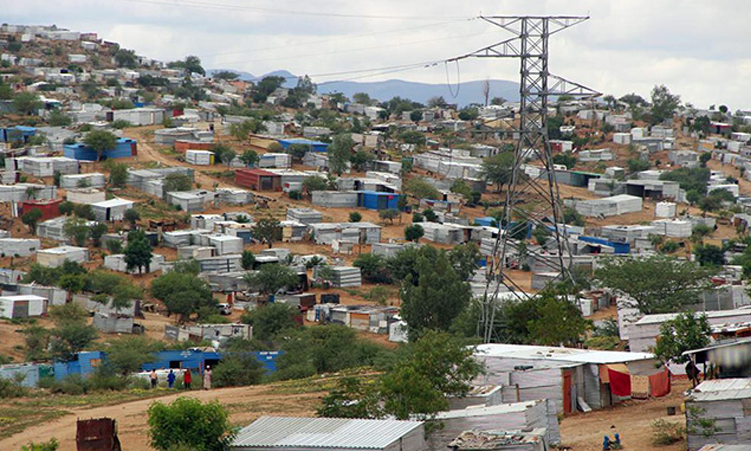
The City of Windhoek has approved four township development projects aimed at formalising informal settlements and accelerating access to land and housing for thousands of residents.
The developments, approved during the city’s ordinary council meeting last Thursday, will deliver more than 1 400 housing units and accommodate an estimated 4 866 people in Otjomuise and Hadino Hishongwa.
Landless People’s Movement councillor Ivan Skrywer welcomes the approvals, saying they signal council’s commitment to affordable housing and township expansion.
“We are serious about affordable housing for our people. And for the council to approve this in one meeting is a sign that it is serious about housing. The message is clear to the strategic executive of housing that we do not want small items of street renaming and rezoning only, but new townships and housing,” he says.
According to Skrywer, council approved four townships and a subdivision comprising 1 108 erven, with a total yield of 1 483 housing units.
City spokesperson Lydia Amutenya says the approvals form part of ongoing efforts to improve tenure security, expand municipal services and support sustainable urban development.
“The approved projects include the formalisation of informal settlements at Otjomuise Extension 8, as well as major township establishment developments on farms 1007 and 1008 at Hadino Hishongwa,” she says.
The council approved the need and desirability, together with the layout plan, for a township on the remainder of farm 1008 to formalise parts of the Hadino Hishongwa C informal settlement, and accommodate households relocated after the January 2025 flash floods at Otjomuise, she adds.
The development will consist of 234 erven and is expected to house about 1 053 people. It will include 212 single residential erven, four general residential erven for higher-density housing, business sites, public open spaces and institutional land for schools, healthcare facilities and policing services.
The council also approved the subdivision of farm 1008 into portion A and the remainder, together with the establishment of another township on portion A to formalise existing settlements at Hadino Hishongwa C.
This development will comprise 230 erven, including 214 single residential erven, two general residential erven, business sites, public open spaces and institutional land for churches and early childhood development centres.
In addition, council approved the subdivision of farm 1007 and a township establishment on portion A. The development will consist of 333 erven and about 457 dwelling units, accommodating more than 1 500 residents.
Meanwhile, the council also approved the city’s Disaster Risk Reduction Strategy for 2026 to 2030.
Amutenya says the strategy is aimed at strengthening the city’s preparedness against climate-related and urban risks, including flash floods, informal settlement fires, veld fires, chemical spills and other disasters.
Samora Machel community activist Joseph Fernandu commends the City of Windhoek for approving the new townships, but cautions that the allocation of erven should be handled carefully, as Hadino Hishongwa informal settlement is still relatively young.
“… which is perhaps why the move is easier, as plots can still be demarcated unlike in more densely populated areas such as Peter Nanyemba. However, land is what people need, although the development of informal settlements also remains important,” he says.
Fernandu urges the city to allocate plots in a manner that accommodates both the current population and future growth.
He warns that if the municipality strictly applies its ‘blue book’ policy when determining plot sizes, one individual could end up occupying land that could otherwise accommodate two additional people.
He says land allocation should respond to the current demand, while residents should also be educated on how to build houses on smaller pieces of land.
Fernandu further proposes that constituencies be properly demarcated to ensure the equal distribution of services.
Johanna Haindongo, who has been renting at Havana informal settlement for the past year and a half, says the city must ensure the new township houses have running water and electricity, and are located close to basic services.
“They must make sure these houses are not far from essential services like clinics, schools and shops,” she says.
Meanwhile, Shack Dwellers Federation of Namibia director Heinrich Amushila says the city should adopt a self-building approach to help address the housing backlog.
“The current format can only be afforded by a few people, while the majority will take many years to ever own a house. A self-building format is the best way to provide homes, as long as land is made available,” he says.