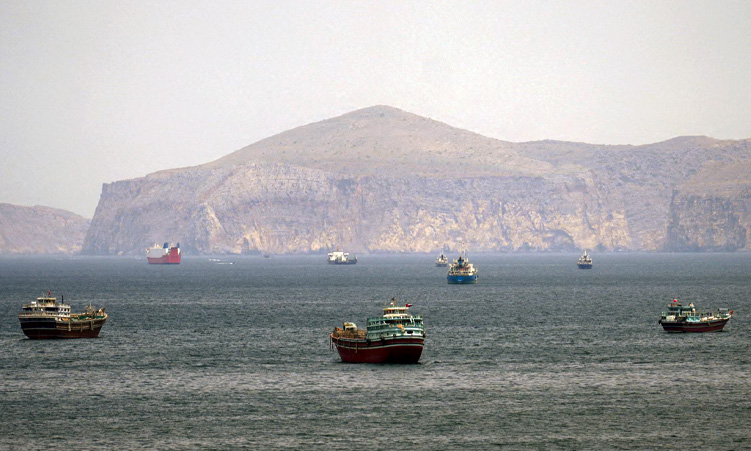
In recent weeks, many of us have become familiar with a narrow stretch of water thousands of miles away in the Middle East known as the Strait of Hormuz.
This awareness has been sharpened by heightened geopolitical tensions between the United States and Iran, during which Iran threatened or limited shipping traffic through the strait.
These events have raised important questions: What exactly is a strait, who controls it, and why does its closure affect countries as far away as Namibia?
The Strait of Hormuz is a narrow sea passage connecting the Persian Gulf to the Gulf of Oman and the Arabian Sea.
It lies between Iran to the north and Oman to the south, and at its narrowest point measures just 21 nautical miles (nm) or about 34km.
Despite this limited width, the shipping lanes within the strait are even narrower, about 2nm wide in each direction, making it one of the most congested and strategic maritime passages in the world.
Under the United Nations Convention on the Law of the Sea (Unclos), a strait is defined as a natural passage used for international navigation that connects one part of the high seas or an exclusive economic zone to another.
Importantly, international straits may fall entirely or partly within the territorial seas of coastal states. In the case of the Strait of Hormuz, this includes the territorial waters of both Iran and Oman.
This legal status is crucial, as while coastal states generally exercise sovereignty over their territorial seas, Unclos places limits on that sovereignty when it comes to international straits.

Ships of all nations are entitled to what is known as the ‘right of transit passage’, which has caused global concern when Iran indicated its ability and willingness to suspend or restrict passage through the Strait of Hormuz.
Notably, neither Iran nor the United States is a party to Unclos, and Iran maintains that the right of transit passage can be suspended under certain circumstances, an interpretation not universally accepted.
Around 20% of the world’s oil consumption passes through the Strait of Hormuz. In addition, about one fifth of global liquefied natural gas (LNG) trade also transits this narrow channel.
The impact, however, extends well beyond fuel shortages. Namibia, like many countries, has felt the effects through rising fuel prices.
Less obvious has been the disruption to the export of Iranian urea fertiliser, a key input for global agriculture.
The Gulf region provides up to 50% of global urea exports, and reduced availability of fertiliser affects crop yields and has the potential to push food prices higher worldwide.
South Africa and Nigeria import urea through the strait of Hormuz and are among Namibia’s top urea suppliers.
Any reduction in fertiliser availability can negatively affect crop yields and potentially drive up global food prices.
For Namibia, there is a clear lesson to be drawn: External shocks to global supply chains have tangible local consequences.
One important takeaway is the importance of strengthening national fuel reserve storage capacity as a buffer against international volatility.
There is also valuable experience to be drawn from countries such as the Kingdom of Saudi Arabia and the United Arab Emirates, which have invested heavily in cross-country pipeline infrastructure.
By transferring oil via pipelines, these systems enhance supply security, reduce logistical risks, and improve overall efficiency an approach worthy of consideration in Namibia’s long-term energy and maritime planning.
A narrow strait in the Middle East may seem distant, but its closure reminds us just how interconnected the global economy truly is and why maritime stability matters to Namibia.
– Erastus Nashima is a Namibian marine consultant and master mariner based in the United Arab Emirates.