Namibia’s labour movements, historically central to anti-colonial resistance through mass strikes and worker solidarity, have operated with reduced influence and mobilisation since the country gained independence in 1990.
Labour movements in Namibia have been rather fragile over the past few decades, ever since the country gained independence from South Africa in 1990. This was not always the case. Collective labour action, both spontaneous and organised, has had a long history in the country as a notable segment of anti-colonial resistance.
With their trajectories embedded in a political economy of settler colonialism, racial capitalism, and extractivism, Namibia’s emerging nationalist organisations of the mid-20th century grew out of a long history of collective protest and resistance. Mobilisation by Namibian workers became an important factor in the struggle that culminated in the country’s liberation from South African rule shortly before the demise of apartheid in South Africa itself.
“Okaholo”
Namibia became a colony of the German empire from 1884. By December 1893, the earliest strike had been recorded at a mine at Gross Otavi. When the Allied powers stripped Germany of its colonies after World War I, the League of Nations entrusted Namibia’s administration to the Union of South Africa.
South Africa systematically extended its established policies of racial segregation to Namibia, seeking to extract as much wealth as possible from the colony as Germany had done before. With labour supply a foremost concern, the South African administration installed political structures in the north and a distinctive contract labour system that marked Namibia’s colonial economy and social relations until independence and beyond.
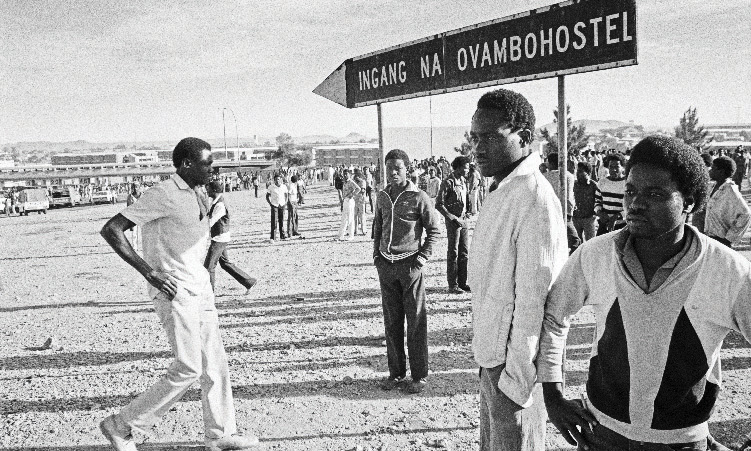
Despite persistently very low wages, travelling to provide migrant labour for the mines, fishing industries, and farms of central and southern Namibia became a defining life experience for the people in the northern regions. Between the 1930s and the 1980s, Owambo men generally spent much of their adult lives as contract workers away from home. In 1938, of the total black labour force of 47 275, 43% were already contract workers; by 1971, the figure was 83%.
The system was administered through the recruitment agency South West African Native Labour Association (Swanla). Locally it was known as “omutete wOkaholo,” literally “to queue up for the [identity] disk,” because of the copper or plastic bracelets showing one’s identification number that freshly recruited contract labourers had placed on their wrist.
The contract system operated under virtually forced labour conditions. No hours of daily or weekly work were stipulated – the worker was simply required “to render to the master his services at all fair and reasonable times.” Contract labourers were housed in compounds for “single” men. Meanwhile, women in the north had to take care of agricultural production and raise families on their own.
The much-hated contract labour system became a primary factor in the emergence of Namibian nationalism. It started with the workers from across the north who were recruited to work in the South African gold mines, where wages remained low, but were still considerably higher than those earned in Namibia.
From Cape Town to Namibia
Working in South Africa allowed the workers new opportunities to gain access to political education and protest politics. By the mid-1950s, an estimated 200 Namibian workers lived in Cape Town. Most of them had deserted labour contracts and were dwelling illegally in the city. If caught, they were under imminent danger of arrest and deportation.
The Namibians in Cape Town formed a close-knit community. Every Sunday, they got together at a barbershop run by Namibian expatriate Timothy Nangolo in Somerset Road. From there, they would go to the Grand Parade to listen to the political speeches delivered there on Sundays by members of the anti-apartheid opposition, including well-known Cape Town socialists.

Andimba Toivo ya Toivo, who became the leader of the Namibian workers, joined the Modern Youth Society, a broadly socialist and racially mixed group. The Namibians in Cape Town benefitted particularly from the support of the radical academic Jack Simons and his trade unionist wife Ray Alexander, who provided political education and a welcoming, anti-racist social environment.
In August 1957, they formed the Ovamboland People’s Congress (OPC), which later evolved into the Namibian liberation movement, the South West Africa People’s Organisation (Swapo). The OPC founders adopted a petition, which was sent to the United Nations. Signed by ya Toivo and 80 others, it demanded that South Africa’s mandate be removed and the administration of Namibia transferred to the United Nations Trusteeship Council.
Significantly, the petitioners also called for the abolition of the detested contract labour system. They raised demands for the right of women to join their migrant worker husbands at their place of employment, and requested that unmarried women from Namibia’s north should be given permission to look for work in the southern regions.
Initially, the OPC was a political revival of a long-standing “brotherhood,” which workers in the mines had formed to cater to their well-being, social security, and recreational needs. It encompassed a sense of comprehensive solidarity, unity, and mutual support among contract workers, and it provided the basis for collective responses to employers and administrations.
In April 1959, nationalist activity gained a base in Namibia itself with the official relaunch of the OPC as the OPO (Ovamboland People’s Organisation). In Windhoek as in Cape Town, some of the group’s leadership harboured wider political goals of national liberation. However, it was the conditions of workers trapped in the contract labour system, and mobilisation around labour issues, that took precedence for the rank and file.
Sam Nujoma, the Windhoek leader who later became Swapo president, visited Walvis Bay in June 1959 to address meetings in the workers’ compounds of the port city. Almost all the workers came out to hear him speak about the need for freedom and an end to the contract system. After this rousing speech, he asked them: “Will you join the struggle to abolish contract labour?” Everyone shouted, “Yes! Yes! That’s what we want!”
OPO built on preexisting informal structures of “brotherhood” and on a long history of collective labour action. Despite brutal suppression, there had been labour action at the mines in Lüderitz, Tsumeb and Oranjemund almost every year between 1946 and 1959. The same was true of the fish processing factories of Walvis Bay.
Starting from 1949, organisers of the Cape Town–based Food and Canning Workers Union took trade unionism into Lüderitz Bay, the southernmost fish canning centre of South West Africa. Alexander played a key role in this effort as a union organiser, and provided a close connection with the Cape Town-based OPC group along with her husband Simons. In the late 1950s, the fish canning industry of Walvis Bay, some 700 kilometres to the north of Lüderitz, emerged as a major centre of industrial strife and political mobilization.
Workers hoped impatiently that the new organisation was going to confront the contract labour system straightaway or, at the very least, that forceful negotiations with the management of mines and factories could ameliorate conditions. Helao Shityuwete, who was working in Walvis Bay at the time, recalled that despite much initial enthusiasm, organising the workers was not always smooth sailing.
This was partly because of interference by the colonial regime and its allies in the “tribal authorities.” However, workers also became impatient as the conditions did not improve rapidly. When the OPO leadership emphasised nationalist aspirations, despite the organisation’s ostensible aim to be the voice of the workers, this did not always match the desires of the workerist rank and file.
Resistance against the contract labour system fuelled the formation of nationalist organisations in Namibia. In the 1960s, however, brutal repression led to the long-term incarceration of some of the leaders on Robben Island, while other members of the founding generation left for exile. The spirit of resistance seemed broken.
– Part 2 will be published on the 5 May. Heike Becker is an anthropologist whose works include ‘Namibian Women’s Movement 1980 to 1992: From Anti-colonial Resistance to Reconstruction’.